


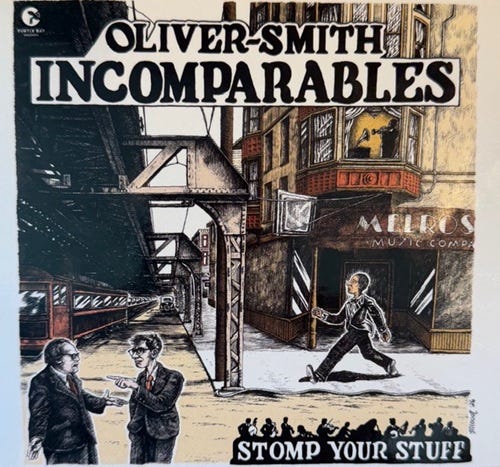
Stomp Your Stuff is one of those recordings with a complex pedigree, so convoluted and important that it deserves a thorough unpacking before ever getting to the music. This is the story of a niche record label devoted to a transitional period in the genesis and evolution of jazz.
What’s in a label?
Early jazz has many monikers: New Orleans jazz, Dixieland, hot jazz, and classic jazz. This was the flavor of the music between 1917 and the release of the Original Dixieland Jazz Band’s "Livery Stable Blues" (backed by "Dixieland Jass Band One-Step") on Victor 18255 and today, as the jazz genre has had an impressive staying power among its fans. Called “Traditional Jazz” today, it exists alongside every movement: swing, bebop, cool jazz, hard bop, post bop, etc. Mostly archival, traditional jazz pays tribute to that American music emerging in the early twentieth century.
Traditional jazz has its speciality record labels, just as modern jazz has its recording outlets. Labels devoted to early jazz include Arbors Records, Nagel Heyer, Whaling City Sound, and Dot Time Records. Shoe-horned among these established labels is the relative newcomer, Turtle Bay Records. The label is an independent record label based in New York City that specializes in traditional jazz, early swing, and ragtime. Founded in the early 2020s by investor-turned-musician Scott Asen, the label operates under the business plan: "the best jazz players of today playing the best tunes of yesterday."
The label secretly dedicates itself particularly to the pivotal moment in jazz history when ragtime transformed into jazz proper—a fluid and generative period during which the strict syncopation of ragtime evolved into the looser, more emotive music of New Orleans jazz. Turtle Bay’s theoretician on this transition is Terry Waldo, who, with his Gotham City Band, has released Treasury Volumes One (2024), Two, (2025) and Three (2026), codifying the place and importance of ragtime to its oncoming turbulent future.
Carrying Waldo’s mission forward is Colin Hancock, who helms The Joymakers and the Jazz Hounds, playing music just over the fence from ragtime. His recordings, The Joymakers’ Down Where the Bluebonnets Grow (2024) and A Texas Sized Band (2026), and The Jazz Hounds’ Cat and the Hounds (2024) (with Catherine Russell) help shore up where the music is going from that perspective of Waldo. Hancock is also a part of The New Wonders, whose Steppin’ Out (2024) rides the riverboat to Chicago, further pushing the developing music’s perimeter, looking back and setting the stage for the innovator bridging two flavors of jazz.
Jelly Roll Morton
Ferdinand Joseph LaMothe, immortalized as Jelly Roll Morton, was the brilliant architect who transformed jazz from an improvised street style into a structured art form. Born into the vibrant musical melting pot of New Orleans, he began his career playing piano as a teenager in the notorious brothels of Storyville. It was in this raw environment that he fused the strict syncopation of ragtime with the deep emotion of the blues, traveling the country to spread this revolutionary new sound.
Morton famously and controversially claimed to have invented jazz single-handedly. While the genre was a collective creation, he was undeniably its first great composer, arranger, and theorist. He showed that jazz's spontaneous, improvisational spirit could survive meticulous notation on sheet music. By introducing what he called the “Spanish Tinge”—incorporating Afro-Cuban habanera rhythms—he gave the music a unique, driving pulse.
The realization of his musical genius culminated in Chicago between 1926 and 1927 through a pivotal partnership with music publisher Walter Melrose. Melrose recognized Morton’s immense talent, securing him a lucrative recording contract with the Victor Talking Machine Company and aggressively marketing his sheet music. This collaboration birthed the historic sessions of Morton’s hand-picked studio band, the Red Hot Peppers. Morton approached these sessions like an auteur producer, using newly introduced electrical microphone technology to pioneer dynamic sonic layering and embed theatrical soundscapes into tracks like “Sidewalk Blues.” He also engineered sudden rhythmic “stops” and drafted strict, color-coded arrangements that predefined exactly when musicians could freely improvise.
Bringing together elite New Orleans musicians like trombonist Kid Ory, clarinetist Omer Simeon, and banjoist Johnny St. Cyr, Morton used these sessions to lay the foundational blueprints for American jazz. Tracks like “Black Bottom Stomp,” “Doctor Jazz,” and “Dead Man Blues”—the latter co-credited to Melrose—perfectly balanced tightly rehearsed ensemble dynamics with brilliant solo flights. These Victor recordings captured the definitive gold standard of early jazz, transforming chaotic or flat music into pristine, commercially viable “hot jazz.”
The Incomparables
The formation of the Oliver-Smith Incomparables was driven by a shared, specific historical curiosity between two jazz traditionalists: pianist Andrew Oliver and drummer Hal Smith. Both men are authorities in early jazz (Oliver specialized in stride and ragtime, and Smith was a veteran percussionist of the genre), they sought to do more than simply cover vintage hits.The duo’s collaboration crystallized around a high-concept “what-if” scenario: What if Jelly Roll Morton’s legendary 1926–27 Red Hot Peppers had recorded the obscure back-catalog of the Melrose Brothers Music Company? The Melrose Brothers were the actual publishers of Morton’s most famous works, but their library contained many other tunes that Morton might have played during his Chicago years but never recorded with his famous ensemble.
To execute this complex vision, Oliver and Smith needed musicians capable of navigating the “manic and chaotic energy” and “stop-on-a-dime” arrangements characteristic of Morton’s style. They assembled an all-star roster of Midwest hot jazz specialists, including:
Colin Hancock (cornet/reeds)
T.J. Muller (cornet/trombone/vocals)
Andy Schumm (clarinet/cornet/sax)
Jacob Alspach (banjo/guitar)
Dan Anderson (string bass/tuba).
The group officially debuted this new sound in 2024 at the Scott Joplin Ragtime Festival in Sedalia, Missouri, testing their “re-imagined” arrangements in front of a knowledgeable audience. Following their successful debut, the band met in St. Louis in August 2025 to record their work. Andrew Oliver, T.J. Muller, and Andy Schumm contributed specific arrangements designed to mimic the “rhythmic architecture” and “tightly woven ensemble exchanges” that Morton pioneered.
What resulted was a collection of 13 compositions from the Melrose Brothers’ catalog that kinetically crackled with the seething power of evolution, where ragtime became hot jazz. Imagine stepping into a crowded Chicago dancehall in 1926. The air is thick; the energy is frantic, and the music feels like it might spin off the rails at any moment. That exact outlaw vitality drives the release, Stomp Your Stuff, by Andrew Oliver and Hal Smith’s Incomparables. While the music sounds like a wild, spontaneous party, a hidden architecture actually governed it. Jelly Roll Morton directly bequeathed this balance as his legacy, proving that hot jazz could be organized and notated without losing its dangerous edge. Co-leaders Andrew Oliver and Hal Smith act as the architects of this impressive chaos, guiding their band through rapid-fire structural and rhythmical shifts that keep the listener entirely off-balance.
The album moves forward on dramatic tension, well illustrated by the explosive title track “Stomp Your Stuff.” Here, the band roars at full volume, only to stop on a dime—a classic Morton trick that leaves Colin Hancock’s raucous cornet completely exposed before the rhythm section crashes back in. This is the essence of Mortonian drama. This potent momentum carries into the sprawling “Bucktown Blues,” where the heavy architecture yields to extended, fiery solos from clarinetist Andy Schumm and trombonist T.J. Muller.
To keep the music dynamic, the arrangements swing colors and textures. A blowing ensemble piece like “San Sue Strut” suddenly insinuates an unexpected alto saxophone into the mix, while “Honey Babe” strips back the purely instrumental madness to introduce T.J. Muller’s sharp cornet lead and the album’s sole vocal performance. Elsewhere, the heavy brass recedes entirely on “Mill Creek Shuffle,” leaving just Oliver’s rolling piano and Schumm’s clarinet to drive the song with a lighter acoustic touch. The energy peaks again with “Original Chinese Blues,” where Jacob Alspach switches to the banjo to deliver a bright, percussive novelty twang over Oliver’s fast-fingered ragtime stride.
Along with the manic ‘viper’ energy, the arrangements of this music are constantly morphing with stop-time changeups and an ADD approach to musical ideas. Fast changing arrangements like this will disappear from the music world during the more laid back swing era and really don’t come back until certain early 70s art rock bands like Gentle Giant and Frank Zappa. As we approached the new century, the modern jazz world again embraced the idea of complicated arrangements, and although today’s jazz does not sound like the 1920s, there are some similarities in approach.