


Year’s end always brings a list of music I did not get to properly but still deserves some notice. This is what 2025 offered.

Not 2025 but too good to miss. Trio Mediæval’ Yule celebrates the ancient Germanic winter festival celebrating the winter solstice, marking the return of the sun’s light. The trio specifically highlights how the ancient pagan Germanic culture interacts with and assimilates with the newer Christianity's more formal spirituality, leading to the modern celebration known today. Much of the music on this album dates from a period when Christmas greenery adorned Yule churches and families sang carols around a burning Yule log, the two traditions, pagan and Christian side by side. The music presented is of current performance, an alchemy where a cappella voices mix with improvising instruments in an amalgam of temporal and spiritual. This is where the modern idea of Christmas came from.

Melissa Carper's voice contains the knotty scrub pine of her native Nebraska. Unadorned and genuine, it does not prevaricate, capable only of the honesty that a simple life provides. What sounds like Hank Williams’ road band circa 1950 crossed with mid-century modern arrangements supports Carper in a spirit that even outstrips Charley Crockett’s “Gulf and Western Sound.” Carper penned 15 brand new holiday songs on a dare that became this warm and inviting recording. With Western Swing instrumentation, Carper conjures an eclectic mix of music that possesses elements of country, blues, Caribbean, zydeco, Latin, zydeco — all Americana. Carper’s previous offerings, Arkansas Bound (SP, 2015), Daddy’s Country Gold (SP, 2021), Ramblin’ Soul (Mae Music, 2022), Borned In Ya (Mae Music, 2024) show music steeped in multiple traditions, gleefully mixing them. That continues here with this warm collection of down-home holiday songs. It is like eggnog spiked with a punctiliously clear moonshine.

The spirit infusing trombonist/vocalist Wycliffe Gordon’s Holiday Fun is the same that inspired Wynton Marsalis’ show-stopping Crescent City Christmas Card (Columbia Records, 1989), arguably the most creative holiday offering in jazz. Gordon has been part of the jazz flame keepers since his heady days with Marsalis. The trombonist makes his way through a baker’s dozen of holiday delights with Thelonious Monk’s “Green Chimneys” thrown in as a Christmas canon expander. Vocalist Ashley Elim, trumpeter Joe Boga, baritone saxophonist Carl Maraghi, and saxophonist Adrian Cunningham provide a lively voice to a swinging “Have Yourself a Merry Little Christmas,” a churchy “Silent Night,” and a gender-reversing “Baby, It’s Cold Outside.” Gordon plays a sporting sousaphone of “Frosty the Snowman.” “The Mistletoe Blues” is all Ellington, beautiful and basic. This is the holiday offering for this season.
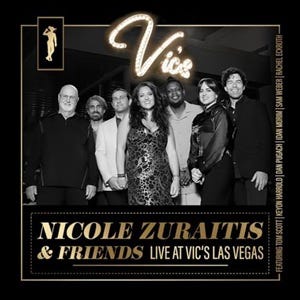
Newly nominated for a Grammy Award for Best Jazz Vocal Album (2025), Nicole Zuraitis’ Live at Vic’s Las Vegas simmers at a high heat, often boiling over as it does on the opening read on Muddy Waters’ “I Got My Mojo working.” The singer switches to a singing version of “The Nearness of You” before taking on “Pure Imagination” and a smoldering, ruminative “Jolene.” Jumping genres uncommonly, the triptych of a waltz made of Fleetwood Mac’s “Rhiannon,” (opaque and complex) the performance centering “Round Midnight,” (smoky and beautifully brutal) and a show-stealing “Wichita Lineman” (stunningly modern) acts as a fulcrum for a superbly programmed setlist without a dull moment. Zuraitis’ Friends push the singer into the outer reaches of performance. These performances are overpowering most wonderfully. The singer’s superb stage presence is infectious. Prepare to be amazed. Good luck, Ms. Zuraitis!
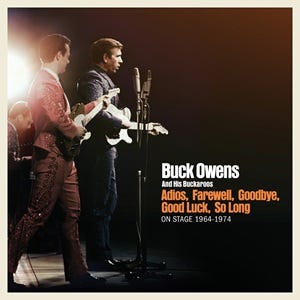
Without Buck Owens, the "Bakersfield Sound" would not exist. Prior to Adios, Farewell, Goodbye, Good Luck, So Long: On Stage 1964-1974, Owens and his Buckaroo’s live recordings were hit or miss regarding quality, production, and retailing. Omnivore Records has pulled three complete performances from the warehouse, releasing them, with 25 previously unissued tracks in the United States and an additional 20 previously unissued anywhere.
Don Rich (lead guitar/fiddle/vocals), Doyle Holly (bass/vocals), Tom Brumley (pedal steel guitar/vocals), and Willie Cantu (drums) made up the Buckaroos of the period. They proved a tight ensemble that typified the Bakersfield sound, particularly live. Three performances provided the material for this collection: The Exciting Sounds Of Buck Owens And His Buckaroos Live From Richmond, Virginia, 1964, plus tracks from the Buck Owens’ Show In Japan, Live In New Zealand, and Buck Owens’ Show “Live” At The Sydney Opera House, The Buck Owens Show–Big In Vegas and Live At The Nugget.
Presented chronologically, these recordings include more essential is the addition of 20 performances available for the first time anywhere: sets from Macys 7th Avenue store from 1967, the 1973 Buck Owens Golf Tournament Dinner, and a 1973 Toys For Tots benefit at the Bakersfield Civic Auditorium. These sides find Owens and the band in fine fiddle and these concerts all a good idea of what they sounded like at the top of their games.
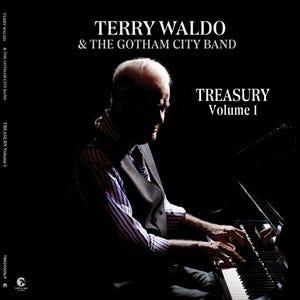
Terry Waldo is a keeper of the flame of that thin interface that exists between ragtime and traditional jazz, where Scott Joplin shakes hands with Jelly Roll Morton. While that interface is thin, its surface covers acres of music. Waldo’s Gotham City Band features bandmates 40 years younger than the leader, who are no less dedicated to sustaining this transitional music. The Treasury Volume 1 hosts a pre-war repertoire that includes the well-known: Jelly Roll Morton’s “Wolverine Blues” (1923), W. C. Handy’s “Yellow Dog Blues” (1915), and the Original Dixieland Jazz Band’s “Tiger Rag.” There are also lesser-known chestnuts like, “Blame it on the Blues” (1914). Veronica Swift sings a sexy "After You've Gone," and Tatiana Eva-Marie purrs "I Get the Blues When it Rains." The band recorded "Maple Leaf Rag" the old-fashioned way, through a horn direct to metal disc, revealing the physical sound at that early twentieth century corner of ragtime and trad jazz.
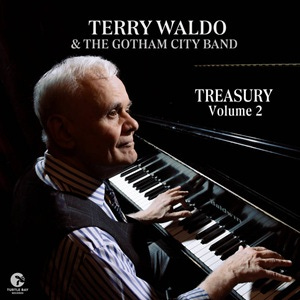
Treasury Volume 2 is the second in a projected three-volume set of Terry Waldo’s survey of the music living in the transition of ragtime to traditional jazz. Waldo, a traditional jazz pianist and bandleader since the 1970s remains quite active at 80. While Volume 1 of the three volumes in his Treasury mostly featured the 2022 version of his Gotham City Band along with two earlier numbers, Volume Two derived from one session in October 2018, and two songs each from May and June 2022.
“Guess Who’s In Town” features Veronica Swift, sounding as if she performs this 1920s repertoire weekly. She has the chops to. “Smiles” features a scat by Waldo and Arnt Arntzen singing the lyrics in perfect period fashion. Waldo is never far from Joe “King” Oliver, presenting “Snake Rag” and “Muscle Shoals Blues.” Singer Molly Ryan contributes vocals on “Get Out And Get Under The Moon,” and banjoist Jerron Paxton recreates Bix and his Gang’s version of “Since My Best Gal Turned Me Down,” and a searing version of Sidney Bechet’s “Viper Mad.” More focused than Volume 1 and no less enjoyable, we should look forward to Volume 3 in Terry Waldo’s Treasury series.
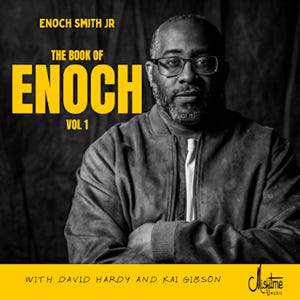
Closing one’s eyes and listening to this collection of sacred music presented in a jazz format, the listener might wonder if the Divine resurrected and recorded Vince Guaraldi again. Not the entire Book of Enoch Vol. 1 but pieces like “Soon and Very Soon,” “A Quiet Place,” and “Gracefully.” Smith has an easy way about his music making. It is very natural and sounds as if he might have been playing in the Garden of Eden.
Smith returns from an eight-year recording sabbatical with an EP of six inspired recreations of gospel hymns through the prism of jazz. Bassist Kai Gibson and drummer David Hardy support Smith, who divines musical sustenance from inspiration from compositions by Andraé Crouch, Kenneth Morris, and Ralph Carmichael. Sophisticated and urbane with a dash of drama, this trio turns these tunes on their respective ears, getting everyone’s attention while doing so.
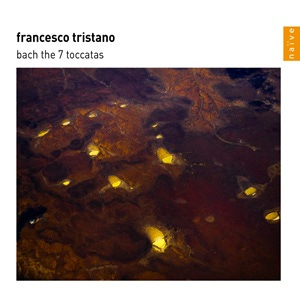
Pianist Francesco Tristano continues his pilgrimage to the heart of J.S. Bach’s keyboard repertoire with Bach: The 7 Toccatas. Preceding this volume are Bach The 6 Partitas (Naïve Records, 2024) and Bach The 6 English Suites (Naïve Records, 2024). Early in 2026, we will see Bach The 6 French Suites released. While musicologically grouped among the suites, the toccatas have not enjoyed such series inclusion. Tristano has amply proven his Bach bona fides, providing a grand juxtaposition with his contemporary Bach peer, Icelandic pianist Víkingur Ólafsson, whose pristine and crystalline Bach has been all the rage since the release of Johann Sebastian Bach (Deutsche Grammophon, 2018). While Tristano’s playing is exacting, it possesses a certain warmth lacking in Ólafsson’s performance (no chide against Ólafsson). The Toccatas offer a slightly unique challenge compared with the Suites. Parts are harrowing, but the pianist navigates them with grace and without-a-net courage. This is impressive Bach by any measure.
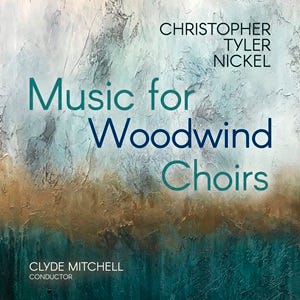
Canadian composer Christopher Tyler Nickel enjoys combining instruments in creative ways to release sounds he has created in his head. He favors winds, familiar and unusual. On Music for Woodwind Choirs. Nickel continues his composing survey of sacred music: the sections of the Suite for Two Oboes and Two Cors Anglais (2017) adopts its title from four well-known prayers in the Christian liturgy—Kyrie, Dies Irae, Lacrimosa, Gloria—each presented in a thought-provoking abstract, easily adapted to worship.
Nickel’s The Symphony for Flute Choir (2017) is a larger work composed for four flutes, piccolo, and alto and bass flutes. From such small forces, Nickel summons an emotional depth and breadth on a symphonic scale. Its format is the standard four movements. The piece makes the listener use their imagination to think bigger than the music. This is the charm of Nickel and his art.
Emilia:
Thank you for these kind words. I am grateful.
M
I have discovered so much beautiful music thanks to you Michael. I am listening to Terry Waldo's 'Treasury Volume 2' right now and loving it. Thank you for writing about music! Have a wonderful 2026 !