


Luxembourg-born pianist, composer, and electronic producer Francesco Tristano uniquely bridges classical tradition and contemporary techno. Born in Luxembourg City in 1981, Tristano trained at the Juilliard School, alongside studies in Brussels, Riga, and Paris, notably under Bach specialist Rosalyn Tureck. While honing his classical technique by day, he immersed himself in New York’s nightclub culture. This duality forged his core philosophy: viewing the driving grooves of Bach’s basso continuo as a form of “proto-techno.” It also sparked high-profile collaborations with Detroit techno pioneers Carl Craig and Moritz von Oswald, fostering a distinct performance style that treats the modern grand piano as a deeply rhythmic instrument.
Tristano’s ongoing recording cycle for Naïve Records, released under his personal imprint intothefuture, is a lifelong mission to record J.S. Bach’s complete solo keyboard works. Navigating the catalog chronologically, the project launched in November 2024 with the 6 Partitas (recorded in Kakegawa, Japan), favoring virtuosic, fleet tempos. The 6 English Suites followed in May 2025, exploring a bright, rapid, “trumpet-like” atmosphere, while October 2025 brought the 7 Toccatas (recorded in Tokyo), capturing the repertoire’s youthful, improvisatory joy.
The June 2026 release of the 6 French Suites marks the fourth chapter of this journey, signaling a deliberate shift in Tristano’s interpretive approach. Historically, the English and French Suites represent two contrasting technical and compositional philosophies. The most immediate distinction lies in their macro-structure. While every English Suite opens with a massive, virtuosic Prelude modeled after the Italian concerto grosso, the French Suites omit introductory movements entirely, plunging the performer directly into the initial Allemande.
This structural difference mirrors the internal texture of the music. The English Suites feature a dense, unyielding polyphony that demands absolute finger independence to weave complex counterpoint between both hands. Conversely, the French Suites—conceived around 1722 in Cöthen as an accessible pedagogical tool for Anna Magdalena Bach—pivot toward a transparent galant style. They favor a singing, lyrical right-hand melody supported by a more compliant bassline.
This textural shift significantly alters the physical demands placed on the pianist. While the English Suites require rigorous athletic stamina to articulate relentless sixteenth-note runs, the French Suites dial back overt fireworks for intimate interpretive nuance. Even the internal dance forms differ in execution. The English Suites feature intricate French courantes twisting through complex metric shifts, whereas the French Suites embrace the Italian corrente style, relying on fluid, linear scalar speed. Finally, the two collections approach notation differently. Bach explicitly wrote out complex ornamentation directly into the score of the English Suites. In the French Suites, he left the musical text intentionally lean, transferring the burden from explicit finger gymnastics to the stylistic taste of the performer, who must apply historical ornaments to a cleaner canvas.
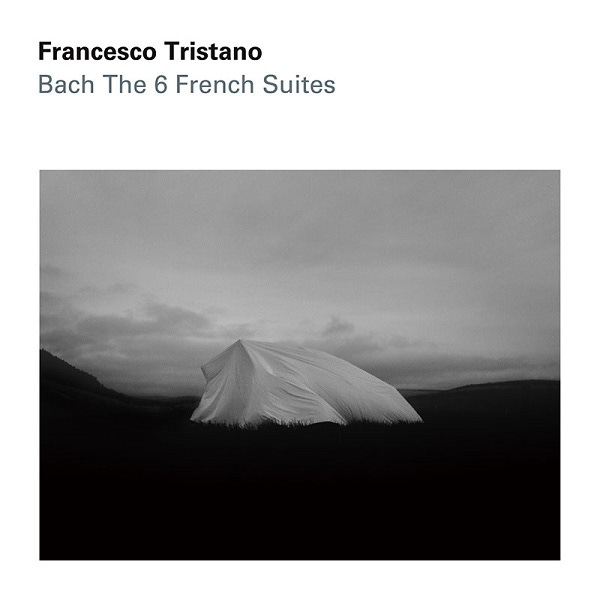
Moving away from the rapid, vertical pacing of his previous Bach recordings, Tristano embraces this softer, warmer lyricism to explore what he calls “density through compression.” Performance quirks define this entry. He prefaces the cycle with the revised version of the Sixth Suite in E major, introducing it with the Prelude from Book I of The Well-Tempered Clavier. True to the aesthetic of the intothefuture series, the album also features a minimalist visual component, using stark, black-and-white photography by Breno Rotatori to mirror the structural arc of each suite.
Tristano’s reading of the French Suites succeeds because it treats Bach’s music not as a fragile museum piece, but as a living, breathing blueprint for rhythm and expression. By trading the driving, industrial momentum of his earlier Naïve recordings for a softer, more intimate lyricism, Tristano proves that his genre-blurring artistry is as capable of profound warmth as it is of modern precision. This album stands as an interesting chapter in his ongoing chronological survey—a release that honors historical transparency while effortlessly projecting Bach’s timeless structures into the future.
