


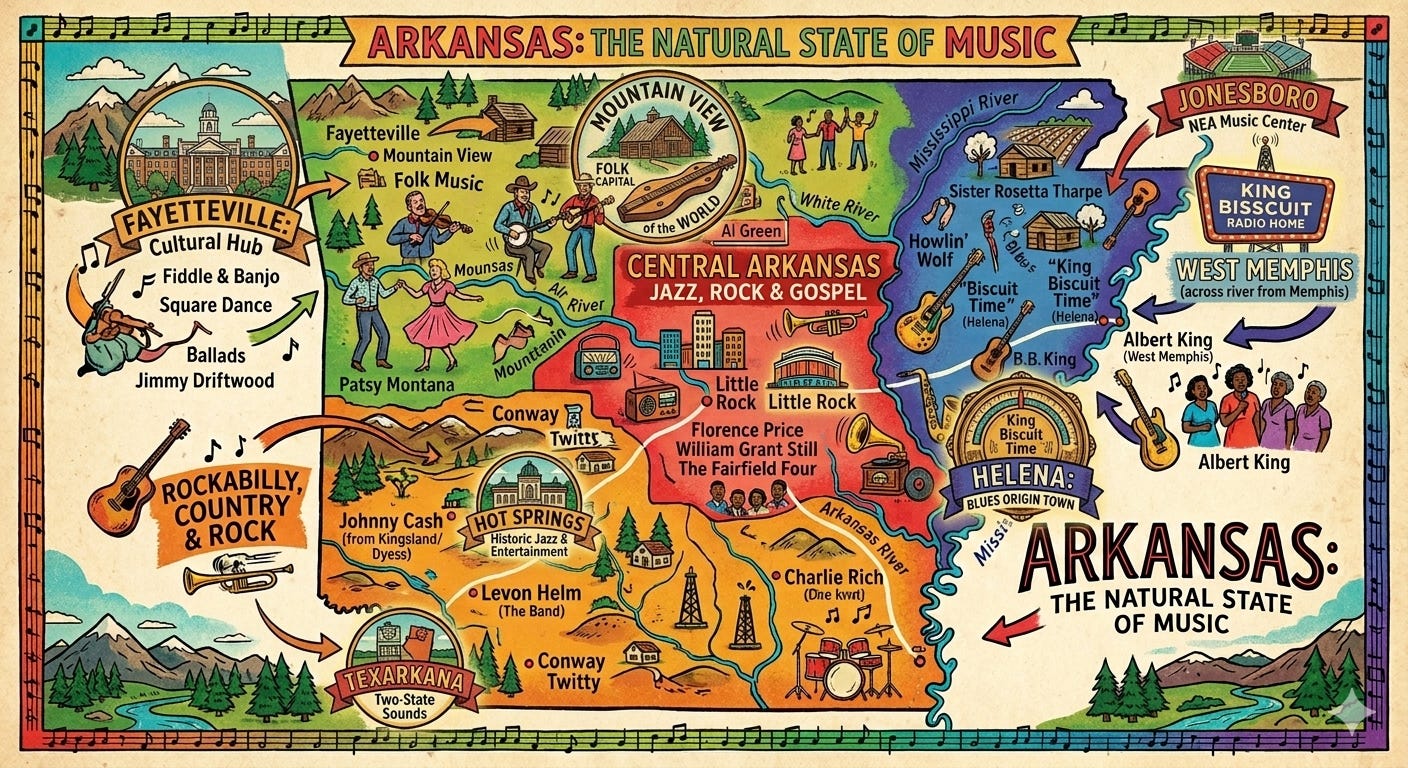
Arkansas’s sonic footprint is a foundational blueprint of American vernacular music, proving that the state is an essential cradle of cultural innovation rather than a regional punchline. For decades, a persistent “hillbilly” caricature has obscured a complex reality: the Natural State sits directly at the geographical and cultural crossroads of the Mississippi Delta, the Ozarks, and the American West. This caricature found its sharpest, most vitriolic champion in the legendary Baltimore critic H. L. Mencken (1880–1956). In his infamous 1917 essay “The Sahara of the Bozart,” Mencken weaponized regional stereotypes to dismiss the entire American South as a cultural wasteland, declaring it “almost as sterile, artistically, intellectually, culturally, as the Sahara Desert.” Barely a decade later, William Faulkner would write The Sound and The Fury (Jonathan Cape and Harrison Smith, 1929). Mencken, you swarmy, smart bastard.
To Mencken, the region below the Potomac was a “vast vacuity” filled with “paralyzed minds,” and he routinely singled out Arkansas as the absolute nadir of this perceived backwardness. He wrote that “to be born in Arkansas is a misfortune and an injustice from which they will never recover.” On many levels, Mencken’s pronouncements continue to bear a whiff of truth, while closer inspection reveals a smell of something else altogether. By analyzing the deep continuum of the state’s actual musical heritage, Mencken’s elite condescension collapses. We can map a direct line from isolated, 19th-century frontier string bands to the explosive, integrated rockabilly movement that reshaped global culture. Since achieving statehood in 1836, Arkansas has continuously produced structural pioneers who defied Mencken’s diagnosis of artistic sterility.
The state’s cultural output relies on a rich ecosystem shaped by its stark internal borders. A geological diagonal cleanly bisected Arkansas, separating two entirely different worlds. In the swampy, fertile eastern floodplain of the Mississippi Delta, towns like Helena, West Memphis, and Cotton Plant became epicenters of Black creative resistance. Architects like Sister Rosetta Tharpe (1915–1973), Big Bill Broonzy (1903–1958), and Robert Lockwood Jr. (1915–2006) forged the language of the blues and modern gospel. Helena’s King Biscuit Time radio program anchored the regional sound, while in West Memphis, Howlin’ Wolf (Chester Burnett, 1910–1976) electrified Delta blues into a heavy, primordial rumble. Marvell’s Levon Helm (1940-2012) was the Virgil Cain of the Band’s “The Night They Drove Old Dixie Down.” This blues chassis directly collided with the traditions of the rugged Ozark and Ouachita highlands to the north and west. In mountain communities like Mountain View, Anglo-Celtic ballads and old-time fiddle tunes survived in an isolation chamber. Because musicians played for local square dances without amplification, they developed a hyper-aggressive, driving tempo to be heard over stomping feet. This environment produced raw, eccentric string bands, alongside icons like Johnny Cash (1932–2003), Patsy Montana (1908–1996), and Charlie Rich (1932-1995) each shattering commercial expectations.
Beyond rural roots, this geographic pressure cooker served as a vital incubator for avant-garde classical, jazz, and rock visionaries—further impugning Mencken’s claim that there was “not a single orchestra capable of playing the nine symphonies of Beethoven... nor a single musical composer” across the region. In Little Rock, Florence Price (1887–1953) broke racial and gender barriers as the first African-American woman to have a symphonic work performed by a major national orchestra, while William Grant Still (1895–1978) seamlessly infused the blues into classical symphonies. Decades later, saxophone giant Pharoah Sanders (1940–2022) pushed the absolute boundaries of avant-garde and spiritual jazz alongside John Coltrane (1926–1967). It was also out of Little Rock that musical magpie Jim Dickinson (1941–2009) emerged, a figure who perfectly embodied this regional pipeline. Though widely celebrated as a central architect of Memphis music, Dickinson was an Arkansas native whose entire artistic worldview was anchored by his cross-state journeys. Crossing the river, he brought the wild, unhinged spirit of the Arkansas lowlands into elite recording studios, contributing piano to legendary local sessions and playing with iconic national acts like Arlo Guthrie (1947–Present), Aretha Franklin (1942–2018), and the Rolling Stones. As a producer for Big Star and the Replacements, Dickinson injected a dangerous, anti-commercial independence into rock ‘n’ roll that he traced straight back to hearing Howlin’ Wolf on the radio in West Memphis.
This music did not spring from leisurely artistic expression; it was forged as a desperate escape capsule from grueling systemic poverty. Following the Civil War and moving through the Great Depression, the cotton-dominated sharecropping economy kept both Black and white rural laborers trapped in a cycle of crushing debt. For a young Johnny Cash picking cotton in Dyess, or a young Big Bill Broonzy working the fields of Jefferson County, a musical instrument was a commodity and a survival strategy. By the mid-1950s, the mechanization of agriculture had displaced hundreds of thousands of Arkansans. Young, restless musicians working day jobs in timber mills or factories spent their nights blowing off steam in highway honky-tonks, using affordable independent recording technology to cut records on local labels like Alley or Fernwood.
The mid-century rockabilly explosion was simply the consequence of these earlier folk traditions. The rockabilly guitarists of the 1950s did not invent their manic pacing or rowdy energy out of thin air; they inherited it directly from the old-time fiddlers and banjo players who came before them. When you strip away the generational differences in technology, you find the same defiant Arkansas pulse. The frantic, percussive chug that drove rural square dancers to stomp holes in barn floors during the Great Depression is the identical engine that propelled sweaty teenagers onto the gymnasium floors of post-war sock hops.
Tracing this lineage, the historical illusion of a generational musical rupture evaporates. The electric guitar players of the post-war era didn’t abandon their heritage to chase a new national fad. Instead, they weaponized the isolation, the economic angst, and the rhythmic madness preserved by their ancestors. They merely swapped the fiddle bow for an amplifier, plugging into a century of raw, unhinged frontier tradition directly into the high-voltage currents of modern American culture.
This hidden reservoir of sonic radicalism is precisely what makes the dual survival of two recent archival collections so culturally urgent. Rather than viewing the rustic, pre-war mountain string bands of the 1920s and the explosive, post-war electric honky-tonk rockabilly of the 1950s as separate, unrelated phenomena, we must recognize them as sequential chapters of the same ongoing regional struggle. Historical abstractions no longer comprise the raw materials of this defiant musical heritage. By placing these two specific sonic archives side by side, we can finally hear the continuous, unbroken evolution of the Arkansas vanguard as it transformed from isolated acoustic folk preservation into a high-voltage, integrated global phenomenon.
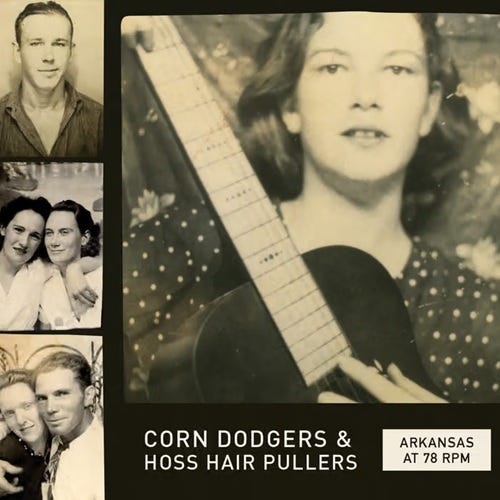
Corn Dodgers & Hoss Hair Pullers: Arkansas at 78 RPM (Dust-to-Digital, 2014)
Dust-to-Digital’s Corn Dodgers & Hoss Hair Pullers: Arkansas at 78 RPM provides an audio time capsule, transporting listeners to an era where music was a hand-cranked, acoustic defense mechanism against economic ruin. Cut primarily between the late 1920s and the dawn of World War II, these 78 RPM shellac discs capture a distinctly communal, front-porch aesthetic. One can easily visualize these performances unfolding on a weathered Ozark porch during the depths of the Great Depression, where neighbors gathered to find a brief respite from the anxieties of failing crops and mounting debt through a shared, localized repertoire. There may have been a whiskey still out there too.
A defining characteristic of this archive is its extreme instrumental minimalism. Long before multi-track recording, overdubbing, or electronic amplification, the sonic boundaries of Arkansas roots music were dictated by what could be carried in a burlap sack or built by hand. The instrumentation relies almost on the foundational trinity of vernacular Appalachian and Ozark folk: the acoustic fiddle, the open-back five-string banjo, and the acoustic rhythm guitar. Unadorned by studio trickery, the recordings project an organic warmth that feels deeply intimate. Melodies throughout the collection are purposefully simple, linear, and iterative—built not for commercial radio consumption, but to anchor community square dances where rhythmic persistence mattered far more than complex chord progressions.
While a singular, homespun thread binds the collection together, a closer examination reveals an internal spectrum of stylistic approaches, regional variances, and performance philosophies. The compilation exposes a sharp stylistic division between raw, chaotic string-band energy and highly disciplined traditional playing. Tracks like Pope’s Arkansas Mountaineers’ recording of “Jaw Bone epitomize the frantic side of the Ozark tradition.” The pacing is breakneck, and the performance feels loose, teetering on the edge of structural collapse. Vocal shouts and percussive momentum take total precedence over melodic cleanliness, capturing a manic energy born out of pure isolation.
In sharp contrast stand selections by Dr. Smith’s Champion Hoss Hair Pullers, such as “Just Give Me the Leavings.” Led by Dr. Henry Harlin Smith (1881–1931), a rural physician from Lawrence County, this ensemble approached old-time music with clockwork synchronicity. Their dual-fiddle arrangements are precise, pristine, and clean, demonstrating that Arkansas folk traditions possessed deep-seated technical discipline alongside their rowdy reputation.
The collection further shifts between narrative-driven, vocal-centric storytelling and driving, rhythmic instrumentals designed for pure physical movement. Instrumental tracks like Luke Highnight (1893–1951) & His Ozark Strutters’ performance of “Fort Smith Blues” are built for the square-dance floor. The guitar acts as a steady metronome, while the fiddle locks into a repetitive loop designed to be heard over the stomping of feet. The melody does not stray; it hammers away at a localized groove, illustrating how simple tools were tempered to generate communal rhythm. Conversely, the vocal tracks on the collection trade rhythmic dominance for narrative intimacy. Sung with a deadpan delivery or a high-lonesome hill country holler, these selections rely on minimal chord changes to keep the focus entirely on tales of localized folklore, historical events, and everyday working-class struggles.
Despite these differences in execution, the commonality across every selection on Corn Dodgers & Hoss Hair Pullers remains its complete lack of commercial pretension. Whether listening to the frantic energy of an old-time breakdown or the measured precision of a pristine fiddle duet, the music never feels manufactured for an outside market. It is an inward-facing archive of survival—the raw, unvarnished sound of a people using the simplest musical tools available to maintain dignity, community, and joy against the crushing backdrop of a national depression.
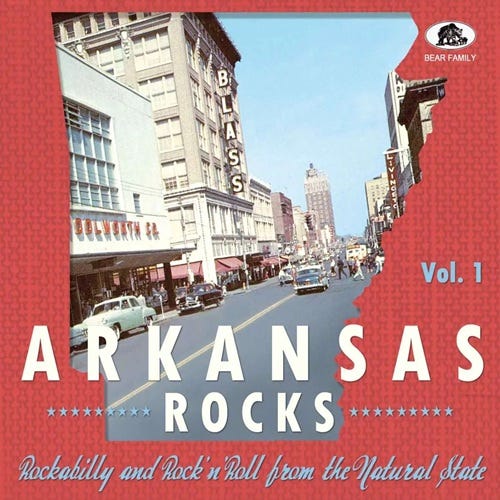
Arkansas Rocks, Volume 1: Rockabilly and Rock ‘n’ Roll from the Natural State
(Bear Family, 2026)
If the Dust-to-Digital archive represents the acoustic solitude of the front porch, Bear Family Records’ Arkansas Rocks, Volume 1: Rockabilly and Rock ‘n’ Roll from the Natural State documents the high-voltage explosion of the highway honky-tonk. Recorded during the mid-1950s and early 1960s, this collection reflects an era when regional isolation was rudely informed by affordable tube amplifiers, overdriven tape echo, and jukeboxes. Yet, the most vital historical revelation of this Bear Family compilation is its geography: it decisively proves that rockabilly was not an exclusive product of the Mississippi Delta strip. Instead, it was a pan-Arkansas epidemic, erupting simultaneously across the entire topography of the state.
While the Arkansas Delta provided a crucial cultural environment, Arkansas Rocks maps a sprawling, multi-regional phenomenon. On this compilation, the driving, manic energy of rockabilly charges out of the mountainous northern tier with tracks like Chuck Comer’s (1934–2017) “Little More Lovin’” from Jonesboro. It surfaces in the central river valley through the frantic, echo-drenched work of Buddy Phillips (1936–2012) on “Coffee Baby.” Even the southwestern timber country chimes in via Luke Royer’s (1923–2013) sharp, anti-authoritarian anthem “One’s All the Law Will Allow.” Rather than emerging from a single localized subculture, rockabilly was an all-encompassing state of mind. It merged the frantic, breakneck tempos of the Ozark hills with the syncopated, rhythmic grease of the lowlands, standardizing a unified sound of white-hot working-class rebellion.
This decentralized explosion finds its conceptual anchor in the legendary work of Johnny Cash at Sun Records. Cash grew up in the federal New Deal colony of Dyess, situated deep within the rich, black dirt of the Arkansas Delta. It was in this unforgiving, mosquito-ridden terrain—where families spent daylight hours back-broken over endless rows of cotton—that rockabilly’s emotional framework was truly born. Cash’s “boom-chicka-boom” rhythm was not a slick studio fabrication; it was the literal sonic translation of the Delta landscape. It mirrored the steady chug of the locomotives pulling agricultural freight across the lowlands and the primitive, rhythmic thud of the field hollers that echoed across the plantations.
The raw selections featured on Arkansas Rocks operate within this creative loop. When listening to Bobby Lee Trammell’s (1934–2008) unhinged, wild performance of “Arkansas Twist” or the chaotic, overdriven energy of The Thunderbirds’ “Flying Saucers,” you are hearing the direct descendants of Cash’s Delta aesthetic. These tracks showcase artists who resonated with the same synthesis of rural country blues, gospel conviction, and localized trauma. They did not play with the polite restraint of the Nashville establishment. Like Cash, they adjusted their instruments to convey the heavy, rhythmic thud of the lowlands. They equipt their music to reflect the grime, the sweat, and close humidity of the agrarian South.
The Bear Family compilation re-centers the origin story of rock ‘n’ roll firmly back into the rural Arkansas terrain. It shows that the genre was not conceived on a clean drafting table in an urban recording facility. Instead, it was drawn directly out of the muddy, resource-starved environment of the timber mills, the sharecropper shacks, and the neon-lit highway taverns. By documenting how this thunderous musical movement sprouted evenly from the Ozarks down to the Gulf coastal plain, Arkansas Rocks proves that the Natural State’s mid-century music was an inescapable, localized force of nature—one that shook the world using the heavy rhythm of the Delta dirt as its primary vehicle.
When weighed together, Corn Dodgers & Hoss Hair Pullers and Arkansas Rocks form an architectural arc over the landscape of American vernacular music. Their superficial differences—acoustic vs. electric, front-porch communalism vs. honky-tonk commercialism—melt away to reveal a unified, unbroken regional pulse. The technical evolution from 78 RPM shellac to 45 RPM vinyl did not fracture Arkansas’s identity; it merely unlocked it. The structural minimalism and simple melodies of the pre-war era provided the exact rhythmic runway that mid-century rockabilly needed to take flight. The frantic, unhinged velocity of Pope’s Arkansas Mountaineers did not disappear in the post-war boom; Bobby Lee Trammell plugged it into an amplifier and shot it at the rest of the world.
This lineage stands as a definitive rebuttal to the elite critiques of Mencken and generations of subsequent caricatures that followed. The music preserved on these collections shows Arkansas was never a “cultural wasteland” or a passive bystander to the trends of New York or Los Angeles. Instead, it functioned as the deep, sub-structural engine room of American sonic innovation, hermetically separated from the urban coasts. These records capture a resilient people who took the raw, unpolished elements of their immediate surroundings—the simple cadence of an Ozark fiddle string, the muddy rhythm of the Delta dirt—and forged an uncompromising aesthetic of survival and rebellion.
Yes ma'am, both were from the Arkansas delta region, Tharpe from Cotton Plant and Cash from Dyess. Levon Helm was from outside Marvel, a small community called Turkey Scratch, where Robert Jr. Lockwood was born.
Fabulous article ! I didn't know that Johnny Cash and Sister Rosetta Tharpe came from Arkansas. I had never heard before of Florence Price ! I started listening to her music, so beautiful. Thank you very much for sharing this !!