


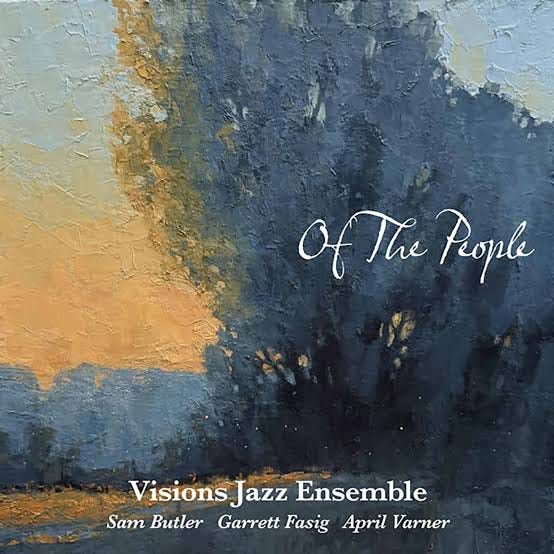
The Visions Jazz Ensemble’s sophomore release, after their debut, Across the Field (Patois Records, 2024), Of the People, marks a profound milestone in the contemporary landscape where Americana and jazz collide. Commissioned by the Timeless Music Project to commemorate the semi-quincentennial of the United States, the 12-song project serves as a rich cultural travelogue that bridges generational divides by reimagining centuries of American musical history through a modern, straight-ahead jazz lens.
Several years ago, a fascinating subgenre of America-centered vocal jazz albums caught the critical eye at All About Jazz, with foundational works like the Tierney Sutton Band’s American Road, Cathy Segal-Garcia’s Social Anthems series, Laurie Antonioli’s American Dream, Jacqui Sutton’s Billie & Dolly, and Frank Macchia’s Folk Songs for Jazzers establishing this unique stylistic lane. While Of the People could easily be categorized as vocalist April Varner’s solo contribution to this specific lineage, the album ultimately distinguishes itself through the formidable, democratic partnership of the Visions Jazz Ensemble alongside its co-leaders, trumpeter Sam Butler and alto saxophonist Garrett Fasig.
On a project teeming with virtuoso players, Varner’s greatest triumph is her restraint. On traditional touchstones like “Simple Gifts,” John Denver’s anthemic “Take Me Home, Country Road” (re-harmonized in the minor), and Gordon Lightfoot’s moving narrative ballad “The Wreck of the Edmund Fitzgerald,” she systematically sheds all traditional jazz artifice. There are no hyper-stylized vocal fry textures, unnecessary scat flights, or complex vocalese gymnastics designed to prove her jazz pedigree. Instead, Varner leans completely into a pristine, unadorned vocal clarity that honors the storytelling roots of folk music, allowing her natural instrument to shine with a stark, striking vulnerability. This ability to dial back her technique makes the moments where the full ensemble unleashes its power even more dramatic, creating a brilliant sonic push-and-pull across the tracklist. A direct comparison can be made between their treatment of Dolly Parton’s “Coat of Many Colors,” where Varner delivers an intimate, tender narrative supported by a gentle acoustic framework, and the driving, supernatural swing of “Ghost Riders in the Sky,” where she matches the high-octane energy of aggressive modal horn charts and a fiery rhythm section.
The thematic heart of the album crystallizes further in the juxtaposition of “Deep River” and “God Bless America.” In an era where cultural and spiritual identities are frequently weaponized as political dividing lines, these two arrangements offer a refreshing, unifying counter-narrative. Rather than channeling the modern, exclusionary flavor of American Christianity that draws lines between people, Varner and the Ensemble approach these songs through the historic lens of a shared Christian ethic, expressing radical gratitude for a collective bounty. “Deep River” is approached with a heavy, soulful reverence as a profound cry for universal liberation and spiritual peace, while “God Bless America” avoids any trace of bombastic jingoism, transforming Irving Berlin’s classic into an elegant, prayerful thanksgiving.
While Varner’s vocal purity provides the narrative spine, it is the brilliant instrumental commentary from Butler and Fasig that prevents the album from becoming a simple folk cover project. On “The Wreck of the Edmund Fitzgerald,” after Varner delivers the haunting lyrical narrative, Sam Butler’s brooding, blues-tinged trumpet solo cuts through the arrangement like a lighthouse beam through a gale, capturing the immense weight of the tragic icy waters. Conversely, Garrett Fasig’s alto saxophone takes center stage during the explosive climax of “Ghost Riders in the Sky,” unleashing a fiery post-bop solo where his horn mimics the frantic, thundering hooves of the phantom herd. Even on the sacred terrain of “Deep River,” the two horn players weave their lines around Varner’s vocals with immense pastoral sensitivity, ensuring that the music functions as a true, unified ensemble triumph.
Nowhere is the structural brilliance of this collaboration more apparent than in its intentional bookending. By opening with the spiritual clarity of “Simple Gifts,” the ensemble establishes an idealist vision of American bounty, only to ground it in reality with the album’s closing track: Stephen Foster’s 1854 parlor song, “Hard Times.” In their rendering, the ensemble handles Foster’s melody as a sobering, historical reflection, with Varner singing the track with an empathetic, weary weight that captures the cross-generational sigh of a working class lingering outside the cabin door. This thematic undercurrent of exhaustion and enduring hope echoes perfectly into the broader lineage of American songwriting, mirroring the exact emotional architecture of Paul Simon’s 1973 masterpiece, “An American Tune.”
Just as Foster captured the fractures of a pre-Civil War society, Simon used the same weary, hymn-like framework to chronicle the squandered idealism and national heartaches of the post-Nixon era. By invoking “Hard Times” to close their cultural travelogue, the Visions Jazz Ensemble and Varner draw a straight line from 1854 to the modern day, acknowledging that the American tune has always been one of struggle, shattered dreams, and resilience. Of the People stands as a unifying document—a sweeping musical travelogue that reminds us that the true beauty of the American songbook lies not in its boundaries, but in its boundless capacity to hold both our highest promises and our deepest pathos.