


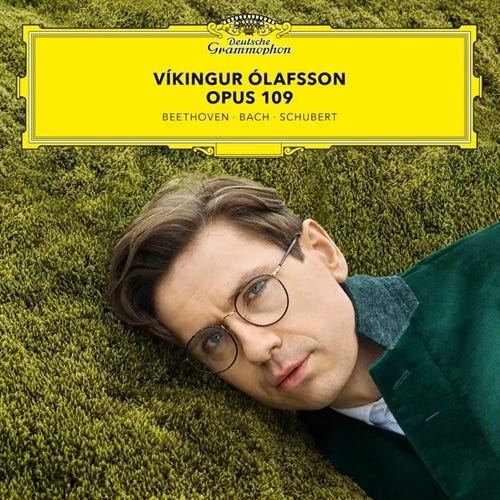
For Icelandic pianist Víkingur Ólafsson, everything begins with Bach. Ólafsson emerged, or better yet, detonated, with the release of Johann Sebastian Bach (Deutsche Grammophon, 2018). The pianist had released three recordings on his own label before debuting on Deutsche Grammophon in 2017 with Philip Glass - Piano Works, which received favorable reviews for his punctilious technique and exacting attention to detail. Since then, Bach has been the foundation of all his recordings, including Debussy • Rameau (2020), Reflections (2021), Mozart & Contemporaries (2021), From Afar (2022), his much anticipated Goldberg Variations (2023), and Continuum: Johann Sebastian Bach (2024).
Ólafsson belongs to a new generation of pianists less content with producing a new discography of selected keyboard works and more interested in providing education and context to their recitals. With Opus 109: Beethoven | Bach | Schubert, Ólafsson musically illustrates his conception of how music thought and performance progressed from Bach (his main discography subject thus far) to Beethoven as the fulcrum to a tipping point between the High Baroque/Classical into the Romantic Era. The pianist makes it a musical game intended to enhance the listener’s appreciation of how the radiant Beethoven casts shadows on the past while illuminating the present and future. The process encourages the listener to learn the significance of each composition alone and then as part of a continuum.
To the uninitiated, the title Opus 109: Beethoven | Bach | Schubert might be a real head-scratcher. What on earth is Víkingur Ólafsson driving at with his new recording?
Let’s unpack that a bit.
Opus 109 refers to Beethoven’s Piano Sonata No. 30 in E major, Op. 109, composed in 1820. Regarding Beethoven’s three creative periods, the Piano Sonata No. 30 is part of the composer’s late piano sonatas, which include:
Piano Sonata No. 27 in E minor, Op. 90
Piano Sonata No. 28 in A major, Op. 101
Piano Sonata No. 29 in B-flat major, Op. 106 “Hammerklavier”
Piano Sonata No. 30 in E major, Op. 109
Piano Sonata No. 31 in A-flat major, Op. 110
Piano Sonata No. 32 in C minor, Op. 111
Ólafsson chooses a theme/concept approach for addressing Beethoven’s late-period piano sonatas, as opposed to simply recording the final piano sonatas for a single release, like the recently released Ziyu Liu’s Beethoven: The Late Piano Sonatas, Op. 109, 110 & 111, (Beijing Global Audio-Visual Publishing, 2025); Tomoko Ogasawara’s Beethoven - The Last Piano Sonatas (Genuin Records, 2025); and Chi Ho Han’s Beethoven's Final Testament, (TomatoClassic, 2024). What the pianist did was select the Sonata No. 30 in E major, Op. 109 as the basis for illustrating Bach’s influence on both Beethoven and Schubert (with a look at what Schubert learned from Beethoven and, perhaps, taught him).
Part of Ólafsson’s method includes programming pieces composed in the same key, E (major and minor). Rather than creating a tonal desert made dry with harmonic stasis, the pianist flips the perceived agenda, opening the music as if with added water, revealing a bright and shining spiritual interior. The pianist kicks off his recital with Bach’s E major Prelude from The Well-Tempered Clavier, Book 1. It is here that Ólafsson, through his light touch, navigates the distance between a sensitive baroque reverie and a tensile reading of Beethoven’s rare, two-movement Piano Sonata No. 27 in E minor, Op. 90, which the pianist considers the vestibule of Piano Sonata No. 30. Chronologically, Op. 90 exists in Beethoven’s “Late Middle” period, though many also include it with the Late Period material.
Ólafsson blurs and blends the transition from Bach to Beethoven in such a way as to stress what the two compositions have in common. The pianist stirs into his Beethoven some Bachian thoughtful restraint, drawing from the Beethoven a greater majesty. After this comparative experience, the pianist revisits his theme by performing Bach’s Partita No. 6 in E Minor, BWV 830. Ólafsson plays with his characteristic punctilious exactness, urged on my his precise, light touch. This is Bach at his most crystalline.
Having swept away the debris of comparison with Bach’s Partita, Ólafsson injects his theme with contemporary goings on in Vienna during the time Beethoven was composing his Nos. 27 and 30 piano sonatas with a reading of Franz Schubert’s Piano Sonata No 6 in E minor, which the pianist believes owes much to Beethoven’s Op. 90. Ólafsson’s performance of the Schubert sonata prepares the ear for the central object of the recording, the Op. 109. The piece provides a thrilling climax to the project, beautifully articulated and succinctly presented as an almost cool draft of air that heats as the performance unfolds.
Ólafsson closes with Bach’s French Suite No. 6 in E Major, BWV 817: III. Sarabande followed by an edit of Piano Sonata No. 30 in E Major, Op. 109: III. Andante molto cantabile ed espressivo. The effect is one of déjà vu, a sonic trailer for the entire album. Listening is a delightful experience.
1. J.S. Bach: The Well-Tempered Clavier I: Prelude No. 9 in E Major, BWV 854
2. Beethoven: Piano Sonata No. 27 in E Minor, Op. 90: I. Mit Lebhaftigkeit und durchaus mit Empfindung und Ausdruck
3. Beethoven: Piano Sonata No. 27 in E Minor, Op. 90: II. Nicht zu geschwind und sehr singbar vorgetragen
4. J.S. Bach: Partita No. 6 in E Minor, BWV 830: I. Toccata
5. J.S. Bach: Partita No. 6 in E Minor, BWV 830: II. Allemande
6. J.S. Bach: Partita No. 6 in E Minor, BWV 830: III. Corrente
7. J.S. Bach: Partita No. 6 in E Minor, BWV 830: IV. Air
8. J.S. Bach: Partita No. 6 in E Minor, BWV 830: V. Sarabande
9. J.S. Bach: Partita No. 6 in E Minor, BWV 830: VI. Tempo di Gavotta
10. J.S. Bach: Partita No. 6 in E Minor, BWV 830: VII. Gigue
11. Schubert: Piano Sonata No. 6 in E Minor, D. 566: I. Moderato
12. Schubert: Piano Sonata No. 6 in E Minor, D. 566: II. Allegretto
13. Beethoven: Piano Sonata No. 30 in E Major, Op. 109: I. Vivace ma non troppo - Adagio espressivo
14. Beethoven: Piano Sonata No. 30 in E Major, Op. 109: II. Prestissimo
15. Beethoven: Piano Sonata No. 30 in E Major, Op. 109: III. Andante molto cantabile ed espressivo.
16. J.S. Bach: French Suite No. 6 in E Major, BWV 817: III. Sarabande
17. Beethoven: Piano Sonata No. 30 in E Major, Op. 109: III. Andante molto cantabile ed espressivo (Edit)