


Mark Isaacs is a noted pianist, composer, and conductor, whose prolific career, lifelong straddling of the classical and jazz worlds. Born into a Baghdadi Jewish family with deep musical roots, he moved to Australia at the age four. Guided by mentors like Peter Sculthorpe and Samuel Adler, Isaacs has earned widespread international acclaim, drawing stylistically from lyricism, rich chromatic harmony, and kinetic, driving rhythms.
While fiercely celebrated as a first-class jazz practitioner who has collaborated with legends like Dave Holland and Roy Haynes, Isaacs has concurrently built a major classical portfolio spanning over 100 serious works, including concertos, chamber pieces, film scores, and major symphonic music. His first two symphonies serve as milestones of his classical output, capturing contrasting eras of personal grief and triumphant creative defiance.
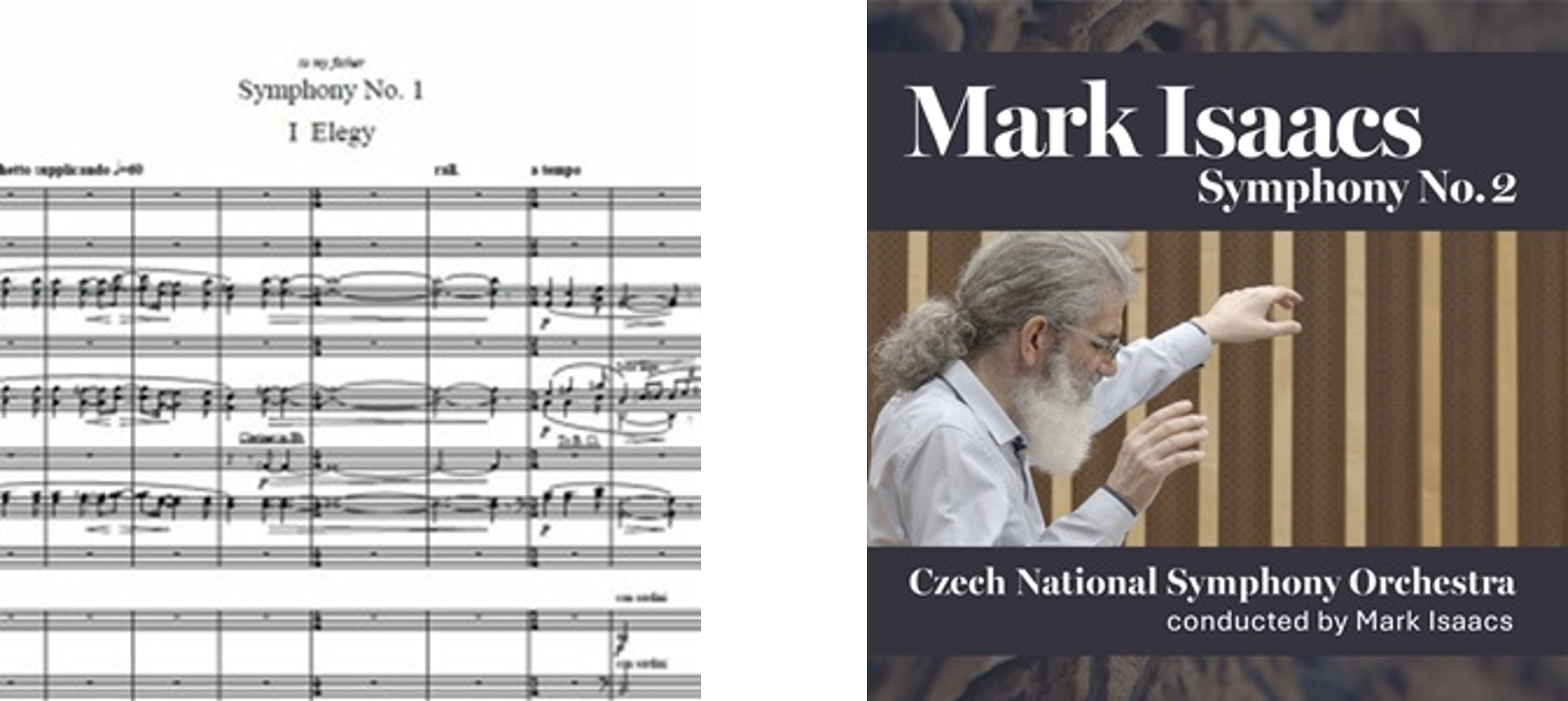
Symphony No. 1: A Journey Through Grief and Celebration
The structural framework of Isaacs’ First Symphony relies on a traditional four-movement classical model. Spanning roughly 35 minutes, the piece operates as a grand emotional arc that systematically navigates the harrowing reality of parental loss, shifting from crushing desolation to a vibrant celebration of life.
The work opens with a substantial first movement built upon a developing, highly modified sonata-allegro design. It wastes no time introducing the symphony’s core thematic motifs, juxtaposing dense, dark orchestral textures with sudden, unexpected bursts of soaring melodic lyricism.
This creates a complex wariness that gives way to a curveball thrown by the composer, inserting a scherzo as the second movement and doubling down with its lively momentum. This segment leverages Isaacs’ background as an elite jazz practitioner, using rapid-fire syncopation and kinetic drive to inject needed vitality into the symphonic structure.
Isaacs casts the traditionally scherzo third movement as the slow movement, creating a deeply somber section which functions as the emotional core of the piece. Acting as a traditional slow movement, it leans into an intimate, chamber-like orchestration. The writing here is intentionally vulnerable, directly capturing the raw shock and elegiac mourning that consumed the composer following his father’s terminal cancer diagnosis.
Finally, the symphony culminates in a grand and unifying fourth movement. Instead of ending in defeat, the finale acts as an uplifting, joyous celebration of life. It gathers the motifs from earlier movements, transforming them into a triumphant, unified resolution.
Symphony No. 2: Cinematic Grandeur and Compressed Defiance
In stark contrast, the Second Symphony adopts a significantly tighter and more modern three-movement architecture. Spanning a concise 24 minutes, the work trades the long-form mourning of its predecessor for a highly theatrical, episodic, and rhythmically complex soundscape.
The first movement (marked Largo maestoso ma agitato – Moderato con brio – Allegro assai – Allegretto teneramente – Moderato ma maestoso) is a structurally brilliant sonata form fractured into fast-shifting sub-sections. It unfolds with a sweeping, cinematic grandness. Critics have noted clear stylistic nods to the energy of William Walton and the orchestration of John Williams. Driven by constant meter changes, it demands high-octane virtuosity from every corner of the orchestra.
The second movement (Adagietto cantando) is a deliberate, heart-touching structural homage to Gustav Mahler’s iconic Fifth Symphony. Isaacs strips down the orchestration to mirror Mahler’s blueprint of strings and harp, but uniquely weaves a shimmering celesta into the fabric. The defining structural moment occurs exactly in the center of the movement, where Isaacs introduces a sudden, jarring pause. This absolute silence acts as an artistic threshold—what reviewers call standing “at the gate of unknowing”—before opening up into some of the most fragile, rarified, and quiet music of the entire composition.
The tension of that stillness breaks violently with the third movement (Largo supplicando – Moderato con brio). The finale detonates into a breathless, syncopated orchestral bacchanal driven by aggressive, irregular meters heavily reminiscent of Igor Stravinsky. Rather than building a self-indulgent coda, Isaacs constructs a tight, compact ending. It delivers an explicit nod to Mahler’s Sixth Symphony by forcing a triumphant major triad to congeal into a stark, haunting minor chord. The piece cuts out cleanly, ensuring that nothing outstays its welcome.