


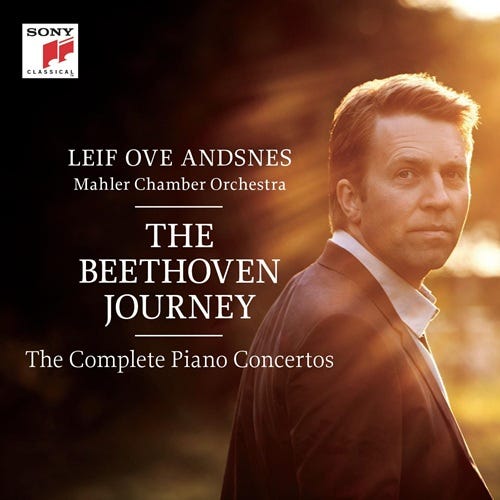
This entry in the 100 Best Live Recordings, at Number 85, is here precisely because this review will run on December 16, Beethoven’s (and by a fortunate act of the Divine, my mother’s) birthday. That is a completely arbitrary assignment that I justify by being the author of this Substack. In 2012, Norwegian pianist Leif Ove Andsnes announced that began a project to record all of Beethoven’s piano concertos and the Choral Fantasy. What places the set on this list is that Andsnes recorded the pieces live, conducting the Mahler Chamber Orchestra from the piano bench. Also, these recordings are the first Beethoven in Andsnes’ repertoire, the pianist having concentrated more on the later, Romantic period.
The series began with the recording of the first and third concertos at the Prague Spring Festival in the historic Rudolfinum building on May 10-12, 2012. The soloist and group recorded the second and fourth concertos in Cadogan Hall, London, from May 20-22, 2012, and made the final recordings of the Piano Concerto No. 5 “Emperor” and the Choral Fantasy at the Prague Spring Festival in the Rudolfinum on May 22, 23, and 24, 2014.
Sony Classical released the program as three CDs. The label released Vol. 1 - Concertos Nos. 1 & 3 on September 17, 2012. Vol 2: Concertos Nos. 2 & 4 followed on February 17, 2014, with the series completed with Vol. 3: Concerto No. 5 & Choral Fantasy on September 15, 2014. The box set entitled The Beethoven Journey: The Complete Piano Concertos was released on October 27, 2014. The complete set contained three discs, gathering all the concertos and the Choral Fantasy in a single package.
Andsnes directs the first and third concertos conservatively, but not so much so that the performances lose their brightness. The pianist compresses the cadenzas and tones down the loud passages while smoothing out the quieter stretches. What he reveals is an amiable, almost sunny Beethoven, closer to Haydn than his own Emperor Concerto. The Third Concerto is something a little darker, more anxious. Andsnes’ playing is crisper, more exact. Militant and pressed, the first movement gives way to a relaxed, lyrical mood and then to a mirthful, nearly reckless celebration in the Rondo.
The second release provided the Second and Fourth concertos, again with the juxtaposition of the past and the future. Op. 19 is much like the Second Symphony regarding their reverence to Haydn and Mozart. Conductor and orchestra are superbly in tune with one another. An electric kinesis drives the conductor and orchestra toward a muscular yet effervescent finale. In the Fourth Concerto, the strings become fully realized, shining like silver sans vibrato, spinning into a durable thread holding the entire three movements together. Andsnes coaxes the music’s alchemic ferocity, tempering it to a subtle suggestion of what would come in the next and last concerto.
The final single-disc provides the justification for the entire set. The Fifth Piano Concerto coupled with the Choral Fantasy is Andsnes’ solid achievement. Beethoven’s Emperor Concerto was the first great high-wire act of the hammerklavier period as the instrument technologically evolved into the modern piano. Andsnes’ playing is robust and vibrant, and his direction of the orchestra determined.
This is Beethoven at his Beethovenian best; pulling every trick from his frock coat and nimbly distilling it into this sublime rendering. But the best of the set remained. The Choral Fantasy, Beethoven’s majestic approach to his Ninth Symphony, proves the real musical prize. The Prague Philharmonic Chorus provided the finishing touches to the two-movement piece with style, grace and power. Winding their mutual way through Beethoven’s lied for soprano, “Seufzer eines Ungeliebten – Gegenliebe,” ending in the hopeful lines:
“Wenn sich Lieb und Kraft vermählen,
lohnt den Menschen Göttergunst.”“When love and strength are united,
Divine grace is bestowed upon Man.”