

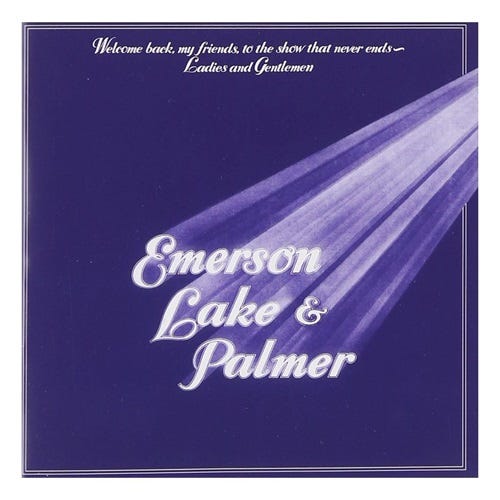
I have long claimed not to be a fan of progressive rock. I have said the same about Black Sabbath. Yet, my adolescent LP collection contained Emerson, Lake, and Palmer, Tarkus (Cotillion, 1971) and Pictures at an Exhibition (Cotillion, 1971), and, of course, Brain Salad Surgery (Manticore, 1973); King Crimson’s In the Court of the Crimson King (Atlantic, 1969) and Islands (Atlantic, 1971); the first four Black Sabbath albums; and Kansas’ Leftoverture (Kirshner, 1976) and The Point of No Return (Kirshner, 1977). So, the veracity of my claim is at best questionable and at worst, criminal.
Critics considered ELP a “supergroup” at the time because it comprised pedigreed musicians: keyboardist Keith Emerson, who did his fieldwork with the band Nice; bassist Greg Lake, late of King Crimson; and drummer Carl Palmer, who was coming from Atomic Rooster. From appearances, ELP looked like some kind of mod organ jazz combo (not unlike the Doors, who, bassless, were closer to the original). ELP’s hook was their interpretation of classical pieces like Aaron Copland’s “Hoedown” from the ballet Rodeo and “Toccata” adapted from Argentine composer Alberto Ginastera’s Piano Concerto No. 1. With this gloss of classicality, the band continued what Wendy Carlos began with Switched-On Bach (Columbia Masterworks, 1968) in electronically transforming the Western Canon using synthesizers.
Concerts from this period for the band were an exciting collision of the old and new, the traditional and avant-garde. Few experiences can match Emerson’s sonic assault introducing “Hoedown” — that octave span between low and high, like a sonic spotlight sweeping the Anaheim Convention Centre on February 10, 1974. The late baby boomer generation was being introduced to the new Janus-faced classical music. My graduate school friend, Dr. Bart Bradbury, considered this “composed music” just like that conceived by the 18th- and 19th-century masters, and who am I to judge?
The band cruised through their previous five studio albums with equal technical and cutting-edge aplomb, reaching a high point when delivering their “greatest hits” in “Take a Pebble,” “Still…You Turn Me On,” and “Lucky Man” in a lengthy suite between “Tarkus” and “Karn Evil 9,” which closes the concert. This phenomenon will never be recreated because people will never forget ELP and this music. Many will think they have, but none will.
And I share that summation. That and I had not discovered the blues.
Thanks for the memories of this Album.
Like you, not a HUGE fan of prog rock, but I like what I like, and "Welcome Back my Friends" was a great song growing up