


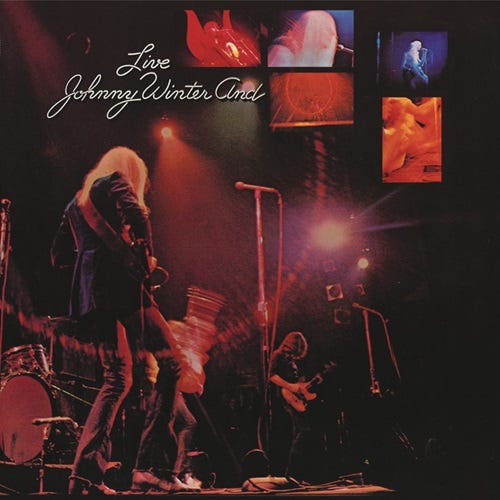
Poorly programmed rock live recordings plagued the 1970s. At the time, live recordings were considered the red-headed stepchild of discographies. Labels often cobbled these recordings together to fulfill contractual requirements, resulting in particularly poor recordings like Eagles Live (Asylum, 1980). Other times, the live recordings of the time suffered from the time constraints of the roughly 60-minute limit of long-playing records. Live Johnny Winter And (Columbia, 1971) suffered this latter deficiency while becoming one of Winter’s best-selling recordings at the same time.
Winter considered this release his least favorite, wincing whenever he heard it. When asked why, Winter explained he did not care for what he considered a “brittle sound” he attributed to playing through an Ampeg SVT bass amplifier during that tour1. To be sure, the sonics are not spectacular, even by the standards of the early 1970s. Even as a hormone-addled 13-year-old, I heard the uneven sonics and questionable material selection. But I also heard the most corrosive blues guitar of the period.
The original vinyl release included:
(Side 1)
“Good Morning Little Schoolgirl” (4:35)
“It’s My Own Fault” (12:14)
“Jumpin’ Jack Flash” (4:26)
(Side 2)
“Rock and Roll Medley”2 (6:46)
“Mean Town Blues” (8:59)
“Johnny B. Goode” (3:22)
Columbia Records recorded these songs during the fall of 1970 at the “Fillmore East in New York City and at Pirates World in Dania, Florida, without attributing at which venue each song was recorded or on what dates the recordings took place. That being said, strict accuracy was not at the top of the list when releasing live recordings in the early 1970s. This shoddy album programming was typical of live recordings from the period, so we, the trusting music-buying public, were none the wiser. We merrily purchased this album on its way to an RIAA “Gold” certification (500,000 units sold).
On April 20, 2010, Collectors’ Choice Music released Live at the Fillmore East 10/3/70, clearing up when the original recordings occurred and that they all derived from the Fillmore East performance. This release included:
“Guess I’ll Go Away” (4:39)
“Good Morning Little School Girl” (3:37)
“Rock and Roll, Hoochie Koo” (4:47)
“It’s My Own Fault” (22:24)
“Highway 61 Revisited” (7:31)
“Mean Town Blues” (18:07)
“Rollin’ and Tumblin’” (4:31)
While murky, evidence suggests that this was the actual setlist for the evening, begging the question of where “Jumpin’ Jack Flash,” “Johnny B. Goode,” and the lame “Rock and Roll Medley are, as these have long been and element in Winter’s shows from the period.
This reveals three things (1) “Guess I’ll Go Away,” “Rock and Roll, Hoochie Koo,” “Highway 61 Revisited,” and “Rollin’ and Tumblin’” were part of the original Fillmore East setlist but went unreleased, (2) “Jumpin’ Jack Flash,” “Johnny B. Goode,” and the “Rock and Roll Medley” were recorded at the Pirates World appearance, and (3) “It’s My Own Fault” and “Mean Town Blues” were dramatically shortened to be included on the original LP release (from 22:24 to 12:14 and from 18:07 to 8:59, respectively). This makes the release of Live at the Fillmore East 10/3/70 justified, but not the more recent release, Live at Fillmore East 1970 (Floating World Records, 2025), which mirrors Live at the Fillmore East 10/3/70 except reordered.
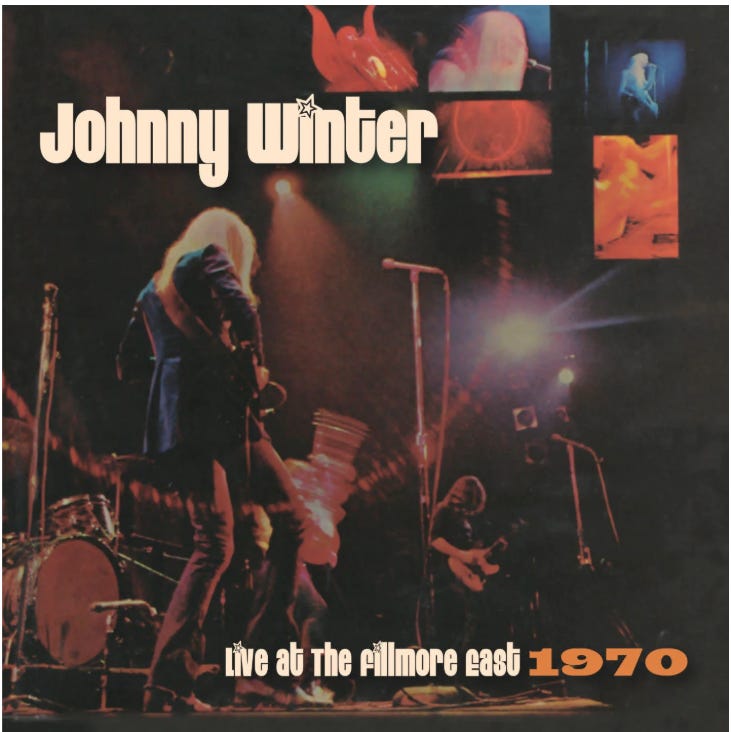
This qualifies Live Johnny Winter And to be considered as poorly released and followed up as was The Allman Brothers at Fillmore East (Capricorn, 1971). It is a travesty that Columbia Records can correct, and they should start by releasing the entire Fillmore concert in performance order.
As things stand presently, to own all the music released from these concerts, one must purchase both Live Johnny Winter And and either Live at the Fillmore East 10/3/70 or Live at the Fillmore East 10/3/70. That is sad. This is Winter’s landmark album. It is what it is.
“Jumpin’ Jack Flash” and “Johnny B. Goode” are the sonic sore thumbs of the original release, not because their sound is bad, but because they are mixed way better than the rest of the material. This is because their performances were recorded at the Florida show and engineered at Criteria Studios in Miami. These songs bear the mark of post-performance mixing. They are too perfect when compared to other recordings from the same period. They are ultimate versions (I cannot hear “Jumpin’ Jack Flash” any other way, and based on this performance alone, it is easy to consider Winter as the definitive Rolling Stones interpreter, just as Joe Cocker is for the Beatles). “Johnny B. Goode” is the bridge between Chuck Berry and Stevie Ray Vaughan.
When considering the performance of Bob Dylan’s “Highway 61 Revisited,” originally released on Second Winter (Columbia, 1969), Winter’s Fall 1970 recording can be compared to his definitive performance of the song found on 1976’s Captured Live! (Blue Thumb). The earlier performance is raw and real, while the mid-1970s performance smacks of more than a little post-production mixing, but remains a scintillating listening experience. Captured Live! also contains a lengthy slow blues, “Sweet Papa John,” which is simply “It’s My Own Fault” with different lyrics. Winter even uses the same blues filigree and arrangement on both songs. The 22 minutes of “It’s My Own Fault” is thrilling but reveals the creative tension that existed between Rick Derringer and Winter. Winter did not need a second guitarist as a foil, and Derringer had a better pop sensibility than a blues sensibility, which made the Fillmore performance unbalanced (and, therefore, ripe for shortening for LP release.
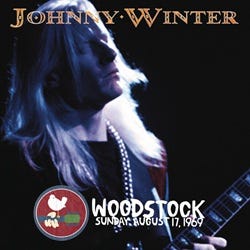
The revelation of these recordings is the uncut version of “Mean Town Blues,” its performance here bettering Winter’s performance a year earlier at Woodstock (Johnny Winter: Woodstock Sunday August 17, 1969 (Sony, 2019)). Like so many artists, Woodstock was the jumping-off point for several artists and the epoch of an era. Winter established “Mean Town Blues” as one of his slide guitar showcases, and this Fillmore East performance is searing. Coming full circle, Live! Johnny Winter And remains a deeply flawed release in its original LP form and in the subsequent releases of previously unreleased material. But it is all that we have available. As an unfinished torso, it remains an exception live recording by an important artist of the period.
Thompson, Art (December 2011). “Johnny Winter”. Guitar Player. Vol. 45, no. 14. pp. 59–64.
“Great Balls of Fire” — “Long Tall Sally” — “A Whole Lotta Shakin’ Goin’ On.”