


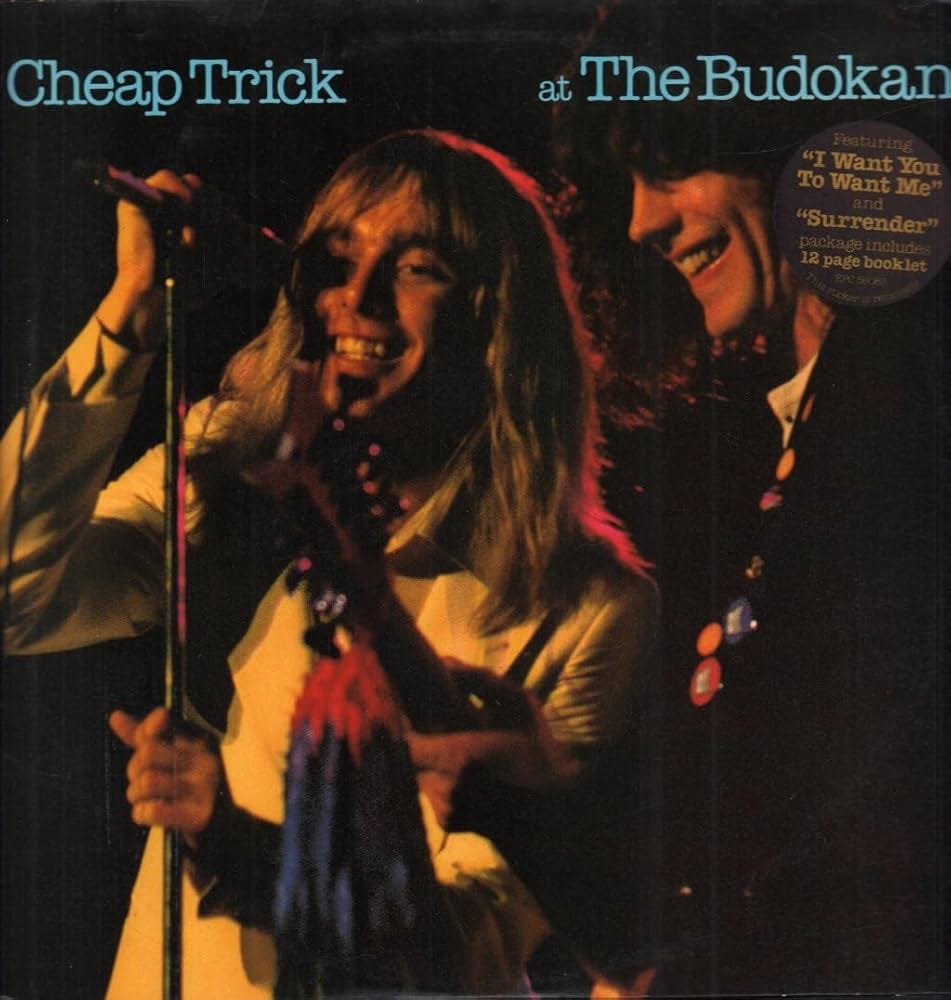
The definitive centerpiece of any serious study of live rock-and-roll history must confront a profound irony: Cheap Trick at Budokan (Epic, 1978) proved that a band does not need to take themselves seriously to make serious rock history. In an era when their rock peers wore humorless masks of dark mysticism or self-indulgent majesty, Cheap Trick weaponized pop-art satire, brilliant hooks, and a cartoonish stage dynamic. This visual presentation frequently misled Western critics into dismissing them as an insubstantial novelty act, a mere blip of fluff designed for screaming teens. Yet, the lightning captured on those Tokyo tapes pounded that narrative to dust. Beneath the laughter and the colorful aesthetics lay a hyper-disciplined, devastatingly heavy live unit that stripped away the polite, compressed production of their studio catalogs to reveal an undeniable sonic powerhouse.
The unfair perception that Cheap Trick lacked the gravity of other legendary live acts stems from a fundamental misunderstanding of their artistic subversion. Arena rock in 1978 featured the bloated, “golden” tropes of untouchable, leather-clad virtuosos. Cheap Trick completely deconstructed this ego by deliberately fracturing their image. They split the band down the middle: two gorgeous, archetypal pop stars juxtaposed against two bizarre, mismatched eccentrics. Because their music was incredibly catchy and their stage show looked like a comic book brought to life, rock purists mistook their humor for a lack of artistic substance. They missed the underlying truth that Cheap Trick was a ferocious, battle-hardened bar band that had spent years playing over 200 grueling dates annually. Budokan was the moment the world finally heard the muscle behind the melody, proving that joyful, unpretentious rock could out-shred, out-groove, and out-volume nearly any “serious” act of the decade.
The magic of the Budokan track list lies in how this live electricity completely reinvented studio tracks that had previously failed to gain commercial traction in America. “I Want You to Want Me,” originally buried in the over-polished, honky-tonk piano production of their In Color studio album, transformed under the Tokyo lights into an absolute arena masterpiece. Carried by the deafening, rhythmically perfect handclaps of the Japanese audience, the song gained a massive rock backbeat, turning a desperate pop plea into a triumphant, driving anthem. “Surrender” followed a similar trajectory, elevated by the live environment to a state of punk-adjacent urgency. The iconic opening riff took on a heavier, more distorted bite, capturing the band’s signature thematic paradox: a song celebrating teenage rebellion and eccentric parents, delivered with flawless pop precision but executed at a punishing, ear-shattering volume.
The album also allowed the band to showcase their deep musical range beyond standard three-minute pop singles. “Can’t Hold On,” a slow-burning blues-rock track that had primarily existed as an obscure B-side, served as the ultimate proof of their raw musical weight. It acted as a vital counterweight to the upbeat hits, allowing the band to stretch out, build slow, menacing tension, and display their roots in heavy British blues. This mastery of rock history culminated in their reimagining of the Fats Domino classic, “Ain’t That a Shame.” Cheap Trick completely stripped the song of its original 1950s rolling New Orleans piano, replacing it with a colossal, cascading guitar-and-drum introduction. They breathed vibrant, modern fire into early rhythm and blues, turning a vintage track into a stadium-sized hard-rock jam that effectively bridged rock’s past with the burgeoning heavy-metal future of the 1980s.
A large part of Budokan‘s charm is how the four radically different, free-spirited personalities meshed into a single, flawless unit on stage. Frontman Robin Zander, the iconic “Voice of America,” served as the majestic, blonde-haired rock anchor. His pristine, pin-up appearance contrasted brilliantly with a versatile voice that could shift seamlessly from a sweet pop croon to a throat-shredding, proto-grunge roar. Beside him stood Tom Petersson, the visual and sonic bridge of the group. As the pioneer of the 12-string bass guitar, Petersson generated a thick, roaring wall of sound. His revolutionary instrument covered both low-end rumble and mid-range rhythm guitar textures, freeing the band up to sound twice as massive as a typical four-piece rock outfit.
Yet, the indispensable engine room driving the Budokan sound was the highly unusual partnership between lead guitarist Rick Nielsen and drummer Bun E. Carlos. Nielsen acted as the band’s manic, cartoonish mastermind. His visual antics, reminiscent of an escaped patient in a flipped-up cap and checkerboard patterns pacing the stage, belied a terrifyingly heavy guitar style. On Budokan, his playing is relentlessly aggressive, driving every song forward with thick, overdriven power chords and lightning-fast solos that laid the groundwork for the next generation of pop-metal. Holding the entire chaotic spectacle together was Bun E. Carlos. Looking like an off-duty cop or an accountant, Carlos sat calmly behind his drum kit, smoking a cigarette in a short-sleeved button-down shirt. Behind this ordinary appearance was a heavy-rock clockwork machine. His drumming throughout the night was incredibly propulsive, thunderous, and steady, providing the rigid, punishing rhythm pockets that kept Nielsen’s chaotic guitar energy from flying off the rails. By leaning entirely into their eccentricities rather than hiding them, Cheap Trick created a live document that remains unparalleled. Live at Budokan did not succeed by copying the serious, pretentious rock formulas of its day—it succeeded because it blew them completely apart.
So many great memories of that record ! ❤️
Certainly a favourite of mine and Budokan perhaps brought back the “live” album as no longer being a throw-away part of a recording contract. As good as “I want you to want me is” , “Ain’t that a Shame” is the highlight. I don’t know if the band ever recovered to repeat the success of Budokan,