


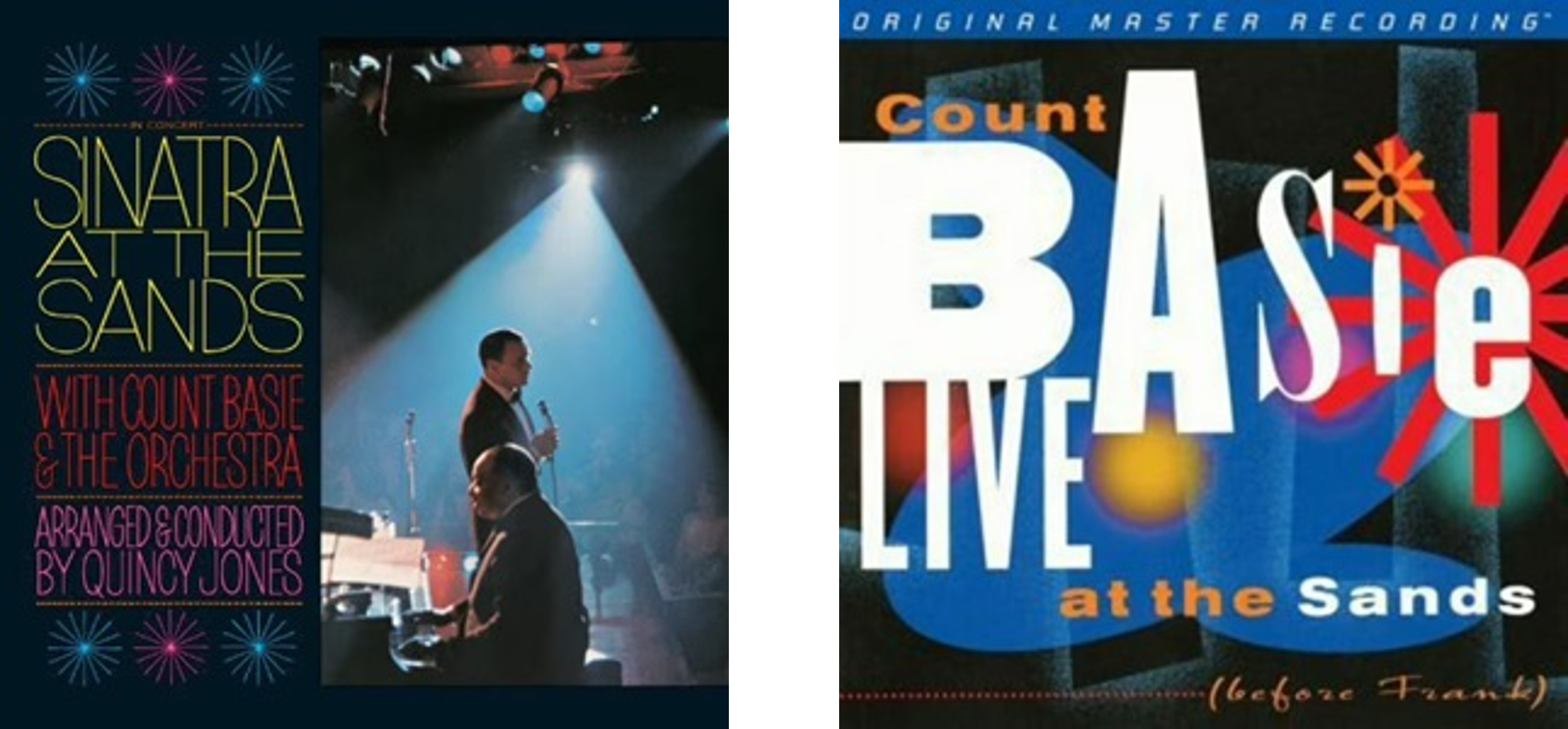
This entry in “The 100 Best Live Recordings” is a ringer.
Two albums. The venue is the same: The Copa Room, Sands Hotel and Casino.
Two concerts. The dates are the same: January 26–29 and February 1, 1966.
One band: The Count Basie Orchestra
One singer: Frank Sinatra.
The mid-1960s Las Vegas Strip was the epicenter of American entertainment, and no venue captured the period’s Zeitgeist quite like the Copa Room at the Sands Hotel and Casino. Over a seven-night stretch from January 26 to February 1, 1966, the stars aligned for a residency that became the gold standard of live big band music. Frank Sinatra, fresh off his 50th birthday, shared the stage with Count Basie and His Orchestra, all driven by the razor-sharp arrangements and conducting of a young Quincy Jones. The resulting recordings yielded two distinct sides of the same legendary coin: Sinatra’s first commercially released live album, Sinatra at the Sands (1966), and its archival companion piece, Live at the Sands (Before Frank) (released in 1998). Together, they represent the apex of the swinging mid-century modern aesthetic.
For Frank Sinatra, the 1966 Sands residency was a triumphant victory lap and a pivotal crossroads. Having established his own Reprise Records label to gain ultimate creative autonomy, he had weathered a few uneven studio years in the early ‘60s. The Sands recordings captured “The Chairman of the Board” at the absolute summit of his vocal control and cultural influence. The main album provided definitive live versions of classics like “Fly Me to the Moon” and “I’ve Got You Under My Skin” while sealing his persona as the ultimate ring-a-ding-ding host. Ironically, this peak marked the end of an era; just months later, Sinatra would pivot to the contemporary pop charts with “Strangers in the Night,” forever altering his musical trajectory.
However, when Sinatra took the Sands stage, a fundamentally different vehicle backed him compared to any other in his career. To truly understand the magic of this collaboration, you must weigh it against Sinatra’s studio partnerships with his other legendary orchestral architects: Nelson Riddle, Billy May, and Gordon Jenkins. Each of these arrangers shaped a distinct facet of Sinatra’s persona, but Basie brought a visceral, kinetic energy that none of the others could replicate.
Nelson Riddle was Sinatra’s definitive musical soulmate, operating with architectural precision and a profound understanding of psychological subtext. Riddle’s arrangements for landmark albums like In the Wee Small Hours (Capitol Records, 1955) used muted horns, weeping strings, and a signature walking bassline to create an intimate, interior world, framing Sinatra’s voice like a spotlight on a dark film noir set. Count Basie and His Orchestra did not build an interior world; they built a blues-fueled steamroller. Where Riddle used classical instrumentation and woodwinds to cushion Sinatra’s vocals, Basie brought a hard-driving, four-on-the-floor rhythm section that forced Sinatra to ride directly on top of the beat. With Basie, Sinatra wasn’t a lonely crooner—he was the swaggering leader of a nuclear jazz machine.
Sinatra’s other frequent collaborators operated on stylistic extremes that the Basie band masterfully bridged. Billy May was Sinatra’s go-to guy for uptempo, brassy bombast, famous for the roaring, saturated brass charts and theatrical punch of Come Fly with Me (Capitol Records, 1958). Basie’s swing, conversely, was effortless, relaxed, and deeply rooted in the Kansas City blues tradition, using an economical use of space—epitomized by Basie’s own minimalist, single-note piano fills—that gave the music a breathing room May’s dense arrangements lacked. On the opposite end of the spectrum sat Gordon Jenkins, the master of melancholy, who dressed Sinatra in lush, weeping string sections. Jenkins entirely avoided the blues-inflected jazz idiom, whereas the Basie Orchestra deliberately rejected cinematic sentimentality. Even on late-night ballads like “Angel Eyes” at the Sands, the Basie band maintained a muscular, midnight-blue grit that kept Sinatra firmly grounded in the lounge.
What makes the 1966 Sands recordings unique is that they represent a seamless hybrid of these worlds, engineered by Quincy Jones. Jones understood he could not simply throw Sinatra in front of a standard Basie jazz chart. He took the harmonic sophistication Sinatra had developed with Nelson Riddle and translated it into the visceral language of the Basie band. By keeping the band’s signature explosive brass shout-choruses while tailoring the dynamics so they never swallowed the vocals, Jones created a spectacular contrast. The tightest big band in jazz history played with the precision of a studio orchestra, executing charts that allowed Sinatra to be simultaneously the most relaxed and the most powerful he had ever been on stage.
For Count Basie, the engagement cemented the commercial resurgence of his “New Testament” band, which had formally signed to Reprise in the mid-1960s. The release of Live at the Sands (Before Frank) in 1998 rescued their instrumental brilliance from the vaults, and people widely recognized them as the hardest-swinging rhythm section in jazz. Recorded live-to-four-track by engineer Lowell Frank, these unburdened instrumental warm-up sets deliver pure big band dynamics. In the Neal Hefti composition “Splanky,” the performance showcases the rhythm section’s legendary economy. The track opens with Basie’s signature minimalist piano plinks, establishing a relaxed, deep-pocket groove before the ensemble enters, generating a massive swing without ever sounding forced. This controlled burn completely ignites on “Jumpin’ at the Woodside,” an uptempo resurrection of Basie’s late-1930s Kansas City roots. Driven by drummer Sonny Payne’s relentless hi-hat work and explosive fills, the band tears through the classic riff at a blistering pace, hitting its shout-choruses with terrifying precision to illustrate the unadulterated horsepower that primed the Copa Room.
When Sinatra takes the stage, this established momentum transforms his definitive hits into something entirely new. While he first recorded “Fly Me to the Moon (In Other Words)” with Basie in the studio two years prior, this live version completely eclipses it. Quincy Jones’s brisk, swinging arrangement strips away any remaining pop politeness from the tune, allowing Sinatra to ride directly on top of the driving rhythm section with absolute rhythmic freedom, turning a space-age love song into the ultimate anthem of mid-century swagger.
This rhythmic translation is even more apparent on “I’ve Got You Under My Skin,” which acts as a fascinating adaptation of Nelson Riddle’s iconic, slow-building 1956 studio arrangement. Jones retrofits it for the Basie machine; the track keeps its famous, volcanic trombone solo, but the razor-sharp Basie brass handles it here, amplifying the tension and kinetic energy into something far more muscular than its studio predecessor. Yet, explosive volume does not solely define the collaboration. The performance slows the Copa Room down to a whisper for the late-night saloon song, “Angel Eyes.” Accompanied primarily by Basie’s sparse, bluesy piano chords and Al McKibbon’s moody bassline, Sinatra delivers a smoky, deeply conversational vocal performance. The track beautifully shows the incredible range of the engagement, proving the Basie unit could pivot seamlessly from a roaring freight train to an intimate jazz combo in the blink of an eye.
The historical importance of the 1966 Sands recordings lies in their preservation of a cultural peak just before the landscape changed forever. Sinatra at the Sands and Live at the Sands (Before Frank) do not merely document a great concert; they mark the definitive end of the classic American pop era. Within months of these performances, the broader musical landscape shifted decisively toward rock and pop music. Sinatra himself pivoted to contemporary radio pop, and the traditional big band format receded from the commercial mainstream. The Sands tapes stand as the final, fully realized monument to a style of showbiz, swing, and sophisticated adult pop that would never hold the center of American culture in the same way again.
Because of this unique historical position, these paired documents demand a high-tier placement in any definitive ranking of live music. The primary Sinatra release routinely places near the very top of lists compiled by major music publications, frequently cited alongside legendary live achievements by artists like James Brown and B.B. King as one of the greatest vocal documents ever put to tape. When paired with the raw instrumental power of the Basie Orchestra’s archival sets, the combined package becomes an undeniable contender for a spot on a comprehensive live album list. It represents a flawless synthesis of jazz sophistication and pop stardom, capturing two masters at the absolute height of their powers, working with the best material of their careers.
The enduring legacy of the Sands recordings is their ability to fully transport the listener. While studio albums offer a pristine, controlled environment, these live tapes capture a living, breathing ecosystem. The clinking glasses (you can almost smell the single malt), the spontaneous laughter, the roar of the brass, and the effortless confidence of Sinatra and Basie together create an immersive time capsule. As an entry in a top 100 live album feature, this collection stands as the ultimate testament to the power of live performance, proving that when the right venue, the right material, and the right musicians collide, the result is an untouchable piece of cultural history.

❤️ !!