


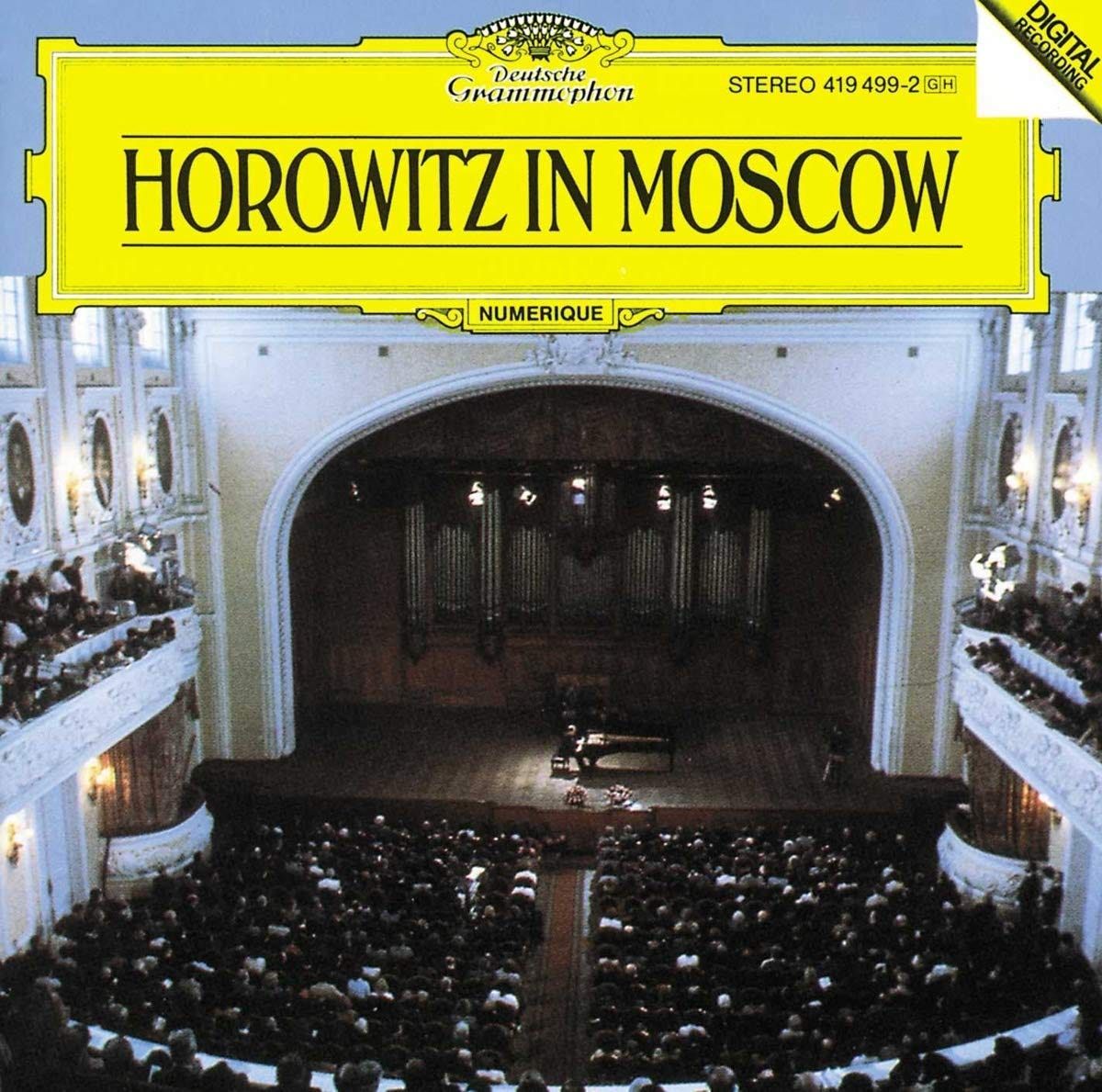
In the grainy video posted on YouTube, it’s not what you see first, it’s what you hear…a cacophonous crowd filling the Great Hall of the Moscow Conservatory. A slight, elderly man in a bowtie makes his way onto the stage. He walks to his Steinway & Sons grand piano—shipped from his home in New York City to Moscow under American military guard—and stands before the capacity crowd, many who had been up all night to get their seats. The sound was fit for a soccer match (albeit a polite one). It is Sunday, April 20, 1986. It was a cold, damp early spring day. Those attendees outside wore winter clothes. There was nothing but warmth in the performance hall. For the first time in 61 years, Vladimir Horowitz was home.
In the small confines of the twentieth century, Vladimir Horowitz (1903–1989) occupies a distinct position as a prominent representative of the late 19th-century Russian Romantic tradition. More than that, he was the pianist of two generations while being a once in an epoch artistic talent…of any type. His artistic development occurred in a pre-revolutionary landscape; at age ten, his performance for Alexander Scriabin had a certain predictive charm. Geopolitics altered his trajectory. Following the expropriation of his family’s wealth during the 1917 Bolshevik Revolution, the teenage pianist endlessly toured the early Soviet landscape to feed his family. So much for that great collective dream. Trotsky and Lenin may have started the process, but Stalin was undeniably history's greatest bad guy. Thinking in those terms, Ayn Rand may have been right all along.
In 1925, Horowitz left the Soviet Union ostensibly to study in the West. This act initiated six decades of self-imposed exile, during which he established a career in Europe and the United States, securing American citizenship in 1944. His performing style—characterized by technical velocity, flat-fingered hand mechanics that produced powerful double-fortissimos, and a wide dynamic range—established him as a global cultural figure. He married Wanda Toscanini, daughter of the conductor Arturo Toscanini, navigating a career marked by critical acclaim but punctuated by clinical depression and stage fright, which led to four separate, extended retirements.
By the spring of 1986, and three full years before the Soviet system’s demise, the 82-year-old pianist had not set foot in his homeland for over six decades. A shift in geopolitics: the cultural exchange agreements emerging from the Geneva Summit between US President Ronald Reagan and Soviet General Secretary Mikhail Gorbachev facilitated his return. Horowitz’s public motivation was personal,
“Before I die, I want to see the land where I was born”
But the broader implications of his early spring recital at the Great Hall of the Moscow Conservatory were diplomatic.
The performance functioned as a visible, televised soft-power bridge between two superpowers during the late Cold War. While the official audience was strictly curated—comprising the Soviet political elite and diplomatic corps—the cultural significance incited a populist response outside the performance hall, as local music students crashed security, securing standing-room access within the hall’s aisles.
Musically, the recital served as a critical rehabilitation of Horowitz’s artistic reputation. His preceding 1983 international tours of Tokyo and Europe had been critical failures, compromised by over-medication and alcohol, which manifested as memory lapses and technical instability. Horowitz in Moscow marked an aesthetic renaissance. The New York Times observed he played with a “clarity and dynamic range... he had not matched in many years,” analyzing the performance as a triumph of elder-statesman stamina1.
A key factor in the acoustic success of the recital was the transport of Horowitz’s customized personal Steinway piano from New York to Moscow, ensuring his specific sonic palette remained intact. Soviet musical scholar Aleksei Batashev characterized the resulting sound as “fantastic, as if from another world.”
The performance was like Horowitz’s previous ones; The recital opened with a triptych of keyboard sonatas by Domenico Scarlatti—specifically the Sonata in B minor (K. 87 / L. 33), the Sonata in E major (K. 380 / L. 23), and the Sonata in E major (K. 135 / L. 224). Though the standard commercial LP release by Deutsche Grammophon condensed this opening set to only feature the K. 380 sonata, the complete live performance documented Horowitz’s delicate sensitivity and unexpected tonal shifts across all three Baroque works, beautifully transfigured by his deeply Romantic hand.
Remaining chronological in his programing, the pianist presented Wolfgang Amadeus Mozart’s Piano Sonata No. 10 in C major, K. 330, executed with a classical transparency tempered with Romanticism that provided a structural contrast to the core of the afternoon. The center of the recital arrived when Horowitz addressed the works of his fellow Russians, Sergei Rachmaninoff and Aleksandr Scriabin. Horowitz knew both men, a fact that contributed to his core understanding of their music. Through Rachmaninoff’s Prelude in G major and the Prelude in G-sharp minor, paired with Scriabin’s Etude in C-sharp minor and the Etude in D-sharp minor, Horowitz re-established a connection to his native lineage. This was an exercise in stylistic transmission; he was communicating a historically specific interpretive vernacular to an audience attuned to its cultural memory but having been subjected to something less for years.
While the more conservative critics took issue with Horowitz’s late-Romantic liberties—such as agogic distortions of tempo and the unauthorized doubling of bass octaves—contemporary reviews agreed that these interpretive choices served a distinct artistic purpose. Reviewers emphasized that on this “home territory,” Horowitz transcended mere textual fidelity. His performance functioned as a mechanism of cultural reconciliation, deploying a shared musical heritage during a period of catastrophically irrational ideological hostility. [1, 2, 3]
The program shifted to Western European Romanticism, incorporating Franz Schubert’s Soirées de Vienne: Valse-Caprice No. 6 (as transcribed by Liszt), Liszt’s Sonetto 104 del Petrarca, and two works by Frédéric Chopin: the Mazurka No. 21 in C-sharp minor and Mazurka No. 7 in F minor. [1, 2]
The definitive cultural moment of the performance occurred during the first encore: Robert Schumann’s “Träumerei” from Kinderszenen. Horowitz rendered this miniature with achingly nuanced lyricism. As the microphones captured the silence of the Great Hall, television cameras famously captured the tear-streaked faces of the Soviet audience. This moment of shared catharsis became an iconic media artifact of the late 20th century. American commentator Andy Rooney later noted the cross-cultural semiotics of the broadcast, writing:
“The television camera left Horowitz’s fingers... and dissolved to the face of a Soviet citizen in the audience. He did not look like the enemy... one lone teardrop ran down his cheek. It was the same teardrop running down mine.”
Horowitz concluded the recital with two virtuoso display pieces: Moritz Moszkowski’s Morceau caractéristique (“Étincelles”) and Rachmaninoff’s Polka de W.R., bringing the event to a close.
As a commercial audio document, the Deutsche Grammophon release remains a monument of live acoustic engineering. It successfully preserves the dialogue between the precise registration of Horowitz’s piano and the resonant properties of the Great Hall. In the United States, Vladimir Horowitz's 1986 concert in Moscow was first televised on the network CBS as a special presentation on the morning news program CBS News Sunday Morning, hosted empathically by Charles Kuralt. While the performance aired live/delayed in the U.S. on CBS, it was simultaneously broadcast to international audiences through major television networks throughout Europe and Asia. This grainy video lends a spiritual mystique to the event. Exactly the way to remember it.
I was visiting my parents, away from graduate school, the morning of the televised performance. It was a good time in my life, a time too easily taken for granted. I watched the performance, holding my breath. I was already familiar with Horowitz’s Baroque and Classical repertoire: Horowitz Plays Clementi (RCA Victor, 1954); Horowitz Plays Scarlatti (Columbia Masterworks, 1965); Horowitz at the Met (RCA Red Seal Records, 1982); and his untethered recordings of Haydn’s Sonata No. 62 in E-flat major, Hob. XVI:52; Mozart’s Piano Sonata No. 11 in A major, K. 331 and Piano Sonata No. 10 in C major, K. 33, and Beethoven piano sonatas. But I was unprepared for the outpouring of love Moscow had for Horowitz and Horowitz for Moscow. No matter the geopolitical context of this concert, it is the spiritual and cultural circumstances of a child returning to his home that rule. Horowitz in Moscow remains one of my favorite recordings.
Taubman, Philip. “For Horowitz in Moscow, Bravos and Tears.” Nytimes.com. The New York Times, April 21, 1986. https://www.nytimes.com/1986/04/21/arts/for-horowitz-in-moscow-bravos-and-tears.html?eafs_enabled=false.
❤️