


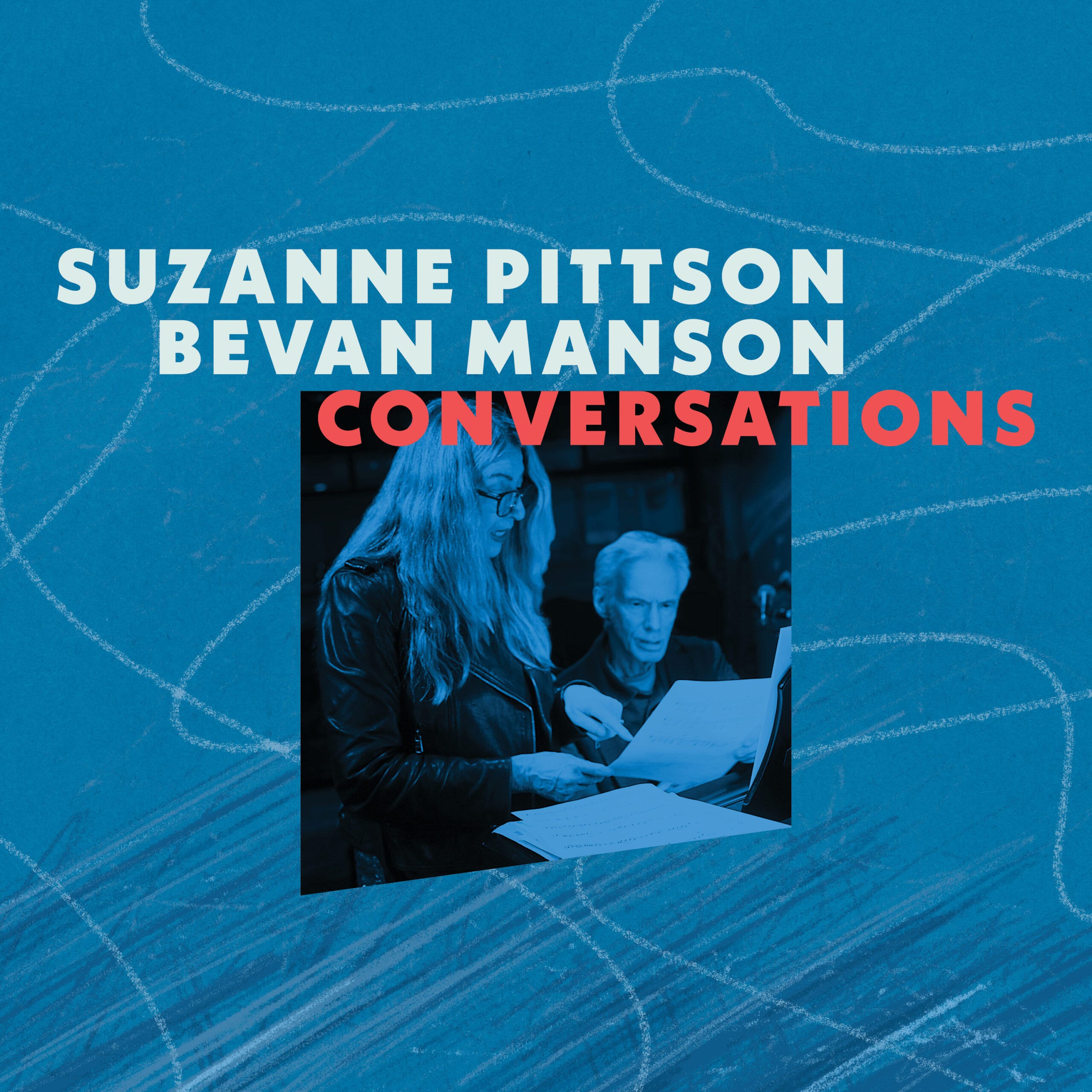
The release of vocalist Suzanne Pittson and pianist Bevan Manson’s Conversations is a significant archival project emerging from world of vocal jazz. Recorded in 2002, this session presents four duo performances alongside an orchestral finale, bridging a twenty-four-year gap between its conception and this presentation. It manifests from a creative patience resolving to this recording after an extended hiatus. Both artists bring significant experience to the project.
Raised in a musical family, Suzanne Pittson began her career as a classical pianist, earning her degrees from San Francisco State University before shifting to jazz vocals. She developed a reputation as a scat vocalist capable of navigating complex bop melodies with instrumental precision on albums like Blues and the Abstract Truth (Vineland Records, 1995) and Resolution (Vineland Records, 1999). After serving as the Co-director of Jazz Studies at The City College of New York, her performing career was paused for over a decade by vocal health struggles, making this release a notable return.
Pittson’s partner on the session, pianist, composer, and arranger Bevan Manson, is an alumnus of the Eastman School of Music who operates between jazz and classical styles. His career includes directing UC Jazz at UC Berkeley, teaching at the New England Conservatory, and working in the Los Angeles film and television industry, where he focused on structured rhythms and varied orchestrations.
The duo tracks of Conversations were captured using chord charts, focusing on the musical interplay between the two artists. However, the album’s closing track, “Out of the Hub,” which is a lyrical adaptation of Freddie Hubbard’s instrumental piece “One of Another Kind1,” required a longer production timeline. Manson composed a forty-two-piece symphonic arrangement for the track in 2009. Because of financial constraints, scheduling factors, and Pittson’s subsequent vocal health issues, the multi-track files remained unmixed.
The process of finishing the music began when Evan Pittson, Suzanne’s son, located the original ProTools files. He edited the raw takes, finding an unutilized piano solo by Manson from the original sessions. In 2023, Pittson and Manson returned to the project, recording the forty-two-piece orchestra at Conway Recording Studios in Hollywood, tracking final vocal parts in New York, and integrating remote instrumentals from New Mexico.
Because this release is structured as an extended play EP, its concise tracklist emphasizes its archival nature. The format focuses entirely on the core chemistry between Pittson and Manson rather than a standard studio rollout. This design creates a trajectory that moves from duo interaction to a larger symphonic setting, establishing a contrast between the minimalist tracks and the finale.
On the duo tracks, the absence of a rhythm section leaves Pittson and Manson working without a traditional anchor. This open landscape places weight on every breath and chord voicing. Manson’s piano covers multiple roles, moving between walking bass lines and harmonic shifts, while Pittson uses her voice like an instrument, matching Manson’s chord substitutions with precise intonation, percussive, and conversational phrasing.
This vocal-instrumental approach is established on the opening track, “Like a Byrd,” an adaptation of Freddie Hubbard’s blues “Byrd Like2” Pittson navigates the rapid bop changes with speed and clear diction. Her vocalese lyrics transition into a multi-octave scat solo where her phrases connect with horn-like flexibility, matching Manson’s fast runs across the keyboard. The duo shifts from this uptempo opener to Cole Porter’s ballad, “After You.” Here, the mood becomes understated, allowing the melody space while Manson frames the voice in dark harmonic shifts.
The technical focus returns on Charlie Parker’s “Confirmation.” Pittson navigates Parker’s chord changes by locking her scat singing directly onto Manson’s left-hand walking bass line. Their trading of phrases functions as a direct dialogue, utilizing the lack of a drum kit to alter time and rhythm fluidly. They bring a similar focus to the second ballad, I’m a Fool to Want You. Stripping away the standard melancholy of classic arrangements, Pittson delivers a direct vocal performance, while Manson’s accompaniment provides a structured foundation beneath her higher register.
The final track, “Out of the Hub,” alters this minimalist setting by introducing a dense, third-stream arrangement. Rather than overshadowing the vocal line, Manson’s forty-two-piece orchestration acts as an expansion of the narrative, with the brass and woodwinds echoing the bop lines while the strings provide a steady harmonic floor. During this performance, Pittson scats a solo in unison with her own synthesizer keyboard lines. This final piece transitions the project from a private duo performance into a large-scale symphonic work, illustrating Pittson’s stylistic range and completing the archival presentation of these session.
The perfomances Conversations are outstanding. Pittson’s scat/vocalese chops are impressive and Manson’s punctiliously percussive pianism make for exceptional listening.
From Hubbard’s One Of A Kind (Arkadia Records, 2009).
Fron Hubbard’s Ready for Freddie (Blue Note Records, 1962). This piece was composed for trumpeter Donald Byrd.