


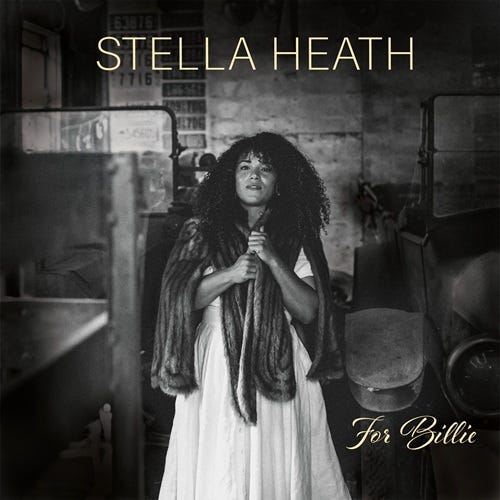
In a single year, jazz vocals experienced an impressive dual resurgence of Billie Holiday’s legacy, capped off by the release of Stella Heath’s For Billie. Arriving hot on the heels of Kandace Springs’ symphonic tribute, Lady in Satin (SRP Records, 2025), Heath’s album offers a striking counter-narrative to how we remember Lady Day. While Springs honors the heavy, heartbreaking twilight of Holiday’s final years, Heath takes us back to the beginning, capturing the crackling vitality of a young artist at the height of her powers. Together, these two records form a compelling dialogue between the concert hall and the nightclub—a dialogue written not just in the arrangements, but in the very vocal fabric of the performances.
To understand the vibrant energy of For Billie, one must consider Stella Heath’s deep roots in historical storytelling. Based in Northern California’s San Francisco Bay Area, Heath began her musical journey with classical voice and theater before immersing herself in the regional gypsy swing scene. As a bandleader, she developed a reputation for immersive, narrative-driven concept shows that celebrate legendary musical icons. Beyond the stage, Heath shapes the future of the genre as the Education Coordinator for the Healdsburg Jazz Festival, bringing jazz history into public schools. For Billie is the natural evolution of this historical devotion, born out of her years touring The Billie Holiday Project.
A fundamental difference between these two recordings lies in the eras they choose to spotlight, creating two entirely separate sonic worlds. Kandace Springs delivers a lavish, song-for-song recreation of Holiday’s penultimate 1958 album. Backed by the sweeping grandeur of the 60-piece Orquestra Clássica de Espinho, Springs filters the original album’s historic heartbreak through a lens of modern, lush symphonic romance.
Heath steps into a time machine set for the 1930s and 1940s. Rejecting orchestral gravity, she builds her tribute around a tight acoustic jazz quintet. Backed by a swinging rhythm section, piano, tenor sax, cornet, and clarinet, Heath recreates the smoky, conversational intimacy of a mid-century jazz club. Where Springs presents a monumental gala performance, Heath delivers an immediate, spontaneous jam session.
These contrasting frameworks directly shape how each vocalist uses her instrument. Because a massive orchestra frames Springs, her vocal approach requires a smooth, sustained legato to float over the dense waves of strings. She deliberately avoids duplicating the raspy, frayed delivery of Holiday’s twilight years. Instead, she delivers a technically flawless performance marked by a rich, velvety tone and a deep, soul-infused control that polishes the raw agony of the original tracks into a smooth, romantic meditation. Springs leans heavily into her lower register, using long, weeping vocal lines and a dark, resonant vibrato to anchor the cinematic weight.
Heath’s vocal performance relies on the agility and rhythmic spontaneity required by a small jazz combo. Rather than singing over her band, Heath sings with them, treating her voice like a nimble horn instrument. Her tone is crisp, bright, and lighter than Springs’, allowing her to navigate rapid tempos. Heath masters Holiday’s signature micro-phrasing—the art of singing just behind the beat—without ever falling into a caricature of Lady Day’s distinct nasal placement. On torch songs like “Good Morning Heartache,” Heath approaches the blues with a conversational intimacy, using subtle pitch inflections, bends, and delicate volume shifts to convey a shared a confidence with her audience.
This split in vocal technique dictates two different track lists. Springs binds herself strictly to the melancholic, down-tempo torch songs of the 1958 Columbia LP, guiding the listener through somber masterworks like “You’ve Changed” and “I’m a Fool to Want You.” Her vocal release remains strictly bound to the slow, stately, and dramatic tempos dictated by a symphonic conductor’s baton.
Heath frees herself from a single album structure, curating a career-spanning 12-track program that highlights Holiday’s versatility. Her track list balances standard ballads with infectious, uptempo swing numbers like “What a Little Moonlight Can Do” and “Now Baby, or Never.” Here, Heath displays a buoyant, athletic vocal bounce. She darts between the staccato stabs of the horn section, displaying a joyful, improvisational freedom that finds no counterpart in Springs’ gravitas.
These concurrent releases offer a beautiful study in contrasts. Kandace Springs uses her vocal prowess to craft a beautiful, respectful eulogy to a fading star. Stella Heath’s For Billie provides the necessary, joyful antidote. She uses her theatrical and jazz sensibilities to channel the sharp, improvisational wit of an artist in her prime—reminding us of the courageous young woman who altered the course of American music with nothing more than a microphone, a small swing band, and a gardenia in her hair.
