

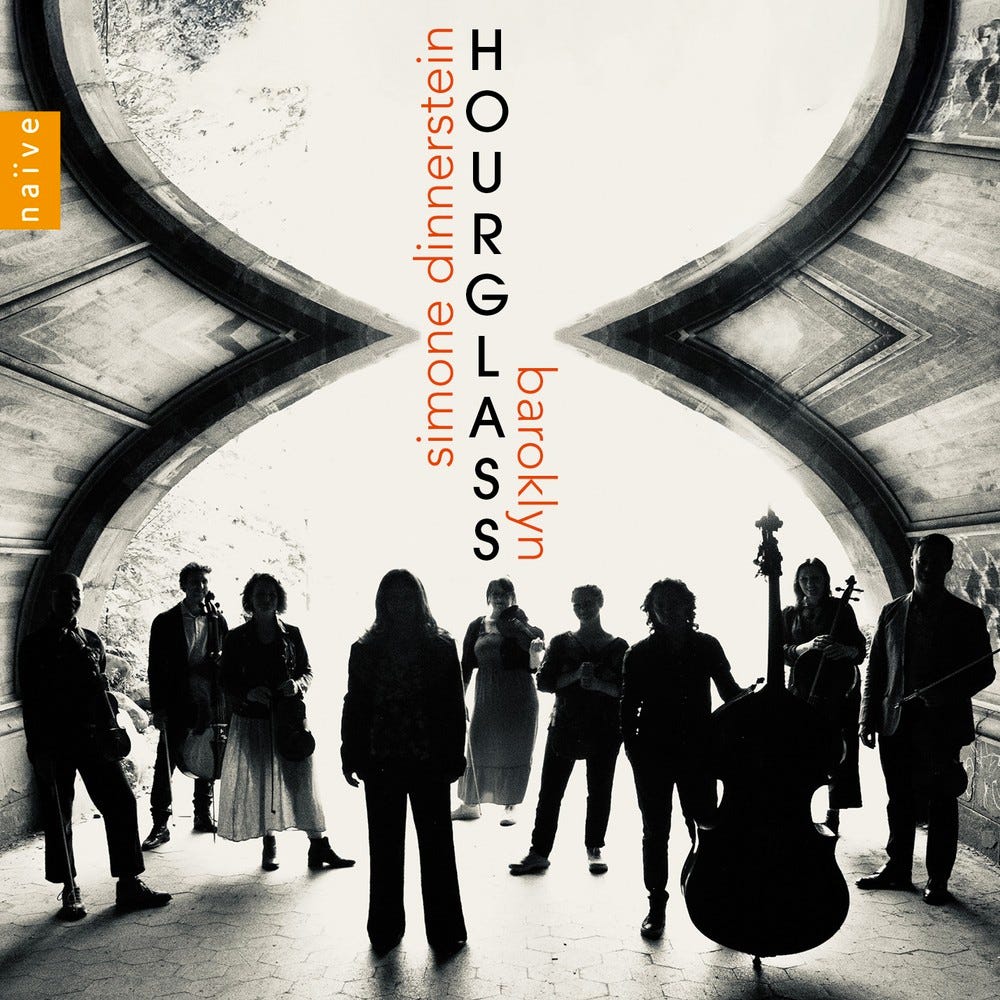
The relationship between pianist Simone Dinnerstein and composer Philip Glass is one of contemporary classical music’s most symbiotic artistic partnerships. On Hourglass—her debut release for Naïve Records and her first all-Glass studio album—Dinnerstein and her handpicked chamber string orchestra, Ensemble Baroklyn, deliver an organic, polyphonic exploration of the composer’s landmark works. Featuring the symphonic Suite from The Hours (arranged by Michael Riesman) and the hypnotic Tirol Concerto, the recording challenges the traditionally mechanical approach to minimalism. Instead, it prioritizes a fluid, horizontal lyricism that mirrors the textures of J.S. Bach—the foundational pillar of both Dinnerstein’s career and Baroklyn’s artistic identity.
Dinnerstein shouldered her way to international fame in 2007 with her self-financed, critically acclaimed recording of Bach’s Goldberg Variations (Telarc), establishing herself as a unique, deeply expressive voice. She has since bridged the gap between the Baroque era and modern masterworks through conceptually driven, chart-topping collaborations. To expand this vision, she founded and directed Ensemble Baroklyn, a group of independent-minded chamber musicians whose name conflates her home borough with the musical sensibilities of Bach. Before tackling minimalism, the ensemble solidified its reputation with its 2025 debut album, Complicité (Supertrain Records), which featured Dinnerstein’s own arrangements of Bach arias and keyboard concertos. On Hourglass, Baroklyn carries this same Baroque-trained ear into Glass’s multi-layered scores, allowing each independent voice a distinct ebb and flow.
This artistic alliance stems from a close professional and personal relationship that began over a breakfast meeting in Glass’s garden. Bonded by a mutual obsession with the horizontal, circular architecture of Bach, Glass recognized Dinnerstein as a supreme conduit for his keyboard music and composed his Piano Concerto No. 3 (2017) specifically for her. Dinnerstein toured the custom work extensively before releasing its world-premiere recording on her 2018 album, Circles (Orange Mountain Music), naturally paired with a Bach keyboard concerto. Hourglass marks the next logical chapter of this alliance, contextualizing Glass’s catalog through the romantic lens of his favorite contemporary champion.
Structurally, the Suite from The Hours mirrors a traditional three-movement symphonic arc. The first movement introduces thematic contrast like a classical sonata exposition, pairing the distinct melodies of “The Poet Acts” and “Morning Passages.” The music then flows into a seamless, developmental second movement that stitches together cinematic motifs before cycling back to the driving rhythms of the opening for closure. Dinnerstein alters this structure by slowing the tempos well past their original film iterations, allowing the unique timbre of the arrangement to bloom. High-register harp and celesta inject a shimmering, spectral brightness over the ensemble, while the strings split into independent voices. Crucially, the double bass breaks away from the cellos to follow its own contour, adding profound depth to the lower frequencies.
The Tirol Concerto anchors the album with a more expansive, Neo-Baroque structural framework. Its outer movements rely on driving, Bach-like rhythms, but the second movement serves as a monumental elegy structured around a cyclical theme and variations. Glass builds intricate metric polyphony into this framework, forcing the pianist’s hands to play in conflicting groups of twos and threes against the orchestra. Timbrally, Dinnerstein subverts the dry, percussive touch typical of early minimalism. She coaxes a crystalline tone from the piano that sounds like light refracting through water, before letting it sink into dark, heavy dissonances. Instead of positioning the piano as a dominant solo instrument, she embeds its timbre directly into the warm, vibrato-rich texture of the strings. The result is a seamless, multi-linear tapestry where the piano and orchestra breathe as a single organism.
The critical reception of Hourglass centered heavily on this radical manipulation of tempo, sparking a vibrant dialogue across the classical music world. By rejecting the fast, metronomic speeds traditionally associated with minimalism, Dinnerstein’s slower interpretive choices transformed how Glass’s music is perceived, earning widespread acclaim for its emotional and structural impact. Critics noted that the expanded pacing serves an intensely emotional purpose. Music writers have hailed the album as a new paradigm, asserting that it establishes a fresh benchmark for performing Glass—not mechanically, but as an organic human creation unfolding in real time. Reviewers felt the slower pulse allowed the music to mimic sand shifting naturally through glass rather than being chopped into rigid segments.
This glacial, deliberate pacing found its ultimate expression in the massive, seventeen-minute central movement of the Tirol Concerto. While a few traditionalist critics expressed minor reservations, noting that Dinnerstein occasionally applied more elastic rubato than some purists might prefer, they ultimately conceded that this manipulation of time enhanced the music’s natural ebb and flow while imparting a vital, expressive intensity to the overall recording.
Hourglass stands as a transformative reimagining of Philip Glass’s music, proving that minimalist repetition can be profoundly human rather than merely mechanical. By interweaving the architectural depth of the Tirol Concerto with the cinematic lyricism of the Suite from The Hours, Dinnerstein and Baroklyn dismantle the traditional barriers of rigid time. Their choice to embrace slower, fluid tempos allows the music’s intricate structures to breathe, while their warm, crystalline timbres elevate the emotional stakes to a spiritual plane. In doing so, the recording transcends typical performance practice, offering a definitive, elastic interpretation that reveals the organic poetry, warmth, and enduring mystery hidden within Glass’s cyclical patterns.