


Jazz history is often characterized through its purists, but its boundaries have always been expanded by its iconoclasts. Noted among these boundary-pushers was Chicago-born saxophonist Eddie Harris (1934–1996), a conservatory-trained musician whose experimental nature refused to follow the often rigid formulas associated with such education. Coming of creative age in the 1960s, Harris was blessed with a fertile imagination and exceptional technical skill, famously mastering the challenging altissimo register of the tenor saxophone. He experienced success early with his 1961 recording of “Exodus” from Exodus to Jazz (Vee Jay Records). Rather than coasting on his early laurels, Harris used his platform to mount a campaign of creative reinvention, pioneering jazz-funk and electronic fusion. He plugged his horn into a Varitone amplifier to electrify his sound and co-created the landmark, groove-driven 1969 live album Swiss Movement (Atlantic Records, 1969) with the equally iconoclastic Les McCann. Often underrated by more conservative critics, Harris authored undeniable standards like “Freedom Jazz Dance” and “Cold Duck Time,” leaving an imprint that bridges hard bop and modern hip-hop sampling. It is worth seeing Harris and McCann in action:

While Harris may be the subject of this story, he is not the protagonist. Stepping into this electrifying lineage is tenor saxophonist, composer, and EWI (Electronic Wind Instrument) player Seamus Blake. Recognized as one of the finest contemporary voices on his instrument, Blake first garnered critical acclaim by winning the Thelonious Monk International Jazz Saxophone Competition in 2002. Since then, Blake has established a reputation for a warm, commanding tone and an expansive vocabulary that synthesizes mainstream jazz, rock, and groove styles across acclaimed sessions like The Call (Criss Cross, 1994) and Bellwether (Criss Cross, 2009). His versatility is so pronounced and his grasp of his material so commanding, Blake has drawn the attention of audiences outside the jazz world, most notably serving as the featured saxophonist for Roger Waters’ touring band.
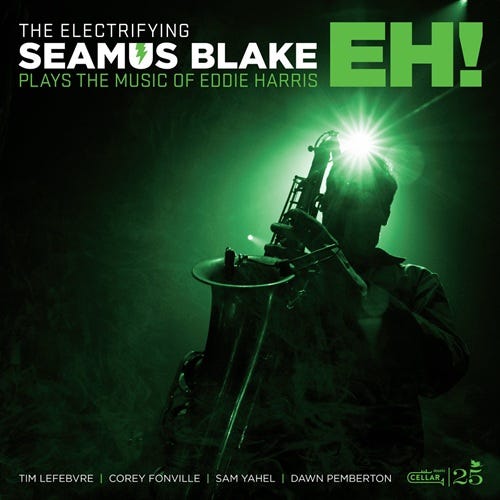
Blake’s decision to record EH! The Electrifying Seamus Blake Plays the Music of Eddie Harris for Cory Weeds’ Cellar Music Group stems from a lifelong admiration of Harris. Blown away by Harris’s visceral grooves and complex harmonic underpinnings, Blake uses his own arsenal of EWI, vocal processing, and pedal effects to treat the material as a living, breathing language, allowing the sound to expand and evolve. Blake assembled a powerhouse, groove-heavy lineup featuring organist Sam Yahel, electric bassist Tim Lefebvre, and drummer Corey Fonville. They are a twenty-first-century organ quartet if there ever was one.
The success of the album relies the telepathic synergy of this high-voltage engine room. Yahel and Lefebvre craft a fascinating rhythm engine. Instead of competing for low-frequency acreage, Lefebvre—famed for his work with David Bowie—anchors the music with a heavy, deeply centered electric bassline. This foundation liberates Yahel, allowing him to use his Hammond B3 and analog synthesizers to paint vivid harmonic textures and swirl cosmic colors around Blake’s horn lines. When this matrix links with Fonville’s crisp, linear drumming, the trio creates an elastic continuum that honors Harris’s boogaloo roots while pushing the music forward.
This dynamic is immediately apparent: “Compared to What” serves as the explosive opening statement; Blake reframes this familiar protest classic by placing guest vocalist Dawn Pemberton at the emotional center. While lacking McCann’s cannabinoid punch, Pemberton’s fire injects a raw energy into a relentless groove. Wrapped in a modern, envelope-filtered horn texture, the arrangement proves the song’s political urgency rings just as true today as it did in the 1960s. “Listen Here” shifts the vibe into quintessential “electric grease” Harris. This track is structurally direct, bluesy, and funky. Blake’s primary triumph here is his utilization of the EWI, which he layers to mimic a massive, fully synthesized saxophone section. Paired with Yahel’s vintage Hammond B3 accents, the performance navigates the line between deep pocket-groove and adventurous electronic dialogue.
EH! is more than a nostalgic look backward; it is a vital continuation of a fearless musical philosophy. Seamus Blake does not merely mimic Harris’s notes. Instead, he embodies his restless, boundary-pushing spirit, proving that jazz-funk and electronic fusion remain fertile ground for profound creative expression. Backed by an exceptional rhythm section, Blake breathes electric new life into timeless blueprints. The record stands as a triumphant success, honoring an iconoclast of the past while firmly positioning his music in the 21st century.
Just gifted EH Medley on Bandcamp ( anything with Freedom Jazz Dance lures me right in) Warm and joyful music. Thank you!