


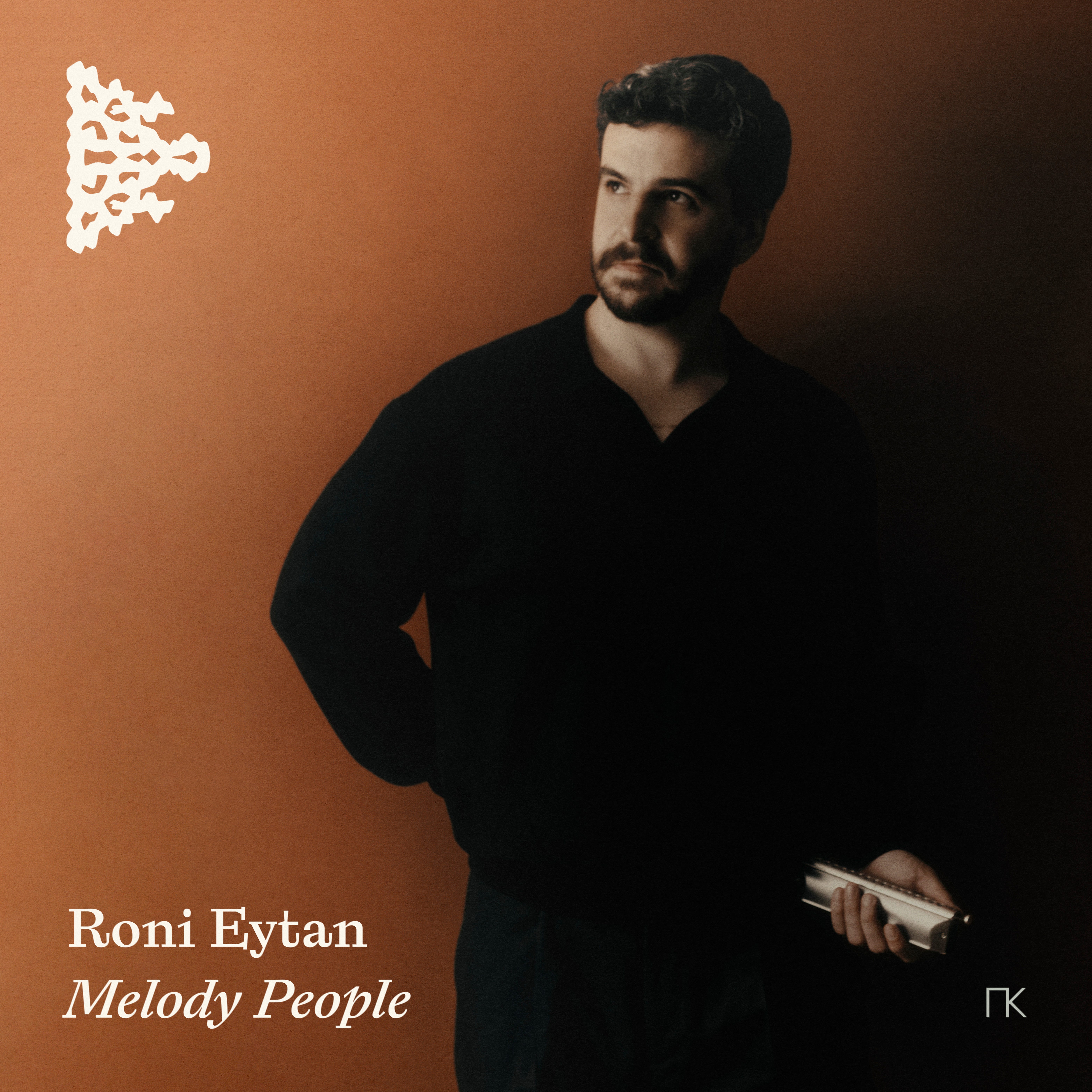
Rarely enough to make it an event, a debut record comes along that makes you sit up, lean in, and realize you are listening to someone who has already put in the long, quiet years of woodshedding on a sound so startlingly new that the listener must put it aside to give it proper consideration. That is exactly the feeling running through Roni Eytan’s new album, Melody People, released on the PKmusik label. Eytan is a Jerusalem-raised, Brooklyn-based harmonica player who doesn’t just play his instrument; he seems to breathe his whole life story right through it.
The humble mouth organ. From its lofty origins in early 19th-century Germany, reputably invented by Christian Friedrich Ludwig Buschmann (who is also thought to have invented the accordion) through its perfection by Trossingen clockmaker Matthias Hohner, the instrument jumped the pond, finding its integral place with the American Ur-music, the blues. But this was not the end of the instrument in the realms of classical music (played by brothers Jerry and Larry Adler) and jazz (most notably by Toots Thielemans, and later by War’s Lee Oskar and Dutch mouth organist Hendrik Meurkens). The next evolution of the instrument begins in the mouth of Eytan.
He didn’t take the usual path. While most young harmonica players spend their time copying old blues records or trying to mimic the greats on their own instrument, Eytan did something a little different. He grew up listening to the phrasing, the breath, and the shape of notes coming from jazz trumpet players, saxophonists, and pianists like Louis Armstrong, Charlie Parker, and Oscar Peterson, respectively. When Eytan looked at the harmonica world, he drew from the deep well of legendary players like Toots Thielemans and his own modern mentor, Grégoire Maret, to inspire him and his development. But he was just as deeply moved by the modern wave of Israeli jazz musicians like trumpeter Avishai Cohen and pianist Yonathan Avishai, alongside the expansive musical storytelling of Tigran Hamasyan.
Those wide-open ears caught the attention of some of the finer minds in jazz. By the time he was twenty-three, pianist Danilo Pérez had snapped him up to tour the world. A few years later, Eytan made history as the very first harmonica player ever accepted into the prestigious Herbie Hancock Institute of Jazz. He spent two full years studying directly under Herbie Hancock and Wayne Shorter. If you’ve ever wondered how a chromatic harmonica could map out the microtonal quarter-tones of Middle Eastern, Andalusian, and North African traditional music, the answer is pure dedication: Eytan actually worked with an instrument builder named Brendan Power to design a custom microtonal harmonica just to get those ancient, singing intervals exactly right.
Until recently, one had to catch Eytan live or look closely at the liner notes of other people’s projects to find him. He built a solid reputation as an expert session musician and touring companion for the likes of John Patitucci, Brian Blade, and Kris Davis. For his first outing as a leader, however, he brought in a companion who helped shape the entire landscape of this recording: pianist and producer Shai Maestro.
For those familiar with the modern piano trio scene, Shai Maestro is one of the most provocative and poetic voices in contemporary jazz. He first turned heads globally as the young prodigy anchoring the Avishai Cohen Trio before launching his own career as an ECM recording artist. Maestro’s style is defined by a rare touch—it is deeply lyrical, emotionally transparent, and intensively invested in the spaces between the notes. The pianist doesn’t simply play chords; he initiates and builds a mood environment that feels almost cinematic. Putting Shai Maestro in the producer’s chair for Melody People shapes how this music hits your ears. A lesser producer might have treated a harmonica debut like a showcase, pushing Eytan’s virtuosic speed and unique microtonal setups right to the front of the mix. Maestro does the opposite. He wraps the entire session in a warm, spacious, atmospheric (read that, ECM) blanket that turns the album into a collective meditation. Under Maestro’s guidance, Eytan’s harmonica becomes an ethereal voice weaving through a living ensemble, rather than a solo act standing in front of a backing band. Maestro’s own piano work on the record acts as the perfect anchor, providing a lush, delicate cushion that allows Eytan’s melodies to float, linger, and carry the weight of a true storyteller.
When you drop the needle on Melody People, you realize that this isn’t just a collection of tunes—it is a subtle game changer for what a harmonica can do in modern jazz. The secret weapon is that custom microtonal instrument, which shares the same free-reed DNA as an accordion. In Eytan’s hands, that physical kinship pays off. When he bends into those quarter-tones, the harmonica takes on a rich, reedy, bellows-like warmth that sounds uncannily like a vintage accordion or bandoneon. Because of that timbre, the music doesn’t just look toward the Middle East and North Africa; distinct shades of Eastern Europe bleed right into the atmospheric spaces Eytan imagines. You hear echoes of Old World Jewish folk songs, klezmer laments, and European chamber music mingling naturally with desert maqam scales.
You get hit with that sound immediately on the opening track, “Winter Dance (A Call to Gather).” Running just over two minutes, it is an intimate, urgent duet between Eytan and drummer Daniel Dor. Strip away the rest of the band, and you can hear the wood, breath, and reed working together. The microtonal intervals let Eytan slide between notes like a human voice, pulling an ancient Middle Eastern dance rhythm straight into an Eastern European village square before the rest of the ensemble even plays a note.
Once the full group enters on “Hopeful,” a piece Eytan first began shaping during his days studying with Herbie Hancock, you see how patient a storyteller he is. Maestro’s piano sets a 6/8 pulse, and Eytan actually holds back until the last stretch, entering with a soaring, chromatic cry that feels earned rather than forced. That restraint makes the eight-minute title track, “Melody People,” hit all the harder. Built around a simple, lullaby-like folk motif, the piece unfolds slowly, with Eytan’s accordion-toned phrasing weaving around Nitzan Bar’s guitar and Maestro’s piano. Later on, Eytan revisits that same theme in a brief, fiery reprise called “Melody People (Holding | Letting Go),” showing just how much emotional mileage he can get out of a single melody.
The deeper you sit with the record, the more those Eastern European undercurrents rise to the surface, especially in the slower, aching pieces. On “Tears (A Mother’s Lament),” that accordion-like vocal quality becomes almost overwhelming as Eytan sustains those in-between microtonal pitches just long enough to make the reed sigh and ache, tapping into a deep well of shared ancestral sorrow. That same intimacy carries into “Elegy for Saba”—using the Hebrew word for grandfather—which stretches past eight minutes and serves as the emotional heart of the album’s tribute to family and memory. Here, the interplay between Eytan and Maestro feels like a quiet conversation across generations, heavy with nostalgia and spiritual weight. Elsewhere, tracks like “Before It Begins” and “Like a River” bring in guest cellist Mayu Shviro, whose resonant, woody strings pair with Eytan’s reedy, microtonal harmonica to deepen that European chamber-folk atmosphere into something timeless and borderless. By the time Eytan closes out the twelve-track journey with “Hayalda Hachi Yafa Bagan” and “Ne Me Quitte Pas,” placing a beloved Israeli classic right alongside Jacques Brel’s French chanson, he has tied all his geographic and musical threads together—Tel Aviv, Eastern Europe, Paris, and New York—under one roof.
This is music, in performance, that doesn’t give up all its secrets on the first listen. It grows more pronounced with every listen and every bit of study. Soulful, deeply spiritual, and completely unhurried, Eytan’s musical vision doesn’t just announce itself on Melody People—it completes itself.
Woah …inspiring read about Roni Eytan. Gonna dive in and listen!
Fabulous ! I'm listening to him right now