


The Jazz Showcase is Chicago’s oldest jazz institution, founded in 1947 by NEA Jazz Master Joe Segal and currently located in the historic Dearborn Station. Over its nearly 80-year history, the club has hosted virtually every legendary name in jazz, from Dizzy Gillespie and Count Basie to Dexter Gordon and Bill Evans. Known as a “listening room,” it maintains a strict atmosphere of quiet appreciation, with walls adorned with over seven decades of performance memorabilia and mammoth portraits of icons like Charlie Parker. It has been the site of many recordings, including Sun Ra at the Jazz Showcase: Live in Chicago 1966-1977 (Jazz Detective, 2024), Art Pepper Quartet Live at the Jazz Showcase 1977 (Widow’s Taste, 2009), and Gene Ammons and Dexter Gordon: The Chase! (Prestige, 1970).
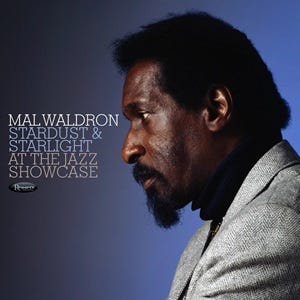
Mal Waldron — Stardust & Starlight at the Jazz Showcase
Mal Waldron was a distinctive American jazz pianist and composer whose sparse, harmonically rich approach left an indelible mark on modern jazz. Born in 1925, he first gained prominence as Billie Holiday's final accompanist in the late 1950s, where his sensitive support showcased his exceptional musicianship. Following a heroin overdose in 1969 that temporarily halted his playing, Waldron rebuilt his technique and moved to Europe, where he spent much of his later career developing an even more personal sound characterized by his use of space, repetitive motifs, and a lyrical yet sometimes dissonant harmonic language. His legacy includes over 100 recordings as a leader and timeless compositions like "Soul Eyes," cementing his reputation as an uncompromising artist who could create profound emotional depth through minimalism and taste. Waldron’s time in Europe turned his playing inward, militantly introspective. He opens this disc with a brooding performance of his original “All Alone.” Its density is that of a black hole of introspection that continues through his similar reading of “‘Round Midnight.” Things even out by the end with Sonny Stitt joining the pianist for two bebop standards, “Old Folks” and “Stardust.” As commented by a fellow musician, “…had Bird never lived, there still would have been Sonny Stitt.” Simply sublime.
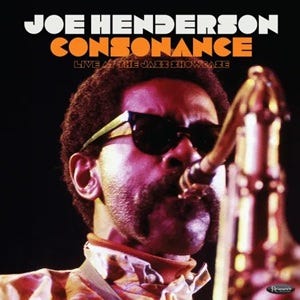
Joe Henderson - Consonance: Live at the Jazz Showcase
Joe Henderson was one of the most distinctive and influential tenor saxophonists in jazz history, renowned for his uniquely robust tone, angular improvisations, and remarkable harmonic sophistication. Emerging in the 1960s, Henderson quickly established himself as a formidable voice through his seminal work with Horace Silver and his iconic contributions to classic Blue Note albums, particularly his groundbreaking performances on Miles Davis’s landmark recordings. His playing style combined a powerful, sometimes gritty sound with an advanced harmonic language that allowed him to navigate complex chord changes with both intellectual rigor and emotional intensity. Beyond his prowess as a sideman, Henderson was a prolific composer, penning enduring standards like “Recorda Me” and “Inner Urge,” and later achieved remarkable commercial and critical success with his Verve Records albums in the 1990s, including his Grammy-winning tribute to Billy Strayhorn. Henderson is one of only a handful of tenor saxophonists who quietly expanded the tenor perimeter in jazz. He was not John Coltrane or Dexter Gordon. He was Joe Henderson. This recording and his State of the Tenor sides from Blue Note Records further define his long, and often unrecognised shadow.
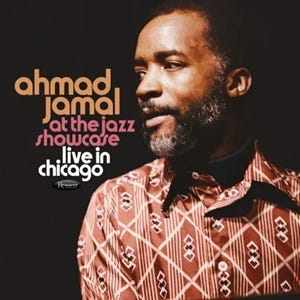
Ahmad Jamal at the Jazz Showcase: Live in Chicago
Despite his enormous influence on the genre's evolution, many have often underestimated Ahmad Jamal, a revolutionary pianist, and his profound impact on jazz. Born in 1930, Jamal developed a distinctive minimalist approach characterized by his masterful use of space, dynamic contrast, and unexpected rhythmic displacements that created a uniquely suspenseful and engaging musical language. His 1958 live album Ahmad Jamal at the Pershing: But Not for Me (Argo) became one of the best-selling jazz recordings of all time, showcasing his trio's tight interplay and Jamal's ability to transform familiar standards through radical reharmonization and inventive arrangements. Miles Davis cited Jamal as a major influence, particularly admiring his economical approach and dramatic use of silence, elements that would shape Davis's own landmark recordings. This Record Store Day release comprises nine, often lengthy, selections spread over two CDs. In concert with bassist John Heard and drummer Frank Gant, Jamal surveys familiar ballad ground with inspired and inventive readings of “Have You Met Miss Jones,” the “Theme from M*A*S*H,” and “A Nightingale Sang in Berkeley Square.” He opens the recital with a sprite performance of his original “Ahmad’s Song,” setting the tone for the rest of the concert.
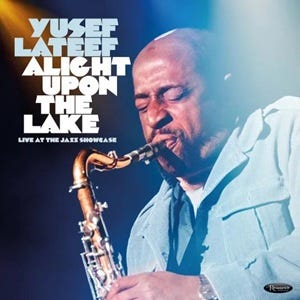
Yusef Lateef - Alight Upon the Lake: Live at the Jazz Showcase
Yusef Lateef was a multi-instrumentalist and composer whose work transcended conventional jazz boundaries, earning him the title "the father of world music." Born in 1920, Lateef was a woodwind player who introduced instruments like the oboe, bassoon, and various flutes from around the world into the jazz lexicon, while also exploring Eastern musical concepts and scales long before "world music" became a popular genre. His approach fused jazz improvisation with global folk traditions, creating an aesthetic that incorporated elements from African, Middle Eastern, and Asian music, as evidenced in his landmark 1961 album Eastern Sounds (Moodsville, 1961 ). Additionally, Lateef was a prolific composer, educator, and author who developed his own musical philosophy he termed "Autophysiopsychic Music," which sought to integrate physical, mental, and spiritual dimensions in musical expression. His collaborations with jazz giants like Charles Mingus and Cannonball Adderley, coupled with his solo work for labels like Impulse! and Atlantic, established him as a visionary artist. “Straighten Up and Fly Right” and the original “I Remember Webster” rub elbows with the mammouth, half-hour,” tour-de-force “The Untitled” opening the set. Lateef’s playing is forward and probing whatever the instrument is.
Which Miles Davis landmark recordings did Henderson play on? That's a new one to me.