


From time to time, I disappear down the rabbit hole that is Robert Johnson. In 1976, when I was a high school sophomore firmly under the spell of Jackson Browne’s masterpiece, Late for the Sky (Asylum Records, 1974) as it sped toward The Pretender (Asylum, 1976). I was putting things together. The Lowell George who contributed the brilliant slide guitar solo on Browne’s “Bright Baby Blues” was also responsible for the same slide guitar licking the corners of “Lafayette Railroad” on Little Feat’s Dixie Chicken (Warner Bros. 1973). The lap steel guitar master, David Lindley, contributed as much or more than Browne did to “These Days” (from For Everyman (Asylum, 1973)) and all of Late for the Sky.
Another narrative was taking shape at the same time that was more socially informed. I was plumbing the dark recesses of the American Romantic myth that was music called the blues and how this humble folk music gave birth to rhythm and blues, soul music, and rock & roll. My first realization was (ahead of Elvis Presley and Arthur “Big Boy” Crudup) that as good as Joe Cocker was, he was not doing anything different from Ray Charles, Otis Redding, Solomon Burke, and Wilson Pickett. I had awoken to the Allman Brothers Band and their great slide guitarist, Duane Allman (always the slide guitar) and their masterpiece, At Fillmore East (Capricorn Records, 1971) and its opening number, “Statesboro Blues.” I thought, “Now, that is a great song!” Not long after, I heard a transfer from the 1928 Victor 78 rpm record (V38001) recorded by its composer, Blind Willie McTell and the history of rock music was becoming clear. Listening to that scratchy, pre-World War II recording was like looking down the big end of a telescope pointed at the beginning.
I made the same connection between David Bromberg’s recording of “Sweet Home Chicago” and the Mississippi revenant, Robert Johnson. That is all the information there was: just a name, Robert Johnson, and his handful of 78 rpm shellacs recorded in the late 1930s. I was under the spell of the idea that an essentially unknown rural black musician had produced stark art of the clarity and dread of “Hellhound on My Trail” and “Stones in My Passway.” Blues reportage was thin with Samuel Charters’ The Country Blues (Reinhart, 1959) and Paul Oliver’s The Blues Fell This Morning: The Meaning of The Blues (Cassell, 1960) being all the scholarship available about this spectre. Both accounts, along with the liner notes to Robert Johnson: King of the Delta Blues Singers (Columbia, 1960) and King of the Delta Blues Singers, Vol. II (Columbia, 1970), were inaccurate, giving way to a well meaning, if misguided, picture of the artist that centered on the lingering myth that Johnson had sold his soul to the devil at some rural crossroads, Faustus style, in exchange for his musical prowess. From that point on, anything written about Johnson was read “as through a glass darkly.” This erected a romantic architecture around Johnson that would mislead and confuse fans and scholars until the twenty-first century. Blowing up all around me was music influenced by this Romantic image of Johnson: Eric Clapton, The Rolling Stones, the original Fleetwood Mac, and every garage rock band thereafter.
In 1975, blues and rock scholarship coalesced for me in Griel Marcus’ Mystery Train: Images of America in Rock 'n' Roll Music (Dutton). This landmark book of rock criticism drew a thread through the pre-war artists Harmonica Frank and Robert Johnson, through The Band, Sly Stone, Randy Newman, and Elvis Presley, furnishing American music a pedigree. That same year, just as my fevered adolescent brain was on fire about this mysterious Robert Johnson, a short blurb appeared as an open letter written in Blues Unlimited1, another Johnson researcher, Mack McCormick, was answering his critics accusing him of sitting on a critical pile of blues research without publishing it:
“This [biography of Robert Johnson] is now a 12 chapter manuscript of 150,000 words undergoing final editing. It has an unusual narrative structure becoming a kind of detective story as it relates the quest and moves, step-by-step, through the five year search.”
McCormick promised his book was nearing completion and his biography would reveal the phantom Robert Johnson.
Finally, I was going to read something factual and definitive about this important artist. I sat on the edge of my seat, waiting for publication. I sat there for 50 years, and ultimately the results were not just disappointing; they were maddening. But that is a story yet to be told completely. I never understood why I and so many other like-minded readers, listeners, and musicians were so drawn to Johnson, his story, and his music.
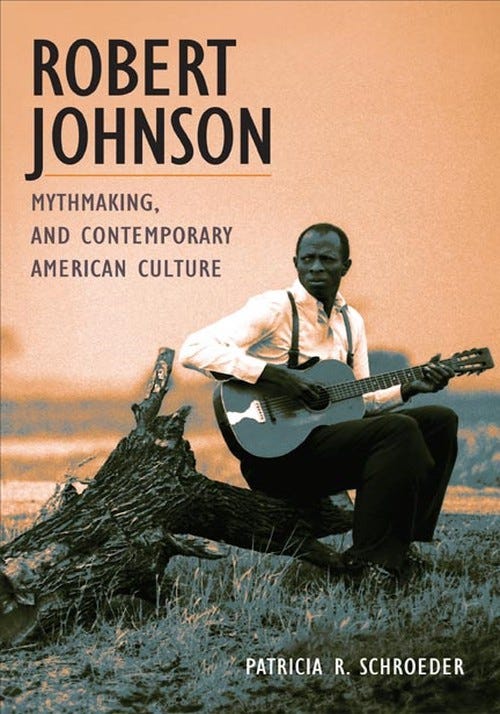
Until I read Patricia Schroeder’s Robert Johnson: Mythmaking and Contemporary American Culture (University of Illinois Press, 2004). I have had this book in my library for 20 years, but could not finish it until recently. “When the student is ready, the teacher will appear.” Schroeder reasons in her book that the myths [like that of the crossroads] surrounding Robert Johnson survived because white music critics and rock-and-roll fans in the 1960s desperately wanted an "authentic, romanticized, tragic hero," and Johnson's mystery allowed them to invent one. Exactly. Johnson was providing the most basic, nonfissionable element in American music: the blues.
In Robert Johnson, Mythmaking, and Contemporary American Culture, Schroeder presents an analytical case study of how a historical figure is transformed into a cultural symbol. By examining the disparity between archival evidence and public reception, Schroeder illustrates how the absence of contemporary documentation allowed twentieth-century commentators to project specific racial and artistic romanticisms onto Johnson.
The dominant narrative regarding Johnson’s technical proficiency attributes his guitar skills to the previously described Faustian pact. Propagated by contemporaries like Son House and later codified by rock music journalists, this myth claims Johnson achieved instantaneous mastery at a Mississippi crossroads. Schroeder deftly strips the silly superstitions accepted by so many mid-century writers.
Schroeder contrasts this supernatural explanation with documented biographical evidence. Johnson’s development relied on traditional methods of apprenticeship and study. During a period of residence in Hazlehurst, Mississippi, Johnson studied under Ike Zimmerman, a skilled local guitarist. Additionally, Johnson used commercial recordings (just like every musician to the present has), analyzing and adapting the techniques of established artists such as Lonnie Johnson and Scrapper Blackwell. His proficiency resulted from love of music and deliberate practice and systemic adaptation rather than sudden intervention.
Modern representations frequently characterize Johnson as a transient, psychological archetype—an isolated individual driven entirely by existential anguish. This trope aligns with mid-century white critical frameworks that valued Black blues musicians primarily for perceived raw emotionalism.
Biographical data shows Johnson operated as a calculated, market-conscious professional. He did not confine his movements to the rural Mississippi Delta; he traveled to major metropolitan centers, including Chicago, New York, Detroit, and St. Louis, to secure radio broadcasts and commercial recording sessions. Consumer demand dictated his repertoire, encompassing popular jazz, country, and pop melodies of the 1930s alongside the blues.
Public accounts of Johnson’s death favor a dramatic resolution involving lethal strychnine poisoning administered by a jealous spouse at a rural venue. While oral testimonies from musicians Honeyboy Edwards and Sonny Boy Williamson II support the poisoning hypothesis, the medical timeline challenges this conclusion. Strychnine acts as a rapid toxin, whereas historical accounts show Johnson succumbed several days after the initial incident. His official death certificate provides no definitive cause of death. Medical historians suggest systemic vulnerability, such as congenital syphilis or a ruptured ulcer exacerbated by alcohol consumption, as more probable factors.
This ambiguity extends to his physical grave. The narrative of the neglected artist led to speculation regarding an unmarked grave. In reality, the lack of documentation reflects the systemic marginalization of Black citizens in the Jim Crow South rather than a deliberate obscuring of his remains. Currently, three distinct markers exist in the Greenwood, Mississippi area because of conflicting eyewitness accounts, with the Little Zion Missionary Baptist Church site holding the highest consensus among researchers.
Schroeder concludes that the mythologized Robert Johnson functions as a cultural artifact. The conversion of a professional, Depression-era musician into a tragic figure shows how media industries and consumer audiences reconstruct history to satisfy contemporary demands for authenticity.
McCormick, Mack, “An Open Letter from Mack McCormick,” Blues Unlimited, Issue 117 Jan/Feb 1976, p.17.
Joe: Shit! I have meant to contact you for months, but got busy when a new granddaughter arrived. I am very interested in how you see the whole RJ thing. I believe more today than ever that until the 2010s, it was hokey because the reportage was so superstitious. I drank the Kool-aide deeply when we were at CHS and I have never fully recovered. The article I am planning will be funny because I am going to tell the Robert Johnson story from the perspective of how I discovered it and then followed it for 50 years. I even have AI involved. I am always up to talk about RJ.
So, while I was basically having a nervous breakdown at our beloved Alma mater in ‘75 (sophomore blues), you were “sliding” down musical history (damn). I always thought the Robt Johnson thing a bit hokey, so kept it at arm’s length, only touching on a few songs. But now with him brought back to earth, I’m gonna load my 5-disc changer & catch up on what I resisted. - JW