


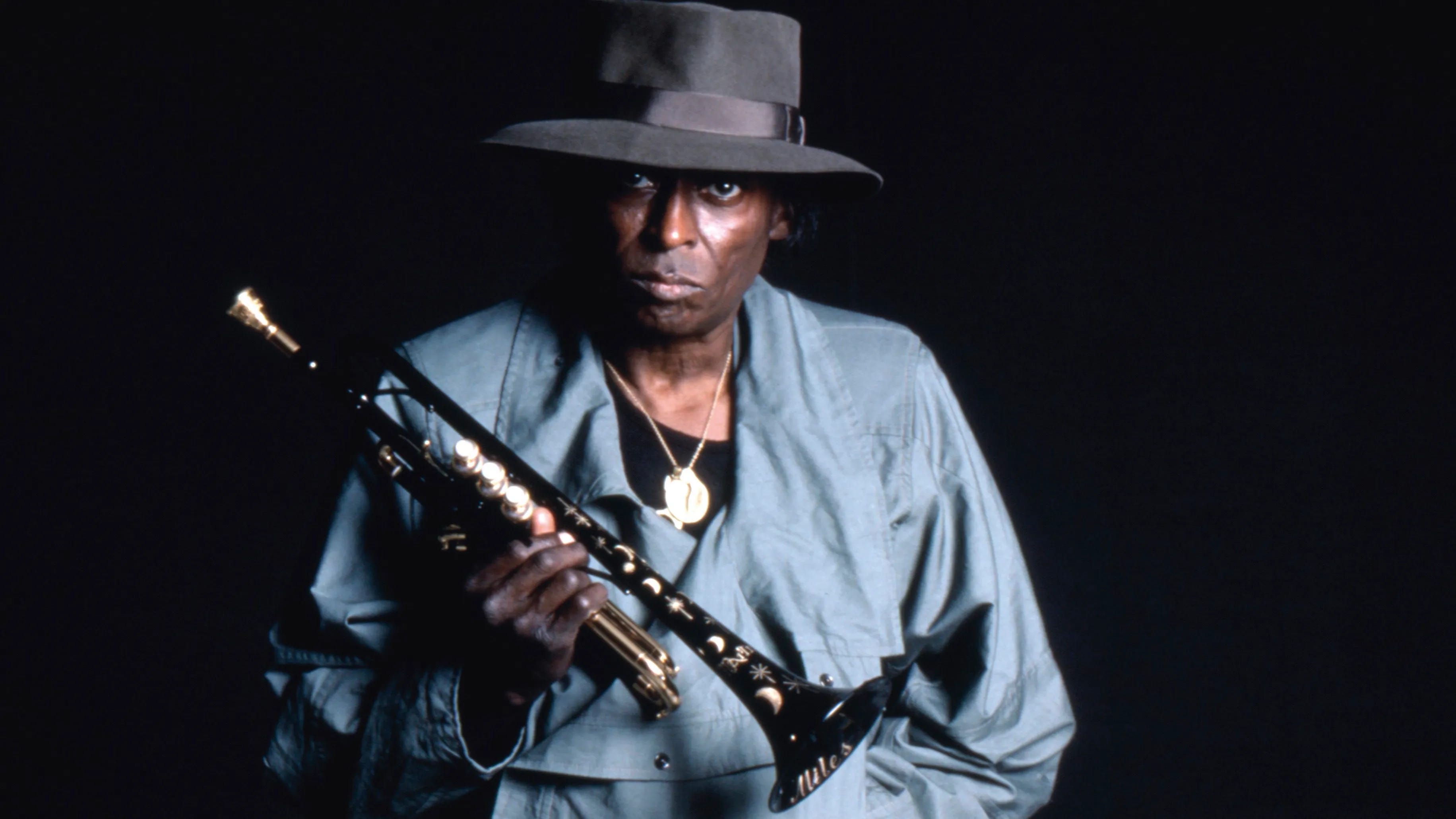
Conventional wisdom marks Miles Davis’ date of death as September 28, 1991. That is the date on which Davis caught his ride, but the shadow of his cultural figure is longer than that, as the trumpeter celebrates his centenary this day.
No single artist has affected their creative corner more than Davis. Louis Armstrong, Duke Ellington, Charlie Parker, and John Coltrane definitely may have some bragging rights, but none can match Davis’ artistic reach as the catalyst of multiple jazz movements:
Bebop (1945—1955): A 19-year-old Davis performed the Charlie Parker Savoy Records date, November 26, 1945, when “Billie’s Bounce” and “Now’s the Time.” Critics consider this session the first “pure” bebop session. Like rock and roll and Elvis Presley, bebop ended on March 12, 1955, when Parker died.
Birth of the Cool (1948—1950): Early recordings of the Miles Davis Nonet appearing at the Royal Roost, September 1948 hint at the coming January 21, 1949 recordings by the Nonet on January 21, 1949, when the first sides that would become Birth of the Cool (Capitol Records, 1957). After cool jazz ignited on the West Coast, did it ever end?
Hard Bop (1954—1964): Critics and historians acknowledge the April 3, 1954 studio session by the Miles Davis Quintet, which produced the title track for the landmark album Walkin’, as the recording that established the hard bop genre. Likewise, the formation of Davis’ second great quintet, when Wayne Shorter joined Herbie Hancock, Ron Carter, and Tony Williams in September 1964, when the ensemble created post bop (see below).
Modal Jazz (1958—?): Many music writers mark the February 4, 1958 studio recording of the title track “Milestones” (appearing on Milestones (Columbia Records, 1958)) by the Miles Davis Sextet as the first official recording of modal jazz. The masterpiece of the genre emerged as Kind of Blue (Columbia Records, 1959). Unlike previous genres like bebop or cool jazz, modal jazz never had a true "end" because its core concept—improvising over scales rather than rigid chord progressions—permanently changed how musicians think about jazz music. If pressed, instead of dying out, the dedicated modal jazz era naturally dissolved between 1965 and 1968 by fracturing into two radically different musical movements: Free Jazz and Post-Bop.
Post Bop (1965—1968): Miles Davis’s Second Great Quintet took the open-ended nature of modal jazz and combined it with the complexity of bebop to create a new subgenre called Post-Bop. Albums like E.S.P. (Columbia Records, 1965) and Miles Smiles (Columbia Records, 1967) used “time no changes”—a concept where the band kept a steady rhythm but the soloist could change the scale or harmonic center completely at will, rendering traditional, static modal jazz obsolete.
Fusion (1969—1980): Critics view the August 1969 recording sessions for Miles Davis’s double album Bitches Brew (Columbia Records, 1969) as the true, definitive genesis of jazz-rock fusion. By trading the traditional jazz swing beat for a heavy rock-and-roll backbeat, plugging his trumpet into electronic effects pedals, and using a massive ensemble stacked with electric guitars and multiple electronic pianos, Davis single-handedly codified the genre. Unlike early jazz genres that faded into the underground, jazz-rock fusion did not experience a quiet stylistic evolution. Instead, its dominant era came to a spectacular commercial crash between 1978 and 1980, when the core innovators of the genre splintered and the rise of Punk and New Wave grabbed the throat of popular music, rejecting the long, self-indulgent, 15-minute instrumental solos that defined 1970s jazz fusion, stripping popular music back down to raw, three-minute songs.
Free Jazz (1959—1967): Just kidding. As close as Davis came to free jazz, he did not embrace it, claiming “all screwed up inside.” That being said, Ornette Coleman began the whole kerfuffle with The Shape of Jazz to Come (Atlantic Records, 1959) and later, Free Jazz: A Collective Improvisation by the Ornette Coleman Double Quartet (Atlantic Records, 1961). Davis’ contribution was John Coltrane, who took the genre to its zenith, ending it with his death on July 17, 1967.
Get the point? May the brilliant and mercurial Miles Davis live forever in that rare ether that is music.