


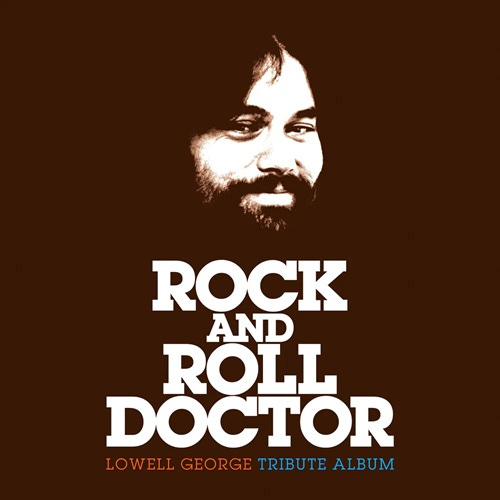
Music’s memory, Omnivore Records, has released Rock and Roll Doctor: Lowell
George Tribute Album. This is a re-release of the 1998 Rock and Roll Doctor: A Tribute to Lowell George (Sanctuary Records). As the band celebrates the 50th anniversary of its early catalog in real-time, it is proper to reconsider the man who started it all.
Today, Lowell George has been gone from Little Feat six times longer than when he helmed the band in the 1970s. After the decade following the death of George, Little Feat reformed and have toured together for the past 40 years as they approach their last tour in the summer and fall of 2026. The original 1998 tribute came out nearly 20 years after George’s death. Now, nearly 30 years after that, it is nice to consider the recording again.
Tribute recordings are commercially dicey animals. The scenario goes like this: a bunch of well-meaning friends get together, prepare stock arrangements of the repertoire, divvied up the music among artists, who record the material catch-as-catch can. The results, with notable exceptions, are often homogenous and bland. While Rock and Roll Doctor: Lowell George Tribute Album is not an exception from this, but does host several notable contributions.
But this is getting ahead of ourselves.
In the eight years that the Lowell George Little Feat existed, George was everywhere. Besides producing the bulk of LF’s material and his own solo recording, Thanks I’ll Eat It Here (Warner Bros, 1979), he also produced Robert Palmer’s Pressure Drop (Island Records, 1975 - uncredited), Valerie Carter’s Just a Stone’s Throw Away (Columbia Records, 1977), and the Grateful Dead’s Shakedown Street (Arista, 1978).
When not in the control booth, George contributed his iconic slide guitar to Harry Nilsson’s Son of Schmilsson (RCA Victor, 1972), John Cale’s Paris 1919 (Reprise Records, 1973), Bonnie Raitt’s Takin’ My Time (Warner Bros, 1973), Robert Palmer’s Sneaking Sally Through the Alley (Island Records, 1974) and a definitive solo on “Your Bright Baby Blues” from Jackson Browne’s The Pretender (Asylum, 1976). George’s slide guitar, punctilious and medicinal, soothes the song’s restless protagonist.
George’s unique slide guitar technique developed following a freak accident where the guitarist sliced the palm of his left hand while working on a model airplane. While forced to use a slide for an extended period while his hand healed, George developed and mastered his unique, “clean” slide sound. George’s slide choice was a heavy 11/16-inch Sears Craftsman wrench socket, which provided a dense and long-lived sustain that became a hallmark of his playing. The guitarist achieved his “Lowell tone” by using high compression, a Fender Stratocaster fitted with a Telecaster bridge pickup. George favored specific hybrid open G and A tunings. The musician who studied George’s slide style, benefitting the most from it, is Bonnie Raitt.
At his most inspired, Lowell George embodied that heady blend between R&B, Delta blues, country, and rock and roll. His use of the slide guitar in his music made a white man playing this funky mixture suddenly legitimate and appealing to all audiences. His body of work is unbelievably deep and varied, and his talent appreciated by many-a lot of musicians he worked with independent of Little Feat. Many appear on this disc, including Bonnie Raitt, JD Souther, and Jackson Browne, to name a few. This is an uneven lot of music, with some contributors hitting the center of the bullseye while others never even registered within the last Lightyear.
As my mother always encouraged me to err on the positive, here are the songs that work best. Bonnie Raitt’s “Cold, Cold, Cold.” Raitt’s clotted, bluesy vocal style along with her excellent slide work make for an aching and well-realized version of this melancholy tale of a man down on his luck and out of time. Also appearing on slide guitar is the late Paul Barrere, who stayed true to George’s original vision of Little Feat, but developed his own unique slide guitar playing, one arguably superior to that of George’s, but lacking in that magic that made George—George.
The Bottle Rockets, with David Lindley on slide, turn in an overdriven performance of “Rocket in My Pocket” off 1977’s Time Loves a Hero (Warner Bros). Lindley’s powerful finger work has just the right heated, corrosive feel, barely containing the intended sexual innuendo of the lyrics and music. Another successful cut is “Roll Um Easy,” covered by George’s close friend JD Souther. Souther’s sweetly seductive interpretation betrays his close association with George.
Allen Touissant and Leo Nocentelli conjure a fun, uptempo version of “Two Trains,” highlighting the New Orleans feel and sound central to many of George’s original compositions with Little Feat. Also, a gas is Taj Mahal’s take on “Feats Don’t Fail Me Now” from the 1974 Little Feat release of the same name. The presence of a crack horn section is the gravy on this performance.
Lowell George certainly rated an homage recording, and Lowell George Tribute Album - Rock and Roll Doctor fits the bill, just not completely. Might I suggest a new one featuring Sonny Landreth, Derek Trucks, Ariel Posen, and Rick Vito. These are the slide guitarists of the present.
Terrific work on a terrific talent. 70’s Little Feat is unmissable. George’s contemporary & bottleneck slide maestro, Ry Cooder is still with us. He lays down the sweet es slide guitar on the delightful original version of Willin’ from the band’s eponymous first album (due to George’s hand injury that you covered). Thanks for the solid work.