


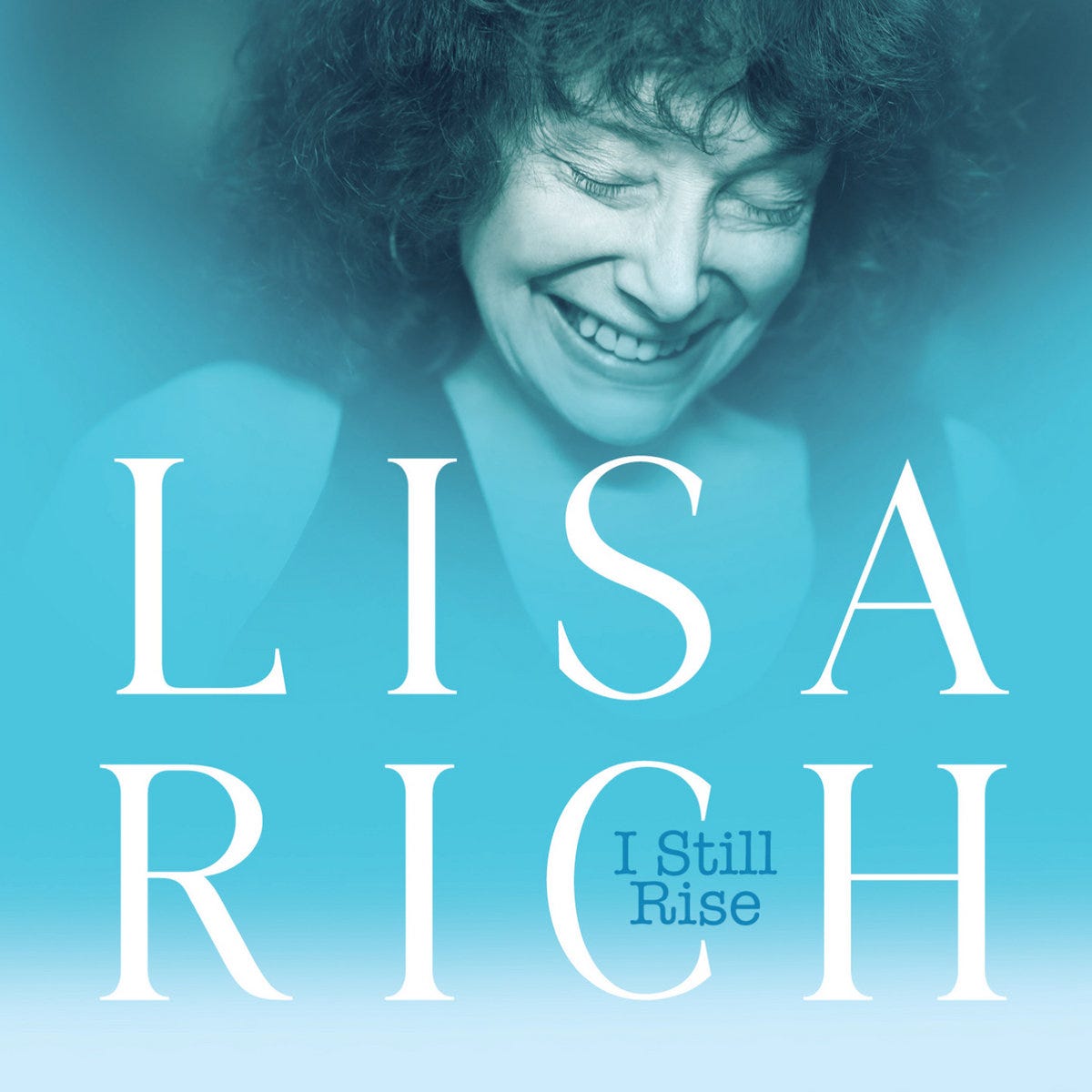
Lisa Rich’s 2026 album I Still Rise is the induction and consolidation of effort in transforming a decades-long battle with debilitating back problems into a remarkable mid-life renaissance. First emerging in the 1980s, Rich was establishing herself as a creative/interpretive force in vocal jazz. She commanded attention with her 1983 debut Listen Here (Tritone Records), made history as one of the rare American jazz artists to tour China and India, and collaborated with the esteemed Clare Fischer Quartet for 1985’s Touch of the Rare (Tritone Records). However, after tracking her third album, Highwire, in 1987, her chronic spinal issues quelled her career momentum. Having undergone back surgery in the 1970s (which made the first two recordings possible), the pain returned, exacerbating each time she tried to sing. The singer reluctantly stepped away from dangerous repeat surgeries, forcing her into a 32-year performance hiatus and shifting her focus entirely to working as a vocal teacher in the Washington, D.C. area.
Her improbable comeback began with physical therapy to regain her strength, but the true vocal breakthrough happened during the COVID-19 pandemic. Partnering with her late mentor and sensei, Jay Clayton, Rich undertook rigorous speech therapy and twice-weekly Zoom singing lessons to reverse years of vocal atrophy. This relentless rehabilitation allowed her to unarchive Highwire in 2019, followed by her first new studio recordings, 2024’s Long As You’re Living (Tritone Records). For comeback, Clayton assembled an elite, empathetic band to support her, pairing Rich with longtime friends pianist Marc Copland and bassist Drew Gress, alongside trumpeter Dave Ballou. Long As You’re Living acted as a joyous proof-of-concept, establishing an airtight musical chemistry and capturing a giddy, happy-to-be-alive energy driven by upbeat, conventional jazz swing grooves.
Building directly on the hard-won confidence of that successful release, Rich uses her previous album as a critical launchpad, pushing that same core quartet into the highly developed and adventurous territory of I Still Rise. Rather than repeating the commercial comfort of its predecessor, the 2026 record represents a distinct artistic departure. Born out of a time of national protest, the tone shifts from celebratory to deeply reflective, somber, and socially aware. Structurally, Rich intentionally strips away all traditional percussion, moving from dynamic swing to an ultra-sparse, drummerless in negative space. This leaves the band floating in a weightless, elastic acoustic environment where the rhythm breathes in response to her vocal phrasing.
Where the 2024 album relied on meticulous arrangements and clean soloist rotations, I Still Rise embraces a fecund and unadulterated spontaneity. During the two-day recording session, Rich and her band improvised the intros, endings, and solos on the spot, exemplified by the completely spontaneous vocal-and-bass duet on the opening track, “No Moon at All.” This fearless craving for studio spontaneity allowed Rich to strengthen her approach to standard repertoire, explicitly subverting well-known jazz classics to match the record’s intimate ethos. On her stunning reimagining of Dave Brubeck’s legendary 1959 masterpiece “Take Five,” she flips the bright mood of the original on its head. Stripping away the commercial polish and Paul Desmond’s light alto saxophone archetype, Rich delivers the melody in a much darker, smokier, late-night vocal register, recalling Shirley Horn, Rebecca Parris, and Patti Wicks. Because the track completely lacks Joe Morello’s rigid, driving 5/4 drum kit pulse, the ensemble softens the sharp rhythmic edges of the signature meter. Rich injects heavy syncopation and stretches the lyrical lines into an unhurried conversation, while Marc Copland eschews Brubeck’s famous block-chord vamps in favor of impressionistic chords that leave plentiful negative space. Drew Gress substitutes for the absent drums by laying down a low-end bassline that bounces playfully beneath her voice.
This provocative subversion extends to the album’s closing track, where Rich assaults Thelonious Monk’s notoriously complex “Well, You Needn’t,” performing it under its lyrical title, “It’s Over Now.” Where many vocalists approach Monk’s jagged melodies with intense gravity—such as Carmen McRae’s historic interpretations—Rich infuses the piece with pure, mischievous fun and a sense of overcompensating joy. Navigating Mike Farris’s intricate lyrics by treating her voice like a horn, she sings with a rhythmically pulled-back, percussive cadence, almost spitting out her scat phrases with sharp agility before settling back into the underlying swing. Halfway through the track, Dave Ballou’s muted trumpet quietly slips into the arrangement. Rather than competing for the spotlight, Ballou and Rich engage in a sideways-swinging duet, trading lines and blending their textures seamlessly to capture Monk’s signature eccentric, off-kilter phrasing.
While I Still Rise documents Rich’s personal recovery; it roundly declares that true artistic maturity cannot be silenced by time or physical limitation. By using the momentum of Long As You’re Living to jump into the avant-garde, Lisa Rich and her trio have crafted an uncompromising, drumless sanctuary where silence speaks as loudly as song. Backed by Copland, Gress, and Ballou—who act less like a backing band and more like a fluid cushion—Rich uses her reclaimed voice to plumb deep personal healing as she emerges from a 32-year exile with an even deeper, more resonant emotional wisdom.
All these lead me to listening to Lisa's latest ~ "drummerless" and "The band as a fluid cushion"...