


“While with an eye made quiet by the power
Of harmony, and the deep power of joy,
We see into the life of things.”
—William Wordsworth, “Lines Composed a Few Miles above Tintern Abbey, On Revisiting the Banks of the Wye during a Tour. July 13, 1798.” Lyrical Ballads (1798).
The English Romantic poets were a blousy, high-strung lot given to composing notable verse about what the Reverend Fr. Bernard DeBosier, in Senior English, termed “The long ago and far away.” This included a solemn reverence for ruins and relics, as evidenced by John Keat’s “On First Looking into Chapman’s Homer” and Bysshe’s “Ozymandias.” So intense was this reverence for the past and its refuse, critics like Francis Jeffery chided the “Lake School” of English Romanic poets (specifically: William Wordsworth, Samuel Taylor Coleridge, and Robert Southey) accusing them of granting a “mystical importance” to trivial objects.
Even one of their own, George Gordon, Lord Byron, in his Don Juan: Dedication (1809), playfully mocked the group’s tendency to emphasize all of nature, narrowing and diluting their efforts, claiming that
“…Poesy has wreaths for you alone:
There is a narrowness in such a notion,
Which makes me wish you’d change your lakes for Ocean.”
The United States has a cultural example of this exquisite brand of this same circumstance: that group of record collectors and “entrepreneurs” responsible for the blues and folk revival of the late-1950s and ‘60s. This motley group is best described in Amanda Petrusich’s Do Not Sell at Any Price: The Wild, Obsessive Hunt for the World’s Rarest 78 rpm Records (Scribner, 2014) and Marybeth Hamilton’s In Search of the Blues (Basic Books, 2010). What this select group worshiped were pre-World War II, ten-inch, shellac discs intended to be spun at 78 rotations per minute.
From among these early blues enthusiasts, these erstwhile modern Romantics, several would become the first blues historians, publishing often incorrect histories of blues and jazz that would haunt blues reportage for the next 60 years. While these authors were fraught with Romantic drivel and knee-jerk political mush, they all were well intentioned. They, to a writer, would call Clarksdale, Mississippi, the ground zero of this idiom we call “the blues” and its scholarship, romance and all.
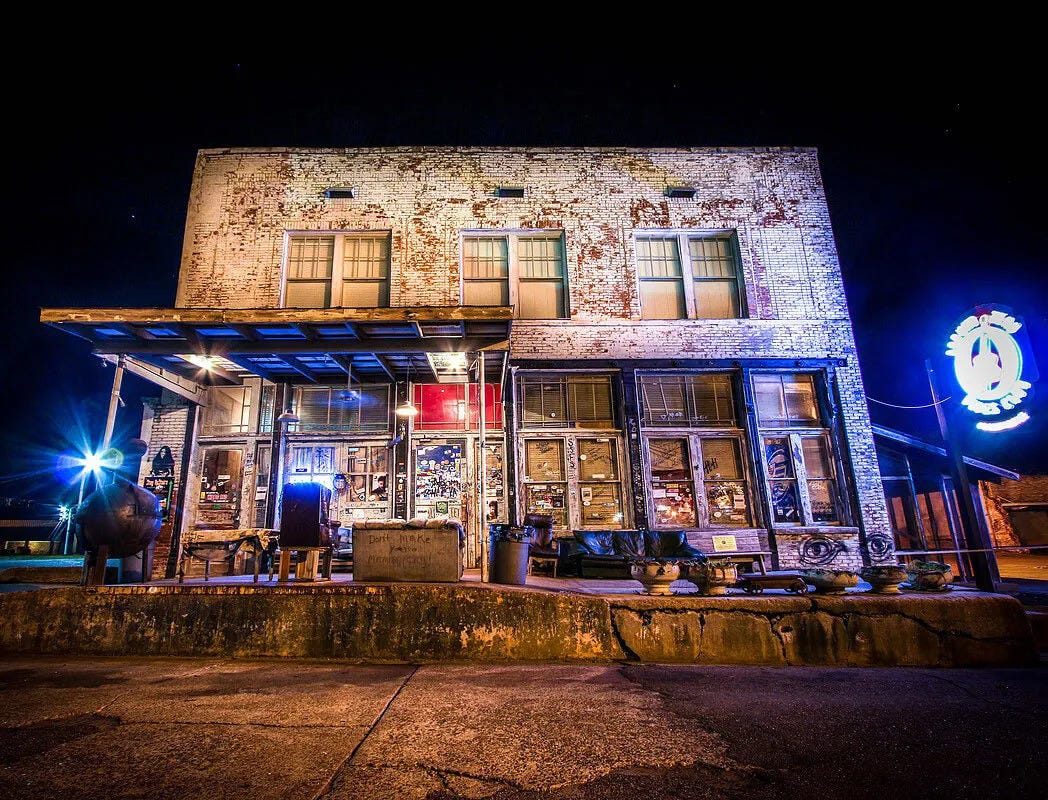
Twenty-first Century Clarksdale looks like many Arkansas and Mississippi Delta towns—not unlike May 1945 Berlin. But within these beautifully shabby environs exists a spirit that percolates from the ground aurally. Music is as much a sensual reality as the smell of beer, barbeque, the August heat, and the sound of harvesting cotton. Literally and metaphorically, for the blues-smitten, Clarksdale represents a musical mecca requiring a pilgrimage. Each year in April, Clarksdale puts on the Juke Joint Festival, now in its 16th year. Each year draws a dedicated, international crowd that doubles the population of Clarksdale on the Saturday of the festival.
In the days approaching that Saturday, one may hear a Dutch piano player performing at Levon’s or an Italian slide guitar player tearing things up outside Cathead Blues Store or a Belgian chanteuse bringing her one-woman-band to the Auberge Hostel on the corner of Delta Avenue and East 2nd Street, just up the block from The Stone Pony. The Bluesberry Cafe is a must for weekend breakfast and special events. For this festival, the cafe inaugurated its back porch as a concert venue, hosting live acts both inside and outside.
Clarksdale hosts its own cast of Characters (with a capital C) who are local to the area. These include The Bluesberry Cafe proprietors, Ms. Carol and Mr. Arthur Civaro and their daughter, Amanda, along with the internationally renown Watermelon Slim, who may cook, bus tables, sing or play his singular harmonica (We will revisit Slim in the next a future article highlighting the Juke Joint festival). Then there is the Hambone Art & Music Gallery, where owner Stan Street holds court, welcoming such local talent as Guitar Frenchie, Cricket, La La, Lucious Spiller, and Deak Harp, all essential members of this wonderful blues community.
You can next experience the Juke Joint Festival in person on April 17, 2027. Do yourself a favor and come earlier that week. There will be plenty to do.
❤️