

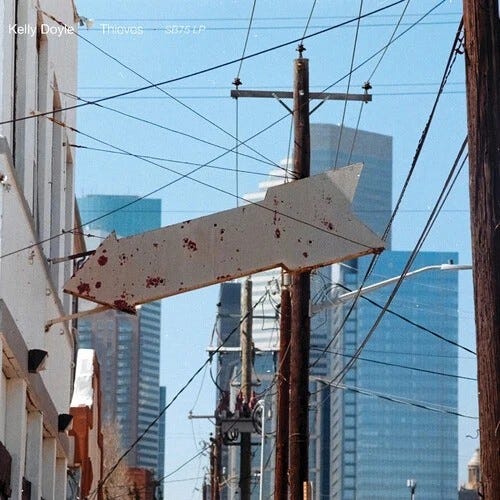
For over three decades, Houston-based guitar virtuoso Kelly Doyle has quietly anchored the sounds of Texas music as one of its most versatile session players and sidemen. He has spent years sharing stages and recording studios with an eclectic roster of prominent indie, rock, and Americana acts, including Robert Ellis, Khruangbin, Phosphorescent, and Craig Finn. Known as a musical chameleon, Doyle grew up in Conroe, Texas, before embedding himself into the Houston scene. He is valued by his peers for a style that balances a disregard for rigid genre boundaries with deep melodic intent.
While Doyle is widely recognized for his years as a utility player, he has also built a fascinating independent discography. Earlier in his career, he explored the lounge-era melodies of the instrumental exotica group Clouseaux. He later pivoted toward independent composition with a series of solo projects. These included his sparse, ambient electronic EP AM in 2016, his 2023 EP Okay Okie, and his subsequent full-length albums Cool Cult in 2025 and Cold Open in 2026.
With his latest release via Strolling Bones Records, Thieves, Doyle steps completely out from the background to deliver a definitive, spotlight-stealing solo statement. Collaborating with producer Steve Christensen and saxophonist Nelson Devereaux, Doyle leverages his rich history with ambient textures and exotic, trading assertive virtuosity for cinematic mood. He blends country twang, jazz improvisation, and 1950s lounge melodies into a singular instrumental landscape driven by concise songwriting rather than flashiness.
This creative ethos, heavily reliant on deliberate simplicity and atmospheric restraint, crystallizes on two of the record’s central pieces: “Cold Open” and “Needlerooser”. Together, these tracks serve as a lesson in how tailored guitar setups and specialized techniques can completely shift the emotional delivery of an instrumental narrative.
On “Cold Open,” Doyle leans into a cinematic, expansive jazz-noir atmosphere. The piece moves with a slow, deliberate pulse, relying on a lush dialogue between his guitar and Devereaux’s saxophone. Instead of overwhelming the arrangement with rapid notes, Doyle applies a strict improvisational philosophy of restraint. He plays open-ended melodic phrases that allow wide pockets of silence to breathe against the rhythm section. To capture this moody, spacious texture, Doyle dials in a warm tone with a soft attack. The physical gear setup leans heavily on subtle, transparent analog delay and plate reverb. This allows his notes to trail off like smoke without clouding the saxophone lines, relying on the natural sustain of the strings to build depth.
In contrast, “Needlerooser” showcases an angular, playful side of Doyle’s musical identity. It subverts traditional instrumental expectations by trading smooth jazz shapes for sharp, technical left turns. Here, Doyle leans into his appreciation for legendary Telecaster virtuosos like Danny Gatton and Nashville pedal steel players like Lloyd Green. His primary technique centers on complex, multi-string pitch bending executed entirely on a standard electric fretboard. By holding a chord shape and isolating specific intervals, he pulls strings in opposing directions to produce a gliding, slightly dissonant country-and-western twang that perfectly mimics a mechanical pedal steel guitar.
The sonic setup for “Needlerooser” requires a completely different technical approach than its jazz-noir counterpart. To provide clean articulation for these elastic pitch bends, Doyle switches to a classic Fender Telecaster routed through a highly responsive, clean amplifier. He strips away the heavy, ambient plate reverbs of “Cold Open” to minimize tone bleed. Instead, he favors sharp note separation driven by hybrid-picking—using a flatpick and bare fingers simultaneously. This gives each bent note an immediate, snappy attack. By contrasting the smoky space of “Cold Open” with the imitative mechanics of “Needlerooser”, Doyle cements Thieves as an album where knowing what not to play is just as powerful as deploying virtuosic technique.
The recording’s structural arc culminates in the closing track, “Lodge Scene.” Where earlier tracks function as isolated genre studies—insulating the mechanics of pure jazz or hyper-specific country western twang—this coda acts as a structural synthesis of the entire record. In “Lodge Scene,” Doyle weaves all these threads together, blending the mid-century exotica of Clouseaux, the warm tone profiles of his jazz impulses, and the technical precision of his string bending into one final, multi-movement landscape. It provides a full-circle resolution, bringing the interplay between his Telecaster and Devereaux’s saxophone to a boiling point before settling back into a quiet, atmospheric hum. By ending on a note that feels both theatrical and tightly controlled, “Lodge Scene” closes the album’s thematic arc, tempering Thieves as a significant step forward for the artist.
