


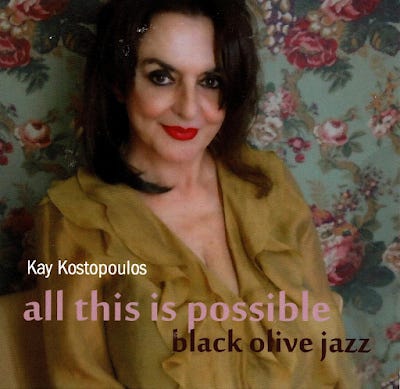
Kay Kostopoulos’s latest record, All This Is Possible, marks a stunning peak in a bicoastal career defined by dramatic flair and technical mastery. The New York and San Francisco-based vocalist, actress, and former Stanford University lecturer has spent decades cultivating a signature “Black Olive Jazz” aesthetic. This style seamlessly blends the Great American Songbook with hard-bop sensibilities, Greek heritage, and textures inspired by her 18 years as an international belly dancer. Following acclaimed prior releases like Black Magic (Black Olive Jazz, 2006), View from Telegraph Hill (Black Olive Jazz, 2010), and Exotica (Black Olive Jazz, 2016), her new album serves as a compelling showcase for her commanding three-octave “serpentine soprano” voice and a deep command of jazz vocal innovation.
Backed by a New York ensemble featuring pianist-arranger John DiMartino and saxophonist Noel Jewkes, Kostopoulos digs deep with advanced scat singing and vocalese to reshape traditional jazz structures, anchored by two back-to-back showcases of elite bop agility. The album opens with a blistering sprint through “Lover / Diggin’ for Diz,” where her fast-tempo bop scatting mimics the sharp, rhythmic articulation of an alto saxophone. She follows this with “I’m All Smiles,” delivering horn-like melodic variations that showcase an innate sense of conversational swing, before tackling the record’s primary vocalese showstopper, Charlie Parker’s “Segment.” On this high velocity bebop piece, Kostopoulos delivers her own rapid-fire, self-penned lyrics, matching the lightning-fast instrumental lines note-for-note with flawless syllabic clarity.
The record’s second half highlights Kostopoulos’s striking versatility, pivoting from high-velocity musicianship to raw, theatrical intimacy. A dark, cinematic reimagining of “Mad About the Boy” utilizes microtonal pitch bends reminiscent of Middle Eastern vocal traditions, while her ballad vocalese on McCoy Tyner’s “Search for Peace” builds an intricate, poetic narrative around the song’s harmonic density. This emotional core is felt most acutely on “Never Let Me Go,” a slower ballad that strips away the bebop velocity entirely to create a vast sonic space where every breath is audible. Instead of crowding the track, she applies minimal, breathy micro-scatting—using short, wordless sighs and subtle pitch bends at the end of her phrases to let the weight of the lyrics do the emotional heavy lifting.
This duality defines the back end of the album, bridging pure technical acrobatics with deep storytelling. She completely subverts Rodgers and Hammerstein’s “I Enjoy Being a Girl,” transforming it into a minor-key, hypnotic groove punctuated by an exotic, wordless soprano chant. Closing with a restrained, deeply sincere take on “More Than You Know,” Kostopoulos proves that her vocal agility is never performative; rather, it is always deployed in service of genuine emotional veracity.
Black Olive Jazz - wonderful review. Thank you.
Uplifting ride all the way through, including "I Enjoy Being a Girl" (love Kay's interpretation of one of my all time faves)