


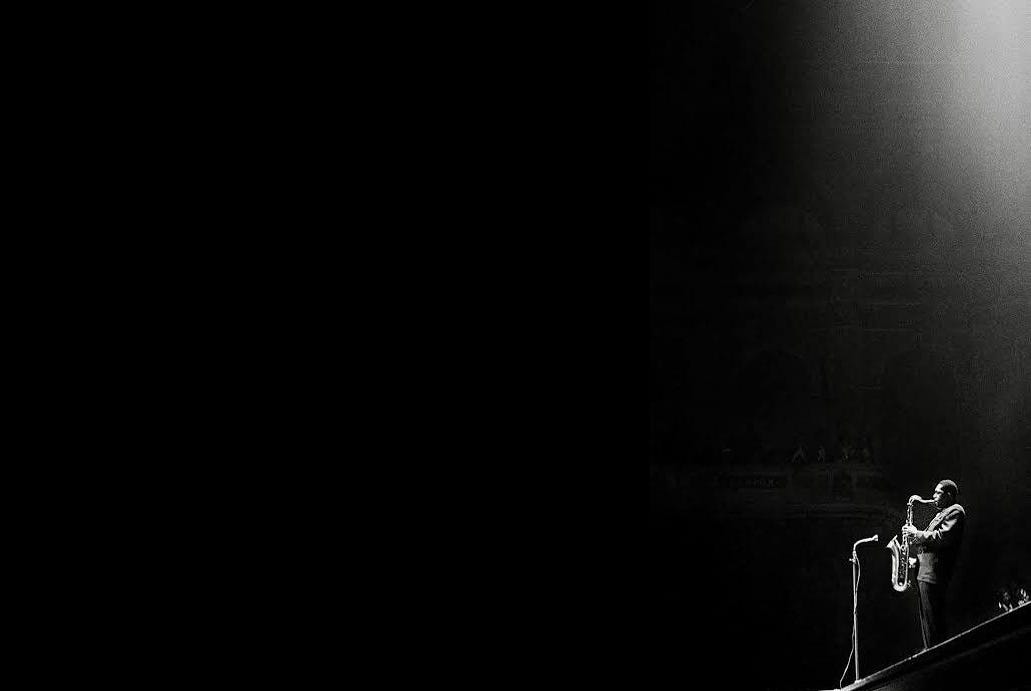
British jazz critic and poet Philip Larkin opined in the introduction to All What Jazz: A Record Diary 1961–1968 (Faber & Faber, 1970), a collection of Larkin’s Daily Telegraph music reviews that, “It was with Coltrane that jazz started to be ugly on purpose.” Larkin, never one to pull punches went on to describe the saxophonist’s late work as “metallic and passionless nullity [giving] way to exercises in gigantic absurdity, great boring excursions…all was chaos, hatred, and absurdity.” I simply believe that Coltrane was jazz music’s most boring genius.
In no way do I disparage Coltrane’s work after his brilliant A Love Supreme (Impulse!, 1965) so harshly. Likely, Larkin failed to understand Coltrane’s new language any more than I did. Like Miles Davis as he searched for his second great quartet (Coltrane having been a member of his first) Coltrane’s ascension began in his live performances, even as early as his last European tour with Davis.1 With his classic quartet of pianist McCoy Tyner, bassist Jimmy Garrison, and drummer Elvin Jones, Coltrane’s sound frayed as early as Live at the Village Vanguard (Impulse!, 1962), coming into full flower by Live at the Village Vanguard Again (Impulse!, 1966) and thereafter, where Coltrane’s muse better resembled the molecules of art shed from the razor edge of creation. This is music better left to the mystics.
Not all the jazz intelligentsia in the early 1960s were enamored with Coltrane’s bold spiritual trajectory. They were not reluctant to express their displeasure in print. Veteran jazz critic Ira Gitler—who had previously praised Coltrane and coined the term “sheets of sound”—wrote a corrosive review of the album’s centerpiece track, “Chasin’ the Trane.” He savaged Coltrane’s aggressive, avant-garde playing as simple “yawps” and “squawks.”
“Chasin’ the Trane,” a blues that consumes all of the second side, is more like waitin’ for a train—a 100-car freight train — to pass. Jones’ dynamic drumming is the most arresting thing happening. If you were to take away his backing and leave Coltrane’s solo standing naked, the latter would become more insignificant than it seems. Shakespeare’s “sound and fury” is musically illustrated here2.
Yikes!
Gitler’s colleague at Down Beat, associate editor John Tynan, was no less tender in his holy war against Coltrane’s direction in his review of a live performance by the John Coltrane Quartet featuring Eric Dolphy at the Renaissance Club in Hollywood, California. This was just weeks before the band's famous November 1961 residency at the Village Vanguard. Tynan opined:
“At Hollywood’s Renaissance Club recently, I listened to a horrifying demonstration of what appears to be a growing anti-jazz trend exemplified by these foremost proponents [Coltrane and Dolphy] of what is termed avant-garde music.”
“I heard a good rhythm section… go to waste behind the nihilistic exercises of the two horns… Coltrane and Dolphy seem intent on deliberately destroying [swing]. They seem bent on pursuing an anarchistic course in their music that can but be termed anti-jazz.”
Coltrane was stung by the “anti-jazz” label. Less than a month after Tynan’s review ran in Down Beat, Coltrane casually assembled his quartet at Rudy Van Gelder Studio in Englewood Cliffs, New Jersey. Coltrane and his group arrived at the studio with music-store sheet music of the songs they intended to record, all which the band had never addressed before. Music writer Gene Lees, in the liner notes for the album these songs would inhabit, noted that the group “…would discuss each tune, write out copies of the changes they'd use, semi-rehearse for a half hour and then do it." Most selections were recorded in one take. Over this session, held December 21, 1961, and two more sessions on September 18 and November 13, 1962, Coltrane’s quiet masterpiece, Ballads (Impulse!, 1963) came together, sticking a just finger in the eyes of his critics, including my own.
Ballads was released among a series of recordings where Coltrane flexed his considerable mainstream jazz muscles. Duke Ellington and John Coltrane (Impulse!, 1963) immediately preceded Ballad’s release, which was then followed by Impressions (Impulse!, 1963) and the exquisite John Coltrane and Johnny Hartman (Impulse!, 1963). I had always considered Coltrane’s saxophone tone harsh and unpretty. These recordings forced a heapin’ helpin’ slice of crow pie as I found everything about these recordings beautiful. But that meal did not visit me immediately.
In 2001, I reviewed Karrin Allyson’s Ballads: Remembering John Coltrane (Concord Music Group). Of Coltrane’s tone, I remarked,
“I do not find John Coltrane's playing on Ballads pretty. It is his genius clarified through the cheesecloth of standards that makes this recording so timeless. His Impulse! recording with Johnny Hartman (John Coltrane and Johnny Hartman, Impulse! 157, 1963) is the same way, but this time with a melding of voice and saxophone, somehow softening Coltrane's thorny exterior. Karrin Allyson takes this a step further with her new release, Ballads: Remembering John Coltrane.” 3
Since that time, I have been forced into a 180-degree position on Coltrane and his place in jazz history. He was a peerless musician, hearing a melody that we mere humans could not.
Miles Davis & John Coltrane—The Final Tour: The Bootleg Series, Vol. 6 (Columbia/Legacy, 1960/2018).
Gitler, Ira. "Double View of Coltrane 'Live': John Coltrane, Coltrane 'Live' at the Village Vanguard." Review of Coltrane 'Live' at the Village Vanguard, by John Coltrane. Down Beat 29, no. 9 (April 26, 1962): 29.
Bailey, C. Michael. “Karrin Allyson: Ballads: Remembering John Coltrane.” All About Jazz, August 2001. https://www.allaboutjazz.com/ballads-remembering-john-coltrane-karrin-allyson-concord-music-group-review-by-c-michael-bailey.