

Louis Armstrong, Duke Ellington, Charles Mingus, Charlie Parker, Miles Davis, Bill Evans; it is among these musicians that John Coltrane belongs. Coltrane’s shadow remains a long one nearly 60 years after his death. Coltrane would be a visionary and, as such, propelled himself into confused irrelevance. The saxophonist’s late music, that found on recordings like (every ship launched after the epochal A Love Supreme (Impulse!, 1965), Ascension (Impulse!, 1965), Live At The Village Vanguard Again! (Impulse!, 1966) and Expression (Impulse!, 1967) is challenging. While not lacking artistic merit, the music is an acquired taste.
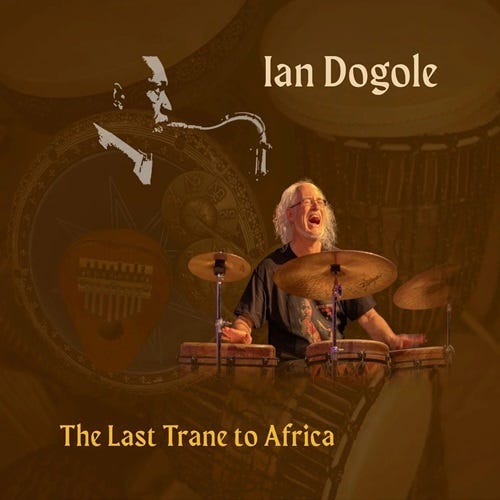
Thankfully, Coltrane admirer and percussionist Ian Dogole pays homage to the saxophonist with Last Train to Africa, a simple live performance that morphed into something else altogether. What started as a concert celebrating John Coltrane’s birthday on September 23rd, 2023, at the Oaktown Jazz Workshops, mushroomed into a full-blown recording project.
Percussionist/bandleader Ian Dogole brought together a band with pianist Frank Martin, bassist Fred Randolph, drummer Kendrick Freeman, saxophonist and vocalist Richard Howell, saxophonist and bass clarinetist Sheldon Brown, and trumpeter Darren Johnson to pay special homage to Coltrane. What Dogole brings to the Coltrane conversation is a deep, percussion-laden bottom where Elvin Jones performed his rhythm ruthless magic. Dogole performs on a variety of African percussion instruments and other indigenous percussion instruments, increasing the artistic focus on Africa and its contributions to Coltrane’s music.
The performance comprised six lengthy pieces either composed by Coltrane or closely associated with him. The Coltrane compositions include “Africa,” “Tunji,” and “Dahomey Dance” coupled with John Lee’s “John Coltrane,” Harold Arlen’s “Out of this World” and frequent Coltrane vehicle, “Afro Blue,” composed by Mongo Santamaria. “Dahomey Dance” includes a length solo by Sheldon Brown that recalls Coltrane’s musical soulmate, Eric Dolphy. Dogole shows off his percussion skills amply on the piece.
“Tunji” and “Afro Blue” make up the closing diptych, driven by the percussion of Dogole and Kendrick Freeman. Frank Martin approximates McCoy Tyner’s block and fragmented chords, while Howell and Brown effectively captured the Coltrane spirit. Dogole’s percussion underpins the project with a wink and a smile to Jones. This project highlights Coltrane’s tactile connection to Africa and his importance to jazz in the second half of the twentieth century.
Yelena: Thank you for these words. I am fine with Coltrane through "A Love Supreme," losing him after that. Intellectually, I can appreciate all the late music. But, I am unlikely to listen to it for pleasure or before bed!
You spoke my mind with these words about Coltraine: "Coltrane’s shadow remains a long one nearly 60 years after his death. Coltrane would be a visionary and, as such, propelled himself into confused irrelevance. The saxophonist’s late music.... is challenging. While not lacking artistic merit, the music is an acquired taste."