


During a period when keyboard music was caught between the architecture of the High Baroque and the symmetries of the emerging Classical style, a monk in a Spanish monastery was reshaping the rules of the keyboard sonata. Padre Antonio Soler (1729–1783) stands as a bridge in this repertoire. Born in Catalonia, Soler spent much of his life as a Hieronymite monk at the monastery of San Lorenzo de El Escorial, where his clerical duties coexisted with his musical output.
While Johann Sebastian Bach and George Frideric Handel built the foundations of the High Baroque with fugal complexity and operatic structures, Soler’s lineage draws from their contemporary, Domenico Scarlatti. As Scarlatti’s student at the Spanish court, Soler inherited the master’s single-movement binary sonata form and his focus on virtuosity. Where Scarlatti relied on rapid register leaps and complex hand-crossing, Soler introduced elements of the Spanish galant style, integrating formal Baroque structures with the rhythms of the bolero, polo, and jota. If Bach provided the architecture and Scarlatti the agility, Soler brought the dance, grounding Baroque forms in Iberian folk traditions.
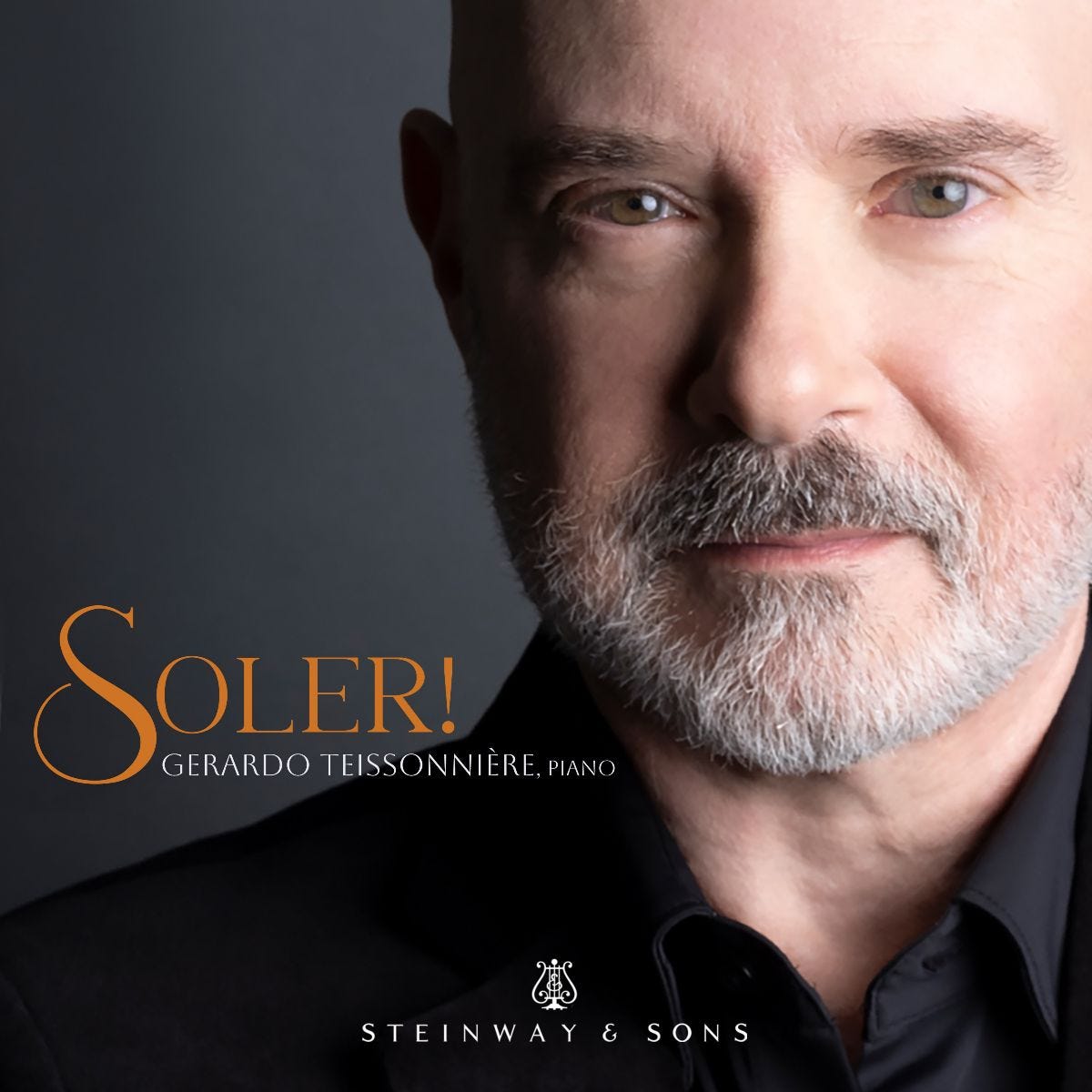
Gerardo Teissonnière brings Soler to life on a release for the Steinway & Sons label. A Puerto Rican-born pianist, Teissonnière’s musical background combines old-world discipline with new-world performance traditions. For SOLER!, Teissonnière has selected a program that moves past treating these works as brief encores, using the modern piano to show how the composer developed his own style separate from Scarlatti’s. The program is anchored by a D Minor Triptych (R. 15, R. 24, R. 39, cataloged by Father Samuel Rubio) that shows Soler’s ability to explore different expressive landscapes within a single key. In the driving Sonata in D Major (R. 84)—written in dialogue with Scarlatti’s K. 492—Soler switches Italian keyboard patterns for an Iberian pulse. Rather than employing the crisp, dry harpsichord articulation typical of Scarlatti recordings, Teissonnière uses the resonance of the Steinway to emphasize the rhythmic drive of the Spanish jota.
This narrative cohesion is central to the Sonata in G minor (R. 87). Where Scarlatti’s syntax is compressed and symmetrical, Soler builds a mosaic of small, decorative, two-bar motifs. Teissonnière connects these fragments with careful dynamic shading, turning an episodic structure into a fluid, rhapsodic performance. A similar stylistic shift informs the pairing of the Sonata in F-sharp Major (R. 90) and the reflective Sonata in F-sharp Minor (R. 85). While Scarlatti evokes tension through close internal friction, Soler opts for progressive modulations. Teissonnière treats R. 85 with a vocal-like cantabile espressivo, using the piano’s sustaining power to ease Soler’s unexpected key changes. Finally, the album highlights Soler’s evolution toward the Classical galant style in the Sonata in D-flat Major (R. 88). Unlike Scarlatti, who rarely looked toward the mid-18th-century horizon, Soler assimilates the rolling accompaniment patterns that would later define Mozart and Haydn. Teissonnière plays this late work with a lightness and balance that mirrors the style of the early Viennese school.
Teissonnière’s approach avoids dry historical reconstruction. With SOLER!, Gerardo Teissonnière presents these historical manuscripts with renewed energy. By matching the composer’s Iberian rhythms with the tonal warmth of the modern grand piano, Teissonnière highlights Padre Antonio Soler’s distinct voice alongside that of Domenico Scarlatti. The result is a recording that transforms historical interest into an expressive performance, serving as an effective entry for both the artist and the label.