



The evolution of early American syncopated music unfolds beautifully across the catalog of Turtle Bay Records. Like its spiritual predecessors Arbors Jazz and Nagel-Heyer, the label treats this transitional repertoire not as a static artifact, but as a living, breathing tradition. These recordings capture a rare, volatile sonic landscape: the elusive hinge where the rigid syncopation of the ragtime parlor gave way to the fluid, collective swing of early jazz.
To understand this transformation, one must look to the mid-19th century and the New Orleans-born classical pianist Louis Moreau Gottschalk. Decades before Scott Joplin codified ragtime, Gottschalk predicted its rhythmic language by absorbing the Afro-Caribbean beats—such as the tresillo and the habanera—vibrating out of Congo Square. In compositions like Bamboula and The Banjo, Gottschalk superimposed jagged, percussive right-hand syncopations over steady, march-like left-hand bass lines. This foundational tension between structural rigidity and rhythmic freedom defined classic ragtime: a formal, multi-thematic, and completely composed piano music meant to be played exactly as written.
The man who famously shattered this rigidity was Jelly Roll Morton. Acting as the stylistic bridge, Morton took the architectural strains of classic ragtime and “jazzed” them. He softened the stiff march pulse into a swinging, walking-bass groove, reintroduced what he called the “Spanish Tinge”—reweaving Gottschalk’s Afro-Caribbean undercurrents back into the music—and established the blueprint for early jazz by balancing written ensemble headers with hot, improvised solos. Under Morton’s influence, the vertical clockwork of ragtime collapsed into a horizontal, blues-inflected, and polyphonic collective improvisation.
Cumulatively, this music creates an acoustic illusion: it sounds like classic New Orleans jazz, but just not quite. This subtle, haunting divergence lies in the music’s geography. Classic New Orleans jazz relies on a strict, interlocking tripartite horn polyphony—cornet leading, clarinet weaving filigree above, and trombone holding the roots below. The Turtle Bay releases, however, pivot into the wider Southwestern territory aesthetic and New York stride styles. The rhythm sections are denser, driving a stomping, four-to-the-bar dance hall pulse rather than a parade-marshal lift. With the addition of larger reed configurations and novelty piano syncopations, a smoother, arranged, pre-swing momentum replaces the stark counterpoint of the Crescent City. It is the thrilling sound of a provincial folk music breaking its regional borders to become a sophisticated national language.
Four distinct entries in the Turtle Bay catalog put this musicological shift into physical practice, acting as an acoustic timeline for a genre in flux. Rather than mimicking historical 78-rpm recordings with clinical precision, each band maps a different geographic and aesthetic corner of the ragtime-to-jazz pipeline. From the lightning-fast piano gymnastics of the Northeast to the gritty, blues-heavy territory bands of the Southwest, these releases show exactly how individual players managed the friction between the printed score and the open air of improvisation. By examining each album individually, we can hear precisely where the strict, vertical architecture of the ragtime era bends, snaps, and ultimately spills over into the horizontal freedom of hot jazz.
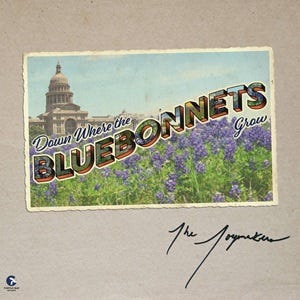
The Joymakers — Down Where the Bluebonnets Grow
The geographical focus shifts south with The Joymakers’ debut album, Down Where the Bluebonnets Grow. Fronted by cornetist and music historian Colin Hancock, this ensemble focuses on the late 1920s territory band sound, capturing the gritty, blues-infused accents of Texas and the Southwest. Their performance of Tom Turpin’s 1913 classic “Goofy Dust Rag” functions as an ideal piece of peri-ragtime. The Joymakers preserve the multi-strain framework of the original rag but color it with a raucous, heavy string-and-brass texture that drags the tune far away from the polite parlor. The music boils over into pure jazz on staples like “Wolverine Blues” and “Tiger Rag.” In these performances, the ensemble entirely sheds formal constraints, leaning into raw, high-energy stomp textures where rhythmic momentum, horn call-and-responses, and maximum emotional feeling override the printed score.
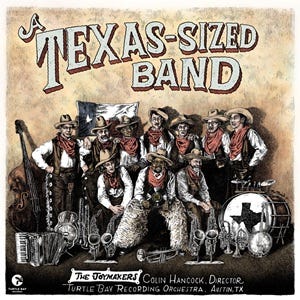
The Joymakers - A Texas-Sized Band
The ensemble expands its footprint to a ten-piece lineup on A Texas-Sized Band, capturing the boisterous energy of late-1920s Southern dance halls where country string traditions, ragtime, and early jazz collided. The album’s peri-ragtime anchor surfaces during “The Pay Off (Stomp),” which features a brilliant, percussive acoustic piano solo rooted firmly in the classic rag school. A sharp, percussive attack from the pianist sounds as if it were lifted off an unhinged, vintage 78-rpm shellac disc. The inevitable jazz spillover arrives on the opening track, “Deep Elm (You Tell ‘Em I’m Blue).” This piece employs a bigger, brassier territory sound filled with unison brass blasts, driving banjos, and loose solo spots. It highlights a localized, regional blues tradition completely devouring the old ragtime syncopations, finalizing the journey from parlor sheet music to the swing era.
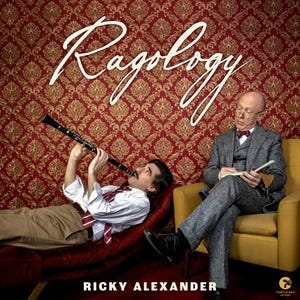
Ricky Alexander - Ragology
On Ragology, clarinetist Ricky Alexander avoids the over-played Scott Joplin catalog entirely to explore the frantic outer limits of early 20th-century syncopation. Flanked by ragtime authorities Conal Fowkes and Jerron Paxton, Alexander uses this recording to investigate the technical extremes of the genre. The album presents its peri-ragtime material through tracks like Felix Arndt’s "Nola" and Zez Confrey’s "Dizzy Fingers." These pieces represent the era of novelty ragtime and "piano gymnastics," where they translated traditional folk rhythms into hyper-articulated, lightning-fast commercial showpieces. The inevitable jazz spillover occurs on Jelly Roll Morton’s "Shreveport Stomp." Here, the quintet completely sheds its academic formality. The strict, compartmentalized ragtime strains collapse into a fluid groove, allowing Alexander's clarinet to ride out front with an elastic, driving swing that liberates the melody from the page.

Terry Waldo & the Gotham City Band - Treasury, Volume 3
Terry Waldo & the Gotham City Band approach this timeline with a loose, conversational authority on Treasury, Volume 3. Waldo, a premier ragtime historian and Eubie Blake protégé, delivers a masterful, pure ragtime presentation on Morton's "Frog-i-More Rag." His performance honors the strict, multi-strain architecture of the composition while allowing the internal rhythms to breathe with an organic, relaxed stride feel. The album's spillover into hot jazz triggers on King Oliver's "Canal Street Blues" and Morton's "Black Bottom Stomp." On these tracks, the vertical ragtime alignment opens up horizontally into a roaring, multi-voiced New Orleans collective improvisation. Jay Lepley’s assertive percussion and Jim Fryer’s tailgate trombone propelled the band, showing how a fixed composition could transform into a vehicle for spontaneous, collective expression.
The transitional window between ragtime and early jazz represents one of the most volatile and fertile chapters in American musicology—when a highly structured folk art transformed into an engine of spontaneous modernism. By documenting this elusive hinge, Turtle Bay Records provides more than just a historical service; the label offers a canvas for brilliant, individual interpretations. Whether through Ricky Alexander’s lightning-fast novelty gymnastics, Terry Waldo’s authoritative archival precision, or the raw, dirt-road stomp of Colin Hancock’s Joymakers, each artist proves that this repertoire is a living language rather than a museum piece. These four recordings capture the exact moment when America’s rhythm liberated itself from the printed page, offering a vital, exhilarating reminder of how our foundational musical identity was forged.