


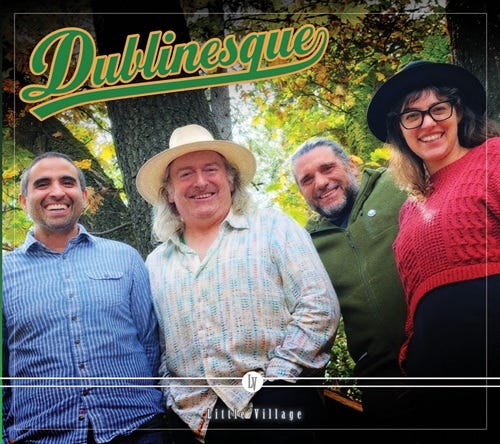
When approaching Dublinesque, the self-titled debut album from the traditional roots ensemble, listeners are immediately introduced to an evocative project released under the banner of the non-profit Little Village record label. Founded by veteran keyboardist Eamonn Flynn, the group brings together an exceptional roster of musicians deeply steeped in Irish soul and roots music traditions. While the collective’s formal discography under this specific moniker is fresh, the individual players boast extensive histories across the global folk and session landscapes, infusing this release with a profound sense of collaborative mastery and stylistic maturity.
The individual musicians occupy a fascinating space in this recording, functioning less as isolated soloists and more as an intuitive, single-minded engine. Eamonn Flynn’s soulful piano and organ arrangements provide an evocative, atmospheric counterpoint, while the fluid, understated bass lines and inventive percussion lock seamlessly to drive the tracks forward. This core cohesion is significantly elevated by the album’s choice guest contributors. Renowned producer and multi-instrumentalist Kid Andersen pulls double duty, not only engineering the project at his award-winning Greaseland Studios but also stepping in to anchor the rhythm section with his precise touches on guitar and upright bass.
Moreover, the band persuades blues and soul keyboard icon Jim Pugh—the founder of the Little Village label himself—to add a layer of deep, swirling Celtic warmth by lending his legendary Hammond B3 organ mastery to the album’s textures. Together, the players craft a sonic canvas where no single instrument dominates; instead, each musician unselfishly serves the arrangement, creating a deeply rooted dialogue that reflects their individual excellence and mutual trust.
Nowhere is this musical synthesis more apparent than on the standout piece, “Butte, Montana.” The composition brilliantly captures elements that are uniquely American, utilizing modal inflections, pentatonic melodies, and wide-interval phrasing that evoke the expansive, sweeping geography of the American West. This approach bears a striking resemblance to the compositional techniques Antonín Dvořák famously employed in his New World Symphony, where he absorbed the spirit of American folk idioms to construct a grand, classical landscape. In “Butte, Montana,” the band translates those same open-air vistas into a roots-music vernacular, using resonant acoustic strings and driving rhythms to paint a sonic portrait of vast industrial history juxtaposed against untamed nature.
Lyrically, the song deepens this portrait by exploring the friction between human ambition and unforgiving environs. The musical narrative explores the industrial legacy of the copper boom, the displacement of immigrant communities, and nature as an indifferent witness to human struggle. Rather than romanticizing the American West, the composition contrasts the hollowed-out grandeur left behind by the legendary Copper Kings with the enduring, impassive terrain that ultimately outlasts their greed.
Dublinesque stands as a refined testament to the enduring synergy of its creators. The production throughout the record is absolutely pristine—perhaps even too perfect, occasionally polishing away the jagged, spontaneous edges that give live roots performances such a fiery spark. Nevertheless, the sheer depth of musicianship and the thoughtful depth of the arrangements make the album a thoroughly engaging and highly enjoyable listen from start to finish.