


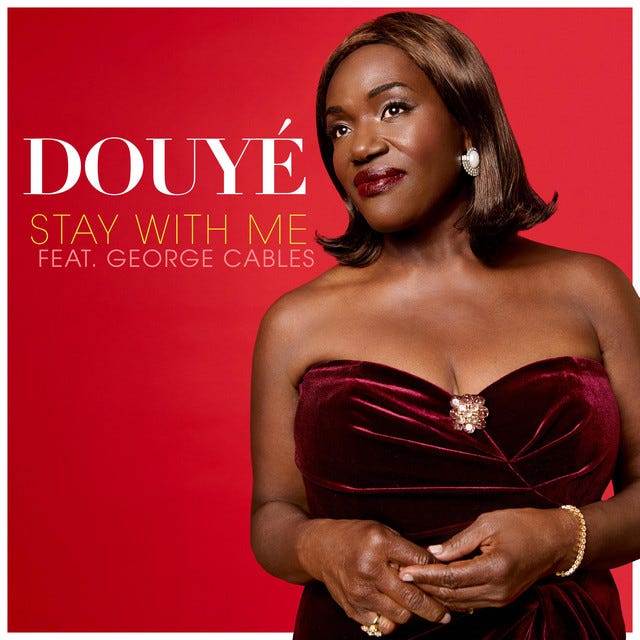
Born in Lagos, Nigeria, and now based in Los Angeles, vocalist, songwriter, and producer Douyé (pronounced “Doe-Yay”) followed an unconventional path to jazz. She first established herself as an R&B artist before embracing the music her father had urged her to pursue. As he lay dying when she was eleven, he told her she should one day sing jazz—a wish that became the defining thread of her career.
After studying at the Musicians Institute in Hollywood and completing graduate work in social work, Douyé debuted with the R&B-oriented Journey (D.I.Y. Records, 2008), followed by So Much Love (D.I.Y. Records, 2014), which broadened her sound with jazz, reggae, and African influences. Her artistic pivot came with Daddy Said So (Groove Note Records, 2017), a straight-ahead jazz recording featuring Kenny Barron, Ron Carter, Russell Malone, and Jeremy Pelt. The album established her as a jazz vocalist with an affinity for the Great American Songbook and an understated sense of swing. She continued to broaden that perspective on Quatro (Bossa Nova Deluxe) (Groove Note Records, 2019), inspired by the shared African roots of Brazilian music, before placing her Nigerian heritage at the center of The Golden Sèkèrè (Groove Note Records, 2023), a synthesis of African rhythmic traditions and American jazz standards.
With Stay With Me, her sixth recording, Douyé brings those influences together while introducing original compositions alongside familiar standards. Working with pianist and arranger George Cables, she favors clarity of phrase, tonal warmth, and ensemble interaction over vocal display, emphasizing interpretation rather than virtuosity.
That approach is especially clear in three of the album’s finest performances. “Love You Madly” recalls the relaxed elegance associated with singers such as Nancy Wilson and Rosemary Clooney, allowing Duke Ellington’s melody to swing naturally through supple phrasing rather than theatrical exuberance. George Cables’ arrangement preserves the tune’s rhythmic buoyancy while subtly enriching its harmonic colors, giving the performance an easy, conversational flow.
“Spring Can Really Hang You Up the Most,” long identified with interpreters including Ella Fitzgerald, Carmen McRae, and Shirley Horn, receives an introspective reading that emphasizes quiet resignation over dramatic heartbreak. Cables’ understated reharmonization deepens the lyric’s emotional ambiguity without altering its structure, while Douyé allows each phrase to unfold patiently, drawing the listener into the song’s bittersweet narrative.
The closing highlight, “Polka Dots and Moonbeams,” reflects the intimate ballad tradition associated with Shirley Horn and Andy Bey. Rather than reinventing the Jimmy Van Heusen–Johnny Burke standard, Douyé relies on careful dynamics, precise diction, and restrained phrasing to uncover fresh nuances within its familiar melody. Cables responds with an open, transparent accompaniment that keeps the focus squarely on the lyric.
Together, these performances define the character of Stay With Me. Rather than pursuing novelty for its own sake, Douyé demonstrates how thoughtful interpretation, supported by George Cables’ elegant arrangements, can bring renewed vitality to familiar repertoire while revealing the continued growth of her own artistic voice.