


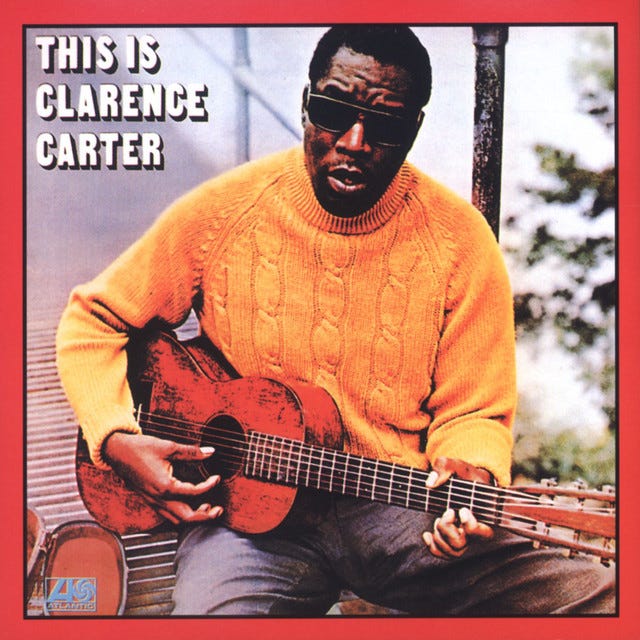
Clarence George Carter (January 14, 1936—May 13, 2026) was a pioneering American Southern soul and blues singer, songwriter, and multi-instrumentalist. Known for his deep, expressive baritone vocals, storytelling lyrics, and trademark full-throated laugh, Carter was a foundational figure in the classic Muscle Shoals rhythm and blues scene. Blind from birth, he transcended his disability to achieve a prolific career that spanned over six decades and included 22 studio albums.
Born into a sharecropping family in Jim Crow Montgomery, Alabama, Carter taught himself to play guitar by listening to blues icons like John Lee Hooker and Lightnin’ Hopkins. He attended the Alabama School for the Blind and later graduated from Alabama State University in 1960 with a Bachelor of Science degree in music.
His professional career began in the early 1960s as part of the duo Clarence & Calvin. After a car accident injured his partner, Calvin Scott, in 1966, Carter went solo. He signed with Rick Hall’s legendary FAME Studios in Muscle Shoals, Alabama, launching a massive string of late-1960s and 1970s hits on the Atlantic Records label. These hits included “Tell Daddy” (Atlantic Records, 1967): Carter’s first solo charting single peaked at No. 35 on the Billboard R&B chart. The song directly inspired Etta James’s iconic answer record, “Tell Mama” (Cadet Records, 1967) with Carter receiving writing credit for it.
The sublime “Slip Away” (Atlantic Records, 1968) cemented Carter’s agonizingly soulful cry. This cheating ballad became Carter’s definitive breakthrough, crossing over into the mainstream, peaking at No. 6 on the Billboard Hot 100 and selling over one million copies.” The salacious “Back Door Santa” (Atlantic Records, 1968): was a delightfully bawdy and funky seasonal R&B track. It became a holiday staple and earned modern immortality when its brass arrangement was sampled by Run-D.M.C. for their 1987 hip-hop classic “Christmas in Hollis.”
“Patches” (Atlantic Records, 1970), originally recorded by the Chairmen of the Board, became Carter’s biggest hit. This plaintive, story-driven treatment peaked at No. 4 on the US Billboard Hot 100, reached No. 2 in the UK, winning the Grammy Award for Best R&B Song in 1971. The 1986 “Strokin’” (Ichiban Records) proves Carter’s lasting recorded legacy. The song is a comically explicit, talking-blues ode to physical love that became an underground phenomenon. Though banned from commercial radio, word-of-mouth promotion turned it into a massive jukebox success.
Carter played a de facto administrative role for FAME Studios. Carter had an exceptional ear for arrangement and storytelling. Because he was an educated musician, he wasn't just a singer showing up to cut a vocal. He worked closely on arrangements and frequently understood exactly how a track should flow—sometimes even pushing back on Hall’s (who was his own A&R man) initial instincts (as he famously did before recording "Patches").
Carter's impressive string of hits in the late 1960s cemented FAME Studios as the premier destination for Southern R&B. While he wasn't out scouring the South actively recruiting and signing acts on behalf of the studio, his presence and distinct sonic blueprint served as the ultimate proof-of-concept that drew other major soul and blues artists to Muscle Shoals.
Carter passed away from natural causes at a hospice facility in Atlanta, Georgia, at 90.
On that troubled hinge connecting the 1960s to the 1970s, I could tune my dad’s transistor radio into the “Mighty 1090”1 and hear Clarence Carter singing rural strife in “Patches” right after Elvis Preseley crooned of urban tragedy in “In the Ghetto” (Released within a year of one another, these songs did exactly what their composers, Dunbar and Johnson and Mac Davis, respectively, intended them to do: pull the listeners by the heartstrings all the way to Cranks in Park Plaza Mall to buy the 45 rpm singles.
Released first, Presley’s single hit the street on April 14, 1969, the same time the Montreal Expos played their first-ever home game at Parc Jarry, defeating the St. Louis Cardinals 8-7 and marking the first regular-season Major League Baseball game ever played outside the United States. In Hollywood, the 41st Academy Awards featured the first and only exact tie for Best Actress between Barbra Streisand (Funny Girl) and Katharine Hepburn (The Lion in Winter), with both receiving exactly 3,030 votes. anticipated its hosting album, From Elvis in Memphis (RCA, 1969). All of this orbited the King’s famous comeback special that aired December 3, 1968. The song helped spearhead that comeback.
Carter’s “Patches” was r” the summer of 1970, the first single from the singer’s fourth album of the same name. Both singles enjoyed commercial and critical success. For a tween boy coming of age, they offered a softer side of the music that would occupy this same pimply-faced kid for the rest of his misspent life. The Southern soul of two artists who shared more in common than they didn’t.

KAAY 1090 AM, Little Rock, Arkansas.
Thank you. I had forgotten about DA’s contribution (and I have this set).