


Canadian composer Christopher Tyler Nickel is single-handedly reviving the art of sacred and choral music. Through his partnership with the prominent classical label Avie Records, Nickel has released a series of highly unique, ambitious, and critically acclaimed albums focusing on monumental sacred choral works and rare instrumental concertos. Nickel’s choral output includes: The Gospel According to Mark—An Oratorio (2023), a mammoth, deeply ambitious seven-hour sacred masterpiece. Conducted by Clyde Mitchell, the work sets the entire text of the Gospel of Mark from the King James Bible to music. Avie Records also issued an accompanying five-movement EP titled Prophecy and a Symphonic Highlights collection. He followed this with his Requiem in 2024, revealing a grand, reverent sacred composition written for full orchestra, choir, and soprano soloist Catherine Redding, performed by the Northwest Sinfonia.
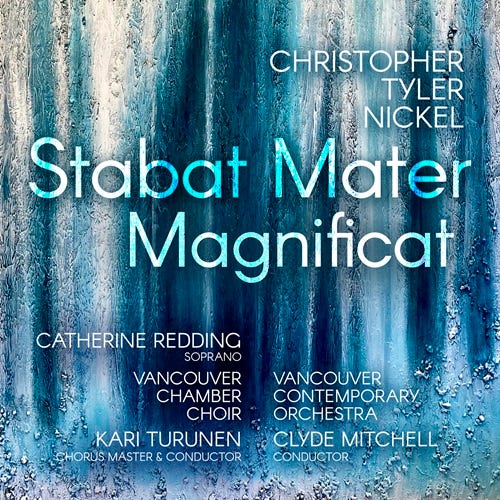
In 2025, Avie released Mass • Te Deum, a taut, 21st-century interpretation of traditional liturgical forms. It couples a concise, highly expressive Mass with a vocally dense Te Deum, recorded by the Vancouver Chamber Choir and the Vancouver Contemporary Orchestra. The composer turns his attention to the alpha and omega of sacred Christian choral music, recording settings for the Magnificat and the Stabat Mater.
The true brilliance of Christopher Tyler Nickel’s pairing of the Stabat Mater and the Magnificat on his Avie Records release lies in its devastating narrative symmetry. Together, these two liturgical pillars form a cohesive, circular biography of Jesus Christ, told entirely through the maternal psyche of His mother, Mary. By positioning the texts alongside one another, the recording establishes a profound emotional arc that spans the entire Incarnation—capturing the full trajectory of a human life from its expectant dawn to its tragic dusk.
Nickel’s exceptionally clean and taut composing style makes this emotional journey possible. Rather than overwhelming the listener with cinematic over-orchestration or dense, chaotic polyphony, Nickel promotes a meticulous harmonic restraint. His writing is lean and structurally precise, stripped of unnecessary ornamentation to let the core emotional architecture breathe. Ironically, it is this very simplicity that dramatically widens the perspective of his subject. By utilizing a taut, uncluttered musical language, Nickel elevates the specific, ancient narratives of Mary into something universal. The music transcends a localized first-century story, transforming into a vast, expansive canvas that mirrors the broader human experiences of profound grief and transcendent hope.
This minimalist clarity demands flawless precision from its interpreters, a challenge met superbly by the album’s featured artists. In the Stabat Mater, soprano Catherine Redding delivers a magnificent, deeply poignant solo performance. Her voice serves as the vulnerable, beating heart of the piece, cutting through the silence with a haunting clarity that perfectly embodies a mother’s private, agonizing monologue of grief. Redding anchors the raw, mortal reality of the crucifixion with immense vocal control, ensuring that the heavy sorrow of the text never descends into melodrama.
Providing a rock-solid foundation to this narrative arc is the superb choral support of the Vancouver Chamber Choir, meticulously prepared by chorus master Kari Turunen. Under Turunen’s guidance, the choir behaves as a singular, highly expressive instrument. In the darker passages, they offer a somber, communal cushion to Redding’s weeping solo lines. When the album transitions into the Magnificat, the choir expands into a radiant power, executing Nickel’s shifting meters with razor-sharp rhythmic precision. Together with the Vancouver Contemporary Orchestra under Clyde Mitchell, they construct a soaring, joyful tapestry of sound that functions as an ecstatic emotional release.
To conclude, appreciating these two pieces in isolation is not fully possible. The soaring hope of Christ’s birth gives weight to the tragedy of His death, while the agony of the crucifixion retroactively tints the innocent joy of the Magnificat with a potent, heartbreaking irony. Guided by Nickel’s compositional restraint and elevated by Redding, Turunen, and the Vancouver ensemble, the album transforms a standard choral collection into an integral, deeply moving masterpiece on the complete cycle of divine and earthly love.