


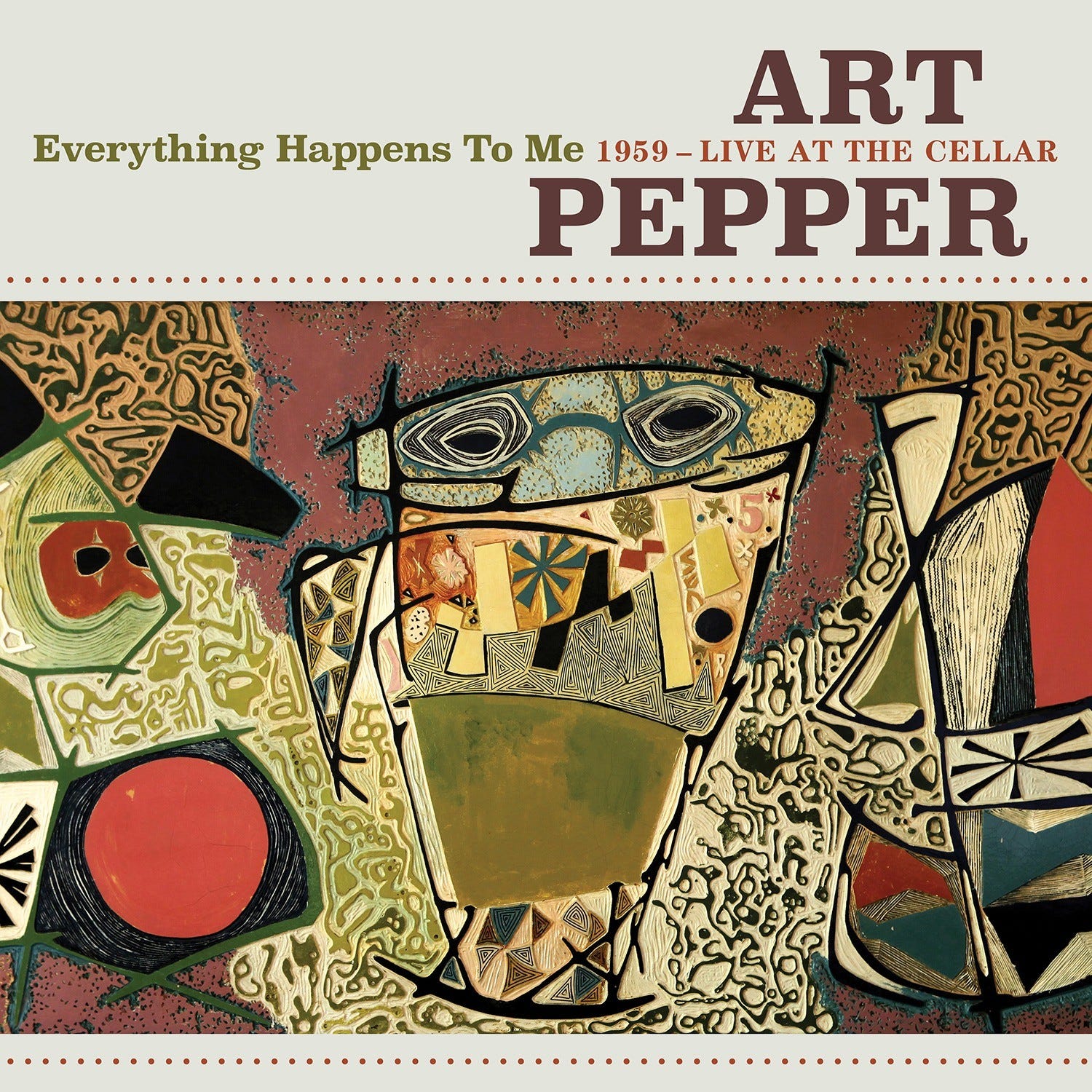
Everything Happens to Me: 1959 – Live at the Cellar arrives as a significant archival discovery in the jazz world, capturing alto saxophonist Art Pepper at the absolute peak of his pre-comeback powers. Released by Omnivore Recordings in collaboration with Widow’s Taste Music, this four-CD box set unearths over four hours of previously unissued live music recorded during a 10-night stand at Vancouver’s legendary jazz club, The Cellar, in September 1959. As the first major cache of live material to surface from the era preceding Pepper’s mid-1970s career resurrection, it bridges a crucial gap in his turbulent timeline, offering a raw, unfiltered glimpse of his genius before years of subsequent incarceration fundamentally altered his signature sound.
This narrow window of freedom caught Pepper at a precarious crossroads, balancing a decades-long battle with heroin addiction against his standing as a leading light of the West Coast jazz movement. Having emerged in the 1940s with Stan Kenton’s big band, Pepper was defined by a bright, highly expressive tone and urgent emotional delivery. Within his discography, the 1959 Cellar recordings sit directly between his landmark studio masterpieces for Contemporary Records: Art Pepper Meets the Rhythm Section (1957), Modern Art (1957), Art Pepper + Eleven (1959), and Gettin’ Together! (1960). Yet, despite the critical acclaim of these studio LPs, Pepper struggled to find steady work in Los Angeles due to his reputation and ongoing legal troubles. Stepping on stage at The Cellar with an exceptional Canadian rhythm section consisting of pianist Chris Gage, bassist Tony Clitheroe, and drummer George Ursan, Pepper found himself completely unburdened by studio constraints. The music captured on these reels reveals a buttery, optimistic West Coast swing that stands in stark contrast to the harsher, more aggressive post-Coltrane edge that defined his eventual 1975 comeback style.
The journey of these tapes from a Vancouver basement to a major box set release is the result of a dedicated curatorial partnership. Since Pepper’s passing in 1982, his widow, Laurie Pepper, has acted as the fierce guardian of his musical estate, unearthing rare live dates, cassettes, and rehearsals through her own imprint, Widow’s Taste. For deeper historical excavations, however, she turned to Cheryl Pawelski, the Grammy-winning producer and co-founder of Omnivore Recordings. Pawelski shares Laurie’s uncompromising ethos for preservation, and their collaborative curation prioritizes a fly-on-the-wall philosophy. On Live at the Cellar, this manifests as a refusal to edit out incomplete tracks where the original tape ran out mid-performance, choosing instead to gift listeners an extra hour of historically vital music. Alongside restoration engineer Michael Graves, the duo has previously spearheaded definitive packages like The Complete Maiden Voyage Recordings and expanded editions of The Art Pepper Quartet. This 1959 set marks the apex of their partnership, delivering a transformative document that Laurie Pepper notes originally inspired Art to emotionally recommit himself to jazz.
The physical presentation of this collection mirrors the historical significance of the music itself, arriving with an extensive, beautifully curated booklet that transforms the box set into a definitive historical dossier. The heart of the printed material is a massive, multi-perspective narrative that reconstructs the social and cultural ecosystem of Vancouver’s premier jazz hub. Run by a musicians’ co-op, The Cellar provided a vital sanctuary for American jazz players traveling north, free from the strict cabaret laws of major U.S. cities. Laurie Pepper contributes deeply personal prose detailing the absolute awe of discovering these tapes and the technical anxieties of bringing them to light, while the text carefully reconstructs the legacies of the original Canadian rhythm section, ensuring these local heroes receive long-overdue international recognition. Visually, the booklet serves as a striking time capsule, heavily illustrated with rare, previously unpublished black-and-white photographs of Pepper performing in the intimate, smoky atmosphere of the club, alongside high-resolution reproductions of original club advertisements, hand-drawn promotional flyers, vintage newspaper clippings, and session logs.
Bringing these sixty-year-old field recordings to modern listeners required a twenty-first century level of audio engineering, helmed by mastering and restoration specialist Michael Graves. Working from amateur reel-to-reel tapes that sat unplayed for over six decades, Graves faced a minefield of technical decay, environmental noise, and physical tape limitations. Over time, the acetate and polyester magnetic tapes had become brittle, requiring physical stabilization and careful baking to prevent the magnetic oxide from flaking off. A major hurdle was tape speed drift caused by vintage motors fluctuating in voltage, which Graves corrected by meticulously analyzing the fundamental frequencies of the instruments to ensure the music remains perfectly in pitch.
Graves’ restoration philosophy strikes a delicate balance between removing distracting artifacts and retaining the historic room sound of the venue. Using advanced spectral editing software, he surgically isolated low-frequency room rumbles, tape hiss, and AC hum, yet applied a light touch to preserve the natural overtones of Pepper’s alto sax. Ambient crowd murmurs, glasses clinking, and off-stage banter were deliberately left intact, placing the listener directly inside the club. Furthermore, Graves and the production team chose transparency over artificial digital patches; when the tape ran out mid-solo, the tracks halt exactly where the reel ended, and when high-velocity passages overloaded the original microphones, Graves smoothed out the harsh transients without rewriting the historical audio blueprint. This gives these performances the intimate immediacy of live performance.
This technical compromise underscores a fascinating aesthetic divide when comparing the raw immediacy of Live at the Cellar to Pepper’s polished studio work for Contemporary Records. Under the direction of producer Lester Koenig and audio engineer Roy DuNann, Contemporary Records became renowned for audiophile excellence, creating a crisp, beautifully balanced soundstage where instruments were perfectly isolated. In contrast, the 1959 Vancouver recordings were amateur mono field tapes where the sound feels compressed and the rhythm section can occasionally get buried behind Pepper’s dominant horn. This technical divide heavily impacted how Pepper approached his music, a contrast made vividly clear when examining the compositions performed in both environments. On his Contemporary LPs, tracks were bound by the strict temporal limits of the 12-inch vinyl format, forcing Pepper to deliver tight, highly disciplined solos. At The Cellar, unburdened by studio clocks, Pepper unleashed a far more aggressive, expansive musical persona.
This contrast comes alive in the repertoire itself. “Dearly Beloved,” originally recorded just months earlier in March 1959 for the tightly arranged album Art Pepper + Eleven, is a blueprint of West Coast cool jazz restraint on the studio LP, navigating Marty Paich’s precise charts in under four minutes. At The Cellar, the tune is completely untethered from big-band choreography, stretching out into a sprawling vehicle for pure improvisation where Pepper takes risks he never could have attempted with a horn section waiting behind him. Similarly, “Minor Yours,” a staple Pepper composition found on 1957’s Modern Art, sheds its polite bop veneer live in Vancouver. Driven by George Ursan’s aggressive drum transients, Pepper attacks the minor blues scale with a biting velocity that pushes his alto to the absolute brink of microphonic distortion. On “Blues in the Night,” which was featured on 1960’s Gettin’ Together! with Miles Davis’s rhythm section as a prime example of slow-burning lyricism, the live rendition transitions into something much heavier and more visceral. The atmospheric weight of the crowded club pushes Pepper to lean into raw, vocalized blues cries, trading pristine instrument separation for a sweat-soaked immediacy. In the studio, Pepper favored architectural perfection, but on the bandstand of The Cellar, he used that same repertoire to test his physical and creative limits.
While audiophiles may always prefer the pristine clarity of the Contemporary albums, Live at the Cellar offers an invaluable trade-off in the form of pure presence while at the same time foreshadowing Pepper’s comback years when he performed like a raw nerve on fire. What the release loses in high-fidelity instrument separation, it gains in unmatched atmospheric weight. Hearing Pepper’s horn occasionally overload a microphone transient provides a visceral punch that standard studio dampening eliminates, transforming the listener from a detached observer into a patron sitting feet away from a jazz legend at an absolute turning point in his life.
For decades, listeners have had to leap directly from the controlled West Coast cool of his late-1950s studio recordings to the fiery, Coltrane-influenced intensity of his 1975 comeback, leaving a massive blank canvas in his creative timeline. This box set does not replace the Contemporary masterpieces; rather, it unshackles them, constructing a vital, historically transformative bridge across that twenty-year chasm. By capturing a rare, uninhibited live residency from his pre-incarceration prime, the set alters our understanding of Pepper’s artistic evolution, proving that his explosive emotional velocity and willingness to push past traditional hard-bop boundaries were already fully formed long before his mid-seventies resurrection.
For jazz critics and historians, it resolves a major discographical mystery, while for casual fans, it provides a thrilling window into a legendary musician playing for his life. It stands not as a redundant archival offering intended to fleece unsuspecting fans, but as an indispensable masterpiece that permanently reshapes the legacy of one of jazz’s most complex figures, proving that Art Pepper’s genius was even more wild, unpredictable, and brilliant than the studio walls could ever contain.