


The enigma of Clarksdale, MS, a moribund Mississippi Delta town serving as the county seat of Coahoma County, is only that to the population at large unfamiliar with the Mississippi Delta Blues and the development of rock music. Each year in April, Clarksdale becomes the cultural hub of the blues during the annual Juke Joint Festival. In the early 2000s, historic downtown Clarksdale, Mississippi, was economically stagnant, with dwindling local businesses and fading opportunities for live musicians. Seeking a way to revitalize the community, Ohio transplant Roger Stolle—owner of the Cat Head Delta Blues & Folk Art store—partnered with local tourism director Bubba O’Keefe. Together, they envisioned a recurring event that would celebrate the region’s rich musical heritage while injecting vital tourism dollars into the local economy. In April 2004, their vision became a reality with the launch of the first Juke Joint Festival, a modest gathering featuring just fifteen blues acts.
From its inception, the festival aimed to honor the historical African American “juke joints”—the informal, community-driven bars where sharecroppers birthed the Delta blues. To bridge the gap between visiting international blues aficionados and residents, the founders adopted a unique format, billing the event as “half blues festival, half small-town fair.” Alongside raw, authentic music, they introduced quirky small-town attractions like racing pigs and herding monkeys, and said monkeys riding said pigs. This hybrid approach proved a massive success, transforming the festival into Clarksdale’s single biggest business and tourism week of the year and sparking a broader downtown economic turnaround.
The festival developed a distinct day-and-night structure that endures today. During the day on Saturday, the streets come alive with over one hundred free musical acts performing across dozens of outdoor stages. When night falls, attendees use a single wristband to hop between over twenty historic indoor venues and authentic local juke joints. Over two decades, these stages have hosted legendary Delta blues royalty like Dave “Honeyboy” Edwards, Big Jack Johnson, and T-Model Ford, while also promoting the genre’s future by showcasing hometown prodigies like Grammy winner Christone “Kingfish” Ingram.
Today, the Juke Joint Festival is a globally recognized cultural phenomenon that regularly attracts upwards of 10,000 visitors each April. Drawing attendees from all fifty U.S. states and dozens of countries, the grassroots event has earned widespread critical acclaim from major international media outlets, cementing Clarksdale’s legacy as the living heart of the blues.
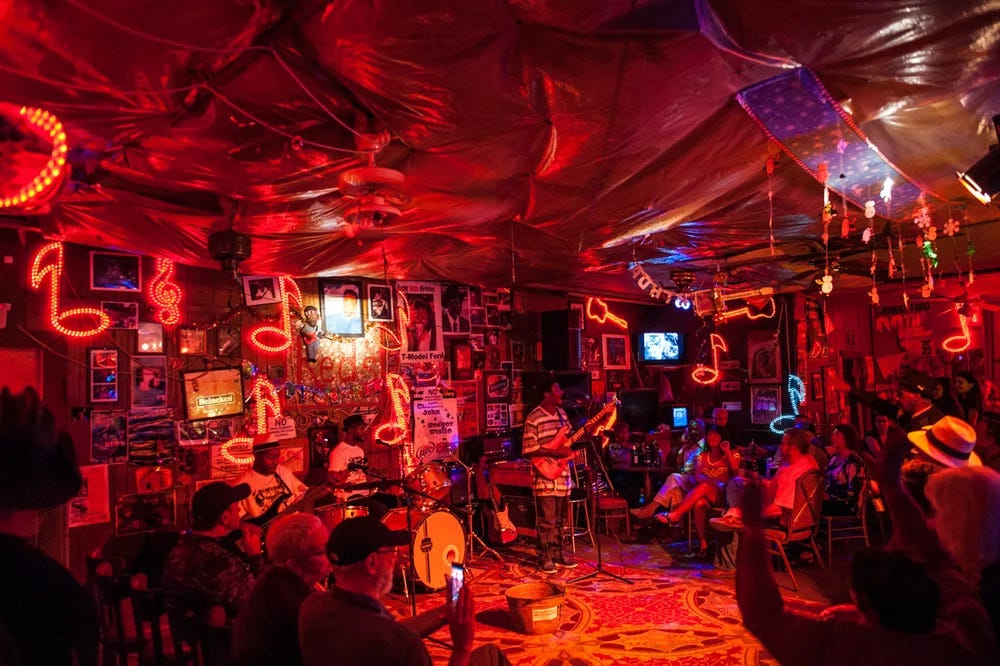
The heart of Clarksdale’s late-night music scene lives within a handful of legendary indoor venues that anchor the Juke Joint Festival crowd each April. Chief among them is Red’s Lounge, a dimly lit space at the corner of Sunflower Avenue and 4th Street, widely regarded as one of the last remaining authentic, old-school juke joints in America. Red’s offers an unpolished, grit-infused experience where crowds pack tightly around raw Delta blues combos playing just feet away. In stark contrast stands the Ground Zero Blues Club, co-owned by actor Morgan Freeman. Housed in a massive, repurposed early 20th-century cotton warehouse next to the Delta Blues Museum, Ground Zero pairs its spacious performance stage with a full menu of Southern soul food and walls completely covered in visitor graffiti.
The festival’s venue footprint also highlights creative urban preservation, best exemplified by The New Roxy in the historic New World District. Once an abandoned 1940s movie theater, it is being revitalized into an open-air main stage where the roof once collapsed, complete with an intimate indoor bar and lobby stage that serves as a sanctuary during rainy festival nights. Nearby on Issaquena Avenue, the Bad Apple Blues Club operates, focusing strongly on historic preservation. Managed by local musician Sean “Bad” Apple, this cozy room function as an acoustic performance classroom where visitors can sit close for intimate storytelling and one-man-band sets. Finally, the Bluesberry Café on Yazoo Avenue balances late-night grit with a relaxed, welcoming atmosphere. Famous for its legendary morning acoustic sets, it gives festival regulars a warm indoor space to recover with hot food and music played early in the day.after a long night of club-hopping.
Teeming with local color, the Bluesberry Café serves as a musical and social hub of the old downtown area. As part of the early 2000s effort to revitalize the famous area, local cultural advocates were working to transform Clarksdale, Mississippi, into a year-round live blues destination. To make this vision a reality, the town needed venues that could capture travelers passing through on Mondays after spending the weekend in larger musical hubs like Memphis or New Orleans. Filling this crucial void, Florida transplants Art “Bongo Daddy” Crivaro and Carol Crivaro (with daughter Amanda in tow) moved to the Delta to open the Bluesberry Café at 235 Yazoo Avenue. Partnering with local blues musician Sean “Bad” Apple, the Crivaros launched a Monday night live music tradition that successfully transformed an otherwise dead night into one of the most vibrant, packed time slots of the week for both international travelers and locals.
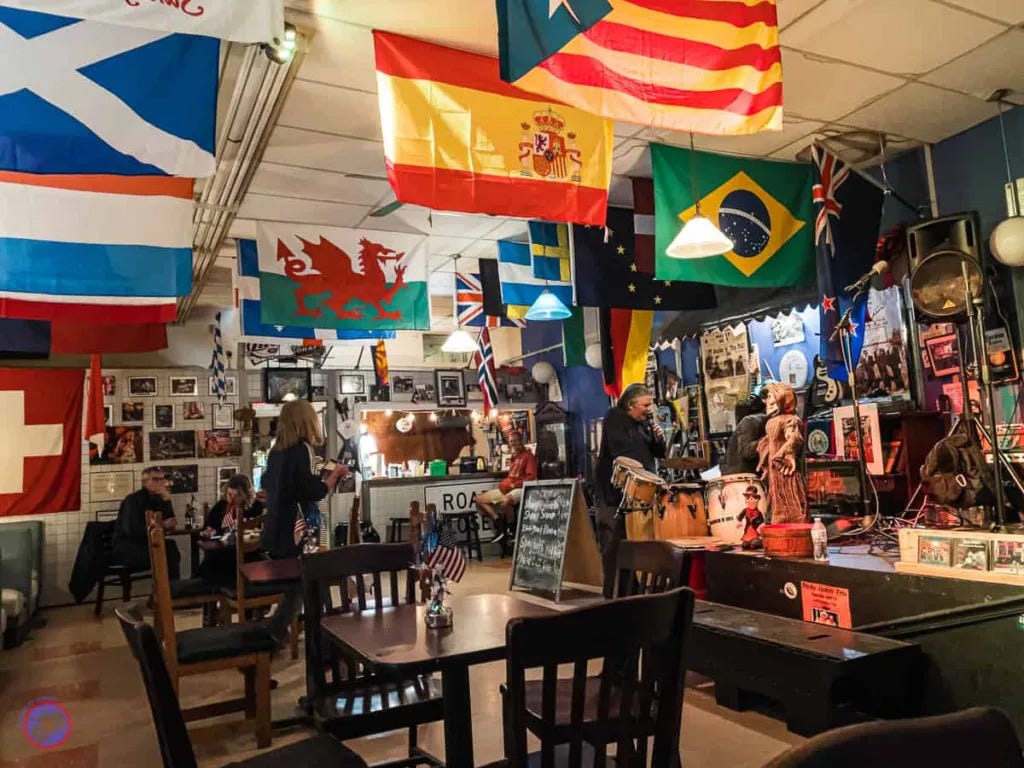
The Bluesberry Café quickly became famous for its unpretentious, homey, and deeply casual environment. Housed in a downtown storefront space adorned with vintage blues and rock posters, the interior featured highly eccentric memorabilia, including an iron lung displayed prominently in the front shop window. Unlike traditional juke joints that strictly served alcohol, the café carved out a distinct niche by pairing live music with hearty comfort food. It became locally famous for serving up plates of warm spaghetti and meatballs during evening shows and a full menu of home-style breakfast omelets during the day.
The venue’s most distinct historical contribution to the Clarksdale scene was pioneering “Blues for Breakfast” weekend acoustic sets. Open on Saturday and Sunday mornings, the café became the premier spot for late-night festival-goers to find hot coffee, a substantial meal, and a relaxed morning performance. This routine deeply intertwined the café with the legendary blues artist Watermelon Slim. After moving to Clarksdale, Slim not only regularly played the venue’s morning sets, but he also stepped in as an informal partner, helping the Crivaros with heavy lifting and washing dishes in the back between his acoustic sets.
It is the union of location and a cast of Characters (with a capital C) like Watermelon Slim (and, to be sure, the Crivaros themselves) that make this hollowed musical ground so appealing. When I am in Clarksdale for the Juke Joint Festival, I will always purchase some local music and books about the area. This year, my musical purchase was Watermelon Slim’s newest recording, on the edge but in the groove (Bloos Records, 2026). To best understand this music, one needs to become acquainted with Watermelon Slim.
Born into a prominent Boston family and raised in North Carolina, William P. Homans III—who would later earn international acclaim as Watermelon Slim—first encountered the blues through his family’s housekeeper. He attended elite schools and Middlebury College on a fencing scholarship, but his life took a radical turn when he enlisted in the U.S. Army during the Vietnam War. While recovering from an illness in a military hospital, he taught himself to play slide guitar upside-down and left-handed using a cheap balsa-wood instrument and a Zippo lighter. This experience sparked both his musical foundation and a fierce anti-war stance, leading him to release Merry Airbrakes (1973) alongside the Vietnam Veterans Against the War—widely cited as the only major vinyl protest album recorded by an active-duty veteran during the war.
Despite his immense intelligence, which was later verified by his membership in Mensa, Homans abandoned the music industry for nearly thirty years to pursue grueling, blue-collar work across America. He spent decades working as a long-haul truck driver, composing raw a cappella blues hollers to stay awake behind the wheel, and officially adopted his famous moniker while farming watermelons in Oklahoma. He also worked as a forklift operator, firewood salesman, collections agent, and sawmill laborer—losing part of a finger in a mill accident. Amidst this heavy labor, he went back to school to earn a master’s degree in history and became a fluent speaker of four languages.
A near-fatal heart attack in 2002 forced him to retire from truck driving and commit entirely to a late-stage music career. Fronting his band, The Workers, Watermelon Slim achieved international stardom with a raw baritone voice and a signature lap-style dobro guitar played with an industrial spark-plug socket wrench. His audio diary of hard labor and grit birthed essential tracks like “Hard Times,” which captured economic anxiety; “Scalemaster Blues,” an intense tale of a trucker bypassing highway weight stations; and “Dumpster Blues,” a reflection on his leanest years working odd jobs. His late-career surge earned him over twenty Blues Music Award nominations, including a historic twelve-nomination streak over a consecutive two-year span (2007–2008) that rivaled legends like B.B. King and Buddy Guy.
Seeking the true roots of his art form, he officially packed up his life and moved to Clarksdale on October 3, 2009. There, he fully immersed himself in the tight-knit circle of regional masters. Though his definitive musical compass, Mississippi Fred McDowell, had passed away decades prior, Slim supported his legacy by standing alongside Bonnie Raitt at the official unveiling of McDowell’s Mississippi Blues Trail marker. Slim became a close creative partner to Clarksdale native James “Super Chikan” Johnson, recording the raw acoustic album Okiesippi Blues (2011), which featured intense musical duels played entirely on single-stringed diddley-bos. He also regularly shared the stage with harmonica giant Big George Brock at Morgan Freeman’s Ground Zero Blues Club and traded blazing riffs with Charlie Musselwhite and Jimbo Mathus.
True to his blue-collar roots, Slim balanced his international musical fame with working as a heavy-lifting laborer and dishwasher at the Bluesberry Café helping the Crivaro clan with the business between his celebrated morning acoustic sets, cementing his legacy as a true, living cornerstone of the Mississippi Delta blues scene. This introduction cannot prepare one to meet Slim. He is a wizened, humble man, easy and amiable, always up for conversation with any and everyone. Slim’s live musical performances are a cultural masterclass in rural America and the blues in particular.
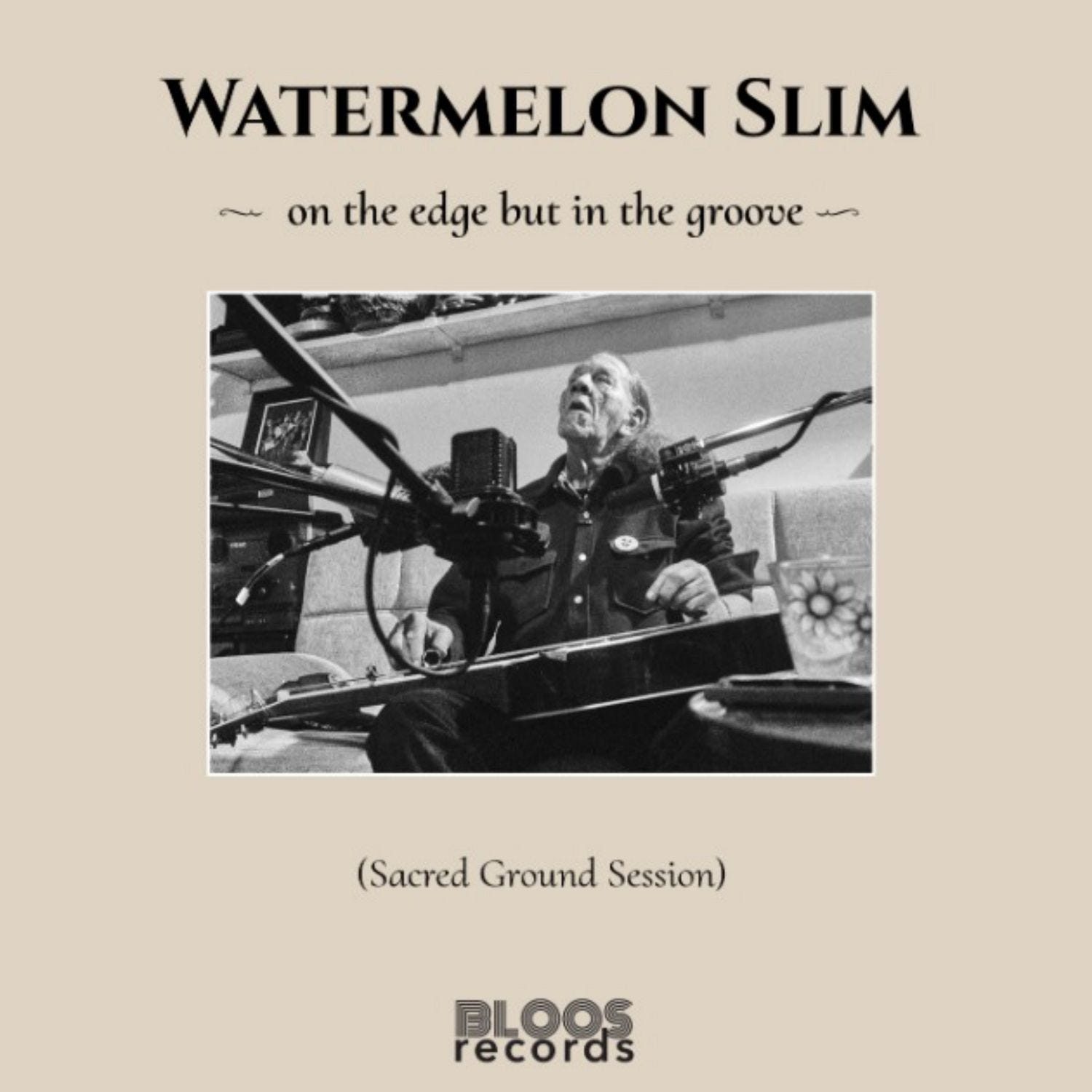
While in Europe earlier this year, Slim recorded an ecclectic collection of regional music, perfectly illustrating the organic nature of the surrounding area. The opening song, “Testing 1, 2, 3” is an a cappella field holler not unlike Son House’s “Grinnin’ In Your Face.” Slim accompanies himself on harmonic (an instrument on which he is a master). It sets the tone for this personal collection of traditional and original compositions. On “Vigilante Man,” Slim performs his on his curious slide guitar, singing of a dangerous man with a dark reputation. Slm is an observer, recounting this fictional character. “Oklahoma Blues” is a song about Slim’s life in Oklahoma, played again on his slide guitar. The record’s center point is the lengthy diptych of “Smokestack Lighten” and “Two Trains Running.” It is a piece of music reminiscent of the music of his friend, Fred McDowell. Raw, authentic, and smelling of that rich delta soil, Slim’s music is a part of the continuum making up this rich and complex region.
Existential Cowboy,
I love that! I have always had a good time and much as you describe it. That sacred place is a special ruin and I love going everywhere there. What a cast of Characters.
I was at the Juke Joint Festival in 2009, and sat a few feet away while Slim performed at Bluesberry Cafe, and had a great chat with him….there’s a photo of us somewhere in my archive.
On Halloween night that same year, I performed with friends (including Stan Street, owner of the Hambone Gallery in Clarksdale), at Ground Zero.
Also, I hung out at Red’s and other juke joints….good times!